




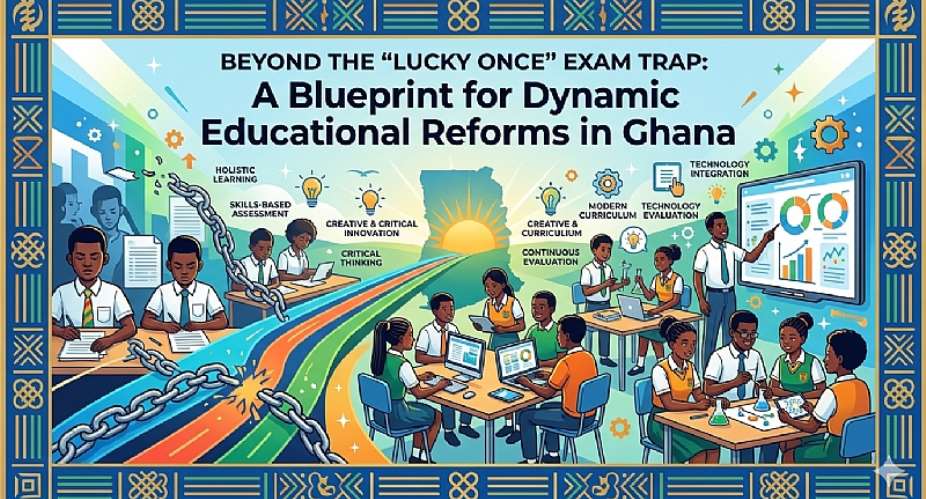
For over half a century, Ghana’s educational framework has been held hostage by a high-stakes, terminal examination model inherited from the British colonial structure. This rigid system measures years of schooling by a single-day performance, heavily rewarding rote memorization and sheer luck while severely penalizing holistic, continuous intelligence. It has warped the psychology of learning, giving rise to an economy of academic shortcutting, "cheating by proxy," and certificate fraud.
This systemic vulnerability is deeply historical. As far back as the early 1970s at the University of Ghana, Legon, gaps in terminal validation allowed individuals to enter the School of Administration using a friend’s certificate and still graduate with academic honors—proving that institutional frameworks heavily rewarded superficial compliance over continuous identity and authentic tracking.
Today, as Ghana competes in a rapidly changing global economy, we cannot rely on a system that favors those who happen to be "lucky once" on an exam day. We must implement an aggressive, universal, and dynamic overhaul across all educational tiers. This article outlines the comprehensive, structural framework required to replace an obsolete testing regime with a skills-driven, private-sector-funded, and digitally secured educational ecosystem.
System-Wide Structural Reforms by Tier
1. Basic Education (Kindergarten to JHS)
- Eliminate Terminal Grading: Replace standard, high-stakes ABC letter grading with diagnostic progress reports tracking core foundational literacy, numeracy, and cognitive development.
- Portfolio-Based Progression: Assess students through portfolios of accumulated classwork, creative projects, and reading logs over the full calendar year.
- Abolish High-Stakes Placements: Transition the Basic Education Certificate Examination (BECE) from a strict pass/fail elimination gate into a diagnostic tracking tool for identifying future senior high pathways.
2. Secondary Education (SHS and TVET)
- Restructure the WASSCE Formula: Mandate that the terminal West African Examinations Council (WAEC) exam constitutes only 40% of a student’s final score, allocating the remaining 60% to verified School-Based Assessments (SBA).
- National SBA Audit Framework: Deploy a digitized, external auditing body to cross-verify school-level grades, permanently erasing local grade inflation, school-level favoritism, and regional biases.
- Expand TVET Parity: Treat Technical and Vocational Education and Training streams as equal to traditional grammar pathways, grading students on physical prototype builds, mechanical systems troubleshooting, and digital applications.
3. Tertiary Education (Universities and Colleges)
- Mandatory Capstone Defenses: Replace standard, sit-down, three-hour end-of-semester exams with practical capstone projects, research defenses, or actionable business plan executions.
- Continuous Workplace Internships: Integrate mandatory, credit-bearing industry placements into every degree track, giving field supervisors direct grading power over a substantial portion of a student's academic standing.
- Open-Book and Problem-Solving Exams: Shift any remaining written tests to open-book or case-study formats that assess how students filter, analyze, and apply information under real-world constraints rather than what facts they memorized.
Actionable Recommendations and Suggestions to Stakeholders
To neutralize universal resistance and seamlessly transition out of the exam-centric trap, specific responsibilities must be assigned to each key group:
For the Government and Ministry of Education
- Launch a Dual-Stream Pilot: Simultaneously deploy this reform model within a single high school track (e.g., General Science or Home Economics at Achimota School and a rural community day SHS) and a single university department (e.g., Accounting or MIS at the University of Ghana Business School).
- Establish National Biometric Integration: Link every student's educational profile to a single, biometric National Identification Authority (NIA) GhanaCard number from kindergarten to university, permanently ending identity theft and certificate fraud.
- Legislate Non-Partisan Educational Reform Bills: Pass long-term legal frameworks that mandate a gradual 10-year transition timeline, ensuring subsequent political administrations cannot scrap structural progress for cheap political points.
For Private Sector Industries and Employers
- Adopt the Co-Investment Model: Finance the digital project-tracking infrastructure and modern equipment in exchange for first-choice access to top-performing graduates, radically reducing corporate recruitment costs.
- Leverage the Talent Incubator Tax Rebate: Secure corporate income tax deductions through the Ministry of Finance by directly investing in public school facilities and technical labs.
- Provide Independent Quality Assurance: Actively sit on external grading panels through Sector Skills Bodies to blindly vet and audit continuous assessment outputs, keeping public education aligned with actual market demands.
For Teachers, Lecturers, and Educational Workers
- Transition to Automated Grading Infrastructure: Move away from manual paperwork by utilizing digitized rubric templates and tablets to capture continuous assessment milestones in real time.
- Redefine Teacher KPIs: Demand that the Ghana Education Service (GES) restructure promotional tracks, tying career progression to classroom engagement metrics and student portfolio growth rather than raw, historical exam pass rates.
For Parents and the Public
- Embrace Skill Acquisition Over Certification: Pivot the family mindset away from the desperate accumulation of physical certificates and shift toward checking if children are acquiring tangible, marketable skills.
- Demand Anonymized External Moderation: Support digital portal initiatives where student projects are uploaded and graded blindly by external assessors, protecting children against local cronyism or favoritism.
Ghana cannot engineer a modern economy using an educational blueprint designed for the industrial factories of the 19th century. A system that reduces an individual’s potential to a lucky streak in an examination hall fails our youth and starves our industries of genuine competence. The memory of entering public universities through fraudulent papers decades ago stands as a stark warning: when certificates become more valuable than actual capability, integrity collapses.
By executing a dual high school and university pilot financed by the private sector, secured by national biometrics, and anchored in continuous, practical evaluation, we can build a resilient educational system. Let us move past the era of the "lucky once" and confidently transition into an era of verifiable, sustainable, and nationwide competence.
✍️ Retired Senior Citizen
For and on behalf of all Senior Citizens of the Republic of Ghana 🇬🇭
Teshie-Nungua
[email protected]


 Wee smokers invade Swedru Methodist Basic School, turn classrooms into hideouts ...
 Otumfuo approved the date for my father’s funeral — Adwoa Safo
 Akofena is embarrassing the family, destroying our late father's legacy – Adwoa ...
 Illegal chainsaw operators shoot reforestation worker at Abesewa Forest
 ICS heads to Supreme Court to ban dog and cat slaughter, consumption in Ghana
 “Where are the 800,000 jobs?" — Patrick Boamah questions govt
 Patrick Boamah alleges several procurement breaches in Ato Forson’s constituency...
 Adu-Boahene Trial: GH¢49.1m from National Signals Bureau account – Prosecution ...
 32 more Ghanaians return from South Africa
 “I warned you several times" — Otumfuo destools 110-year-old chief of Kenyase No...

