




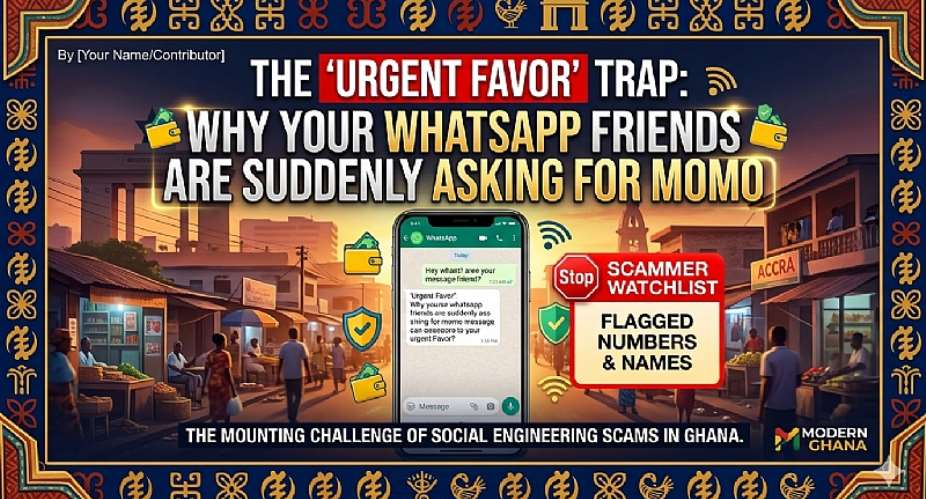
In recent months, a wave of sophisticated social engineering scams has hit Ghana’s digital space, turning the convenience of WhatsApp and Mobile Money (MoMo) against unsuspecting citizens. It starts with a simple, familiar notification: a friend, a former colleague, or a relative reaches out with a polite greeting, quickly followed by a desperate plea for a short-term loan—usually between GH₵ 500 and GH₵ 3,000—to settle an "urgent" matter.
The script is almost always the same: "I’ll pay you back by Friday" or "I'm stuck at the hospital." But behind these messages isn't your friend; it is a cybercriminal who has hijacked their account. By the time the real owner regains access, dozens of their contacts have already been defrauded. As we navigate an increasingly cashless economy, understanding the mechanics of these "e-cash" scams—and demanding stronger action from regulators—is a necessity for financial survival.
Name and Shame: The Scammer Watchlist
To protect the public and alert the relevant authorities, we are flagging the following accounts recently used in these fraudulent attempts:
- AT (AirtelTigo) Number: 0270055904 (Registered Name: Sophia Asalo)
- Telecel (Vodafone) Number: 0204279638 (Registered Name: Kwao Seth)
These names and numbers have been linked to "mule" wallet activities. We call on the service providers to investigate these specific accounts immediately.
A Call for Action: Block the ID, Not Just the Number
While blocking a fraudulent SIM card is a start, it is no longer enough. Scammers simply discard the blocked SIM and buy another. The real solution lies in the Ghana Card.
We are calling on the National Communications Authority (NCA) and all telecommunication companies to implement a "Zero Tolerance" ID-level blacklist. If a number is verified to be involved in fraud, the associated Ghana Card ID should be permanently flagged across all networks. This would prevent known criminals from simply re-registering new SIM cards to continue their predatory activities. We must move from blocking numbers to blocking people.
How to Recover a Hacked WhatsApp Account
If you find yourself suddenly logged out of your account or realize someone else is messaging your contacts, take these steps immediately:
- Re-register Your Number: Open WhatsApp, enter your phone number, and request a new 6-digit verification code via SMS or phone call.
- Force Logout: Once you enter the code, anyone else using your account will be automatically logged out.
- The 7-Day Wait: If the hacker enabled Two-Step Verification, you may have to wait 7 days to sign in without the PIN. However, the hacker is still kicked off your account the moment you enter your SMS code.
- Email Support: If you cannot regain access, email [email protected] with the phrase "Lost/Stolen: Please deactivate my account" and your number in international format (+233...).
Recommendations for Stakeholders
1. To the General Public
- Verify Before You Transfer: Never send money based on a text. Call the person on a direct cellular line (not a WhatsApp call) to confirm.
- Enable Two-Step Verification: Go to Settings > Account > Two-Step Verification to set a permanent PIN.
- Report Fraud Immediately: Use the shortcodes: *170# (MTN), 100 (Telecel/AT), or the dedicated fraud line 419.
2. To Telecommunication Companies (MTN, Telecel, AT)
- Cross-Network Blacklisting: Use Ghana Card data to ensure a fraudster blocked on one network cannot open a wallet on another.
- Real-Time Flagging: Implement AI systems to flag wallets receiving multiple transfers from unrelated contacts in a short window.
3. To Law Enforcement (Cybersecurity Authority & GPS)
- Streamlined Reporting: Create a central digital portal for victims to upload screenshots for immediate investigation.
- Public Prosecution: Publicize the arrest of "mule" account holders to deter others from "renting out" their MoMo wallets to criminals.
The strength of our digital economy depends on trust. When we allow scammers to turn our social circles into hunting grounds, that trust erodes. We must move from being "polite" to being "secure." If a friend asks for money online, don’t be afraid to ask questions or demand a voice call. A true friend will appreciate your caution; a scammer will simply move on. In the digital age, a moment of skepticism is the best insurance for your wallet.
✍️ Retired Senior Citizen
For and on behalf of all Senior Citizens of the Republic of Ghana 🇬🇭
Teshie-Nungua
[email protected]


 Wee smokers invade Swedru Methodist Basic School, turn classrooms into hideouts ...
 Otumfuo approved the date for my father’s funeral — Adwoa Safo
 Akofena is embarrassing the family, destroying our late father's legacy – Adwoa ...
 Illegal chainsaw operators shoot reforestation worker at Abesewa Forest
 ICS heads to Supreme Court to ban dog and cat slaughter, consumption in Ghana
 “Where are the 800,000 jobs?" — Patrick Boamah questions govt
 Patrick Boamah alleges several procurement breaches in Ato Forson’s constituency...
 Adu-Boahene Trial: GH¢49.1m from National Signals Bureau account – Prosecution ...
 32 more Ghanaians return from South Africa
 “I warned you several times" — Otumfuo destools 110-year-old chief of Kenyase No...

