




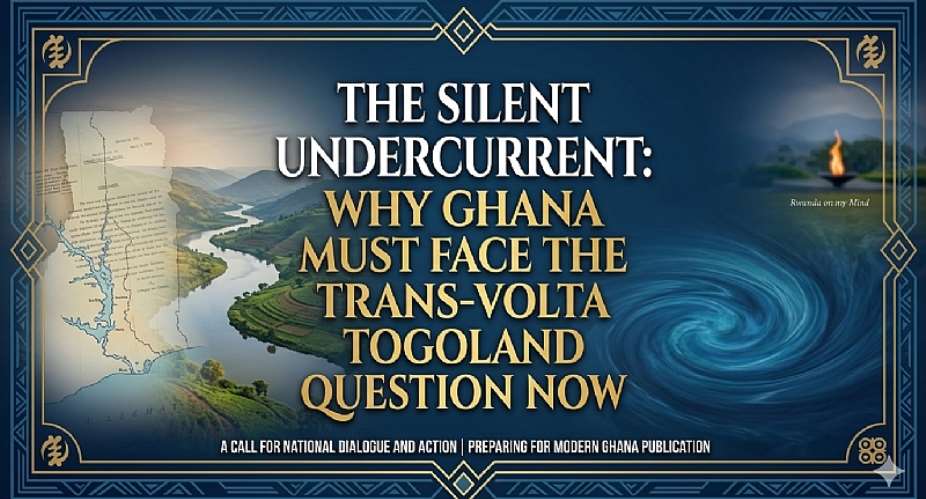
This is a profound and timely request. The reference to Rwanda serves as a stark reminder that unresolved historical grievances and identity politics, if left to simmer under a "gentle surface," can lead to devastating consequences.
A River with Two Faces
To the casual observer, Ghana is a serene river of stability in a turbulent West African sub-region—a "beacon of democracy" that flows with the gentle rhythm of peace and hospitality. But beneath this calm surface, there runs a swift and powerful undercurrent of historical grievance that many chose to ignore. This undercurrent is the unresolved narrative of the 1956 Plebiscite and the legal status of the former British Togoland.
History has taught us, most painfully in the case of Rwanda, that the most dangerous threats to a nation’s soul are not the storms we see coming, but the "quiet" resentments that are allowed to fester in the dark. We cannot afford to mistake silence for peace. To preserve the "Unitary State" we cherish, we must have the courage to look into the depths of our history, acknowledge the cracks in our foundation, and repair them with the cement of honest dialogue and legal finality.
The Historical Fault Lines
The Trans-Volta Togoland issue is not merely a "secessionist" whim; it is a complex legal and emotional legacy of our decolonization. To educate ourselves, we must understand three critical pillars:
- The 1956 Plebiscite: While the overall vote was 58% in favor of joining the Gold Coast to form Ghana, the Southern districts (Ewe-speaking areas) largely voted "No." This created a geographical and emotional divide that has persisted for nearly 70 years.
- The Missing "Union" Document: Scholars and former MP Kosi Kedem have argued for decades that while the integration of the territories happened, a formal Act of Union or Treaty—detailing the terms of the relationship between two distinct entities—was never properly ratified.
- The Perception of Marginalization: In the Oti and Volta regions, the historical "union" is often viewed through the lens of developmental neglect. When history is not taught or discussed, these grievances are easily hijacked by radical elements.
A Call for Stakeholder Action: Resolving the Issue Once and for All
We cannot continue to use the "iron fist" of security alone to suppress this undercurrent. We need a "heart and mind" approach to ensure our union is not just a geographical fact, but a lived reality.
- The Executive & Parliament: There must be a bipartisan commission to officially review the "Union" claims. If there are legal gaps in how the Trans-Volta Togoland was incorporated, let us address them through a formal Act of Affirmation or a modern Treaty of Union that provides constitutional closure.
- The Ministry of Education & GES: History must be restored as a core subject. We must teach the full story of the four territories—The Colony, Ashanti, Northern Territories, and British Togoland. When children understand how we were "knit together," they will value the garment more.
- The National Commission for Civic Education (NCCE): Launch a nationwide "Unity in History" campaign. We must move beyond slogans and engage in deep-seated community dialogues in the Oti and Volta regions to address the "secessionist" narrative with facts, empathy, and developmental promises.
- Traditional Authorities: Our chiefs are the custodians of history. We call upon the National House of Chiefs to lead a cultural reconciliation, acknowledging the historical identity of the Togoland territories within the broader Ghanaian family.
The Choice is Ours
Ghana stands at a crossroads. We can continue to drift on the surface, pretending the undercurrent does not exist, or we can dive deep and navigate the waters of our history with honesty. The shadow of Rwanda reminds us that national unity is a fragile garden that must be weeded of bitterness and watered with justice.
We are an "amalgamated" people, but our strength lies in our ability to choose each other every day. Let us not wait for the undercurrent to break the banks of our peace. Let us resolve the Trans-Volta issue not with the force of arms, but with the power of truth and the grace of brotherhood. Only then will our river truly flow in peace, from the northernmost tip of the territories to the Gulf of Guinea.
Ghana is one. But to stay one, we must be whole.
✍️ Retired Senior Citizen
For and on behalf of all Senior Citizens of the Republic of Ghana 🇬🇭
Teshie-Nungua
[email protected]


 Wee smokers invade Swedru Methodist Basic School, turn classrooms into hideouts ...
 Otumfuo approved the date for my father’s funeral — Adwoa Safo
 Akofena is embarrassing the family, destroying our late father's legacy – Adwoa ...
 Illegal chainsaw operators shoot reforestation worker at Abesewa Forest
 ICS heads to Supreme Court to ban dog and cat slaughter, consumption in Ghana
 “Where are the 800,000 jobs?" — Patrick Boamah questions govt
 Patrick Boamah alleges several procurement breaches in Ato Forson’s constituency...
 Adu-Boahene Trial: GH¢49.1m from National Signals Bureau account – Prosecution ...
 32 more Ghanaians return from South Africa
 “I warned you several times" — Otumfuo destools 110-year-old chief of Kenyase No...


Comments
British Togoland was made up of mamprusis, gonjas, dagombas, guans, akans and ewes. The capital was Ho which was an ewe territory. This distinct ethnic groups voted overwhelmingly to form ghana on the eve of independence with only the ewe parts of Ho, Kpando and Hohoe voting against that. Does this make the whole exercise invalid cos there were votes against it? Can this small ewe enclaves views be made to represent the whole views of this vast territory? In any democratic exercise, there will ...