




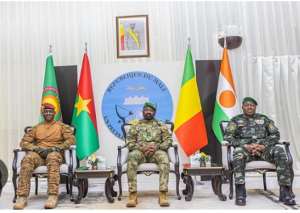
The Chiefs of Army Staff of the Alliance of Sahel States (AES) convened in Ouagadougou, Burkina Faso, on April 16–17, 2026, in a significant move aimed at strengthening regional security cooperation and counterterrorism efforts across the Sahel.
The high-level meeting brought together military leaders from the three AES member states Burkina Faso, Mali, and Niger who are working to operationalize a unified military force to combat growing insurgent threats in the region.
Formation of a 15,000-Strong Unified Force
A key outcome of the meeting is the continued push to deploy a joint force of approximately 15,000 troops. This force is expected to operate across borders, targeting extremist groups and improving coordinated military responses in the volatile Sahel region.
The proposed troop strength represents a major scale-up from earlier joint security efforts and signals the AES bloc’s commitment to self-reliant defense following their withdrawal from broader regional frameworks such as ECOWAS security mechanisms.
Focus on Counterterrorism and Sovereignty
Discussions centered on:
Joint military planning and intelligence sharing
Harmonizing command structures among member states
Securing border regions heavily affected by armed groups
Enhancing rapid deployment capabilities
The initiative aligns with the broader objective of reinforcing national sovereignty and reducing dependence on external military assistance.
Strategic Context
Burkina Faso, which hosted the meeting in its capital Ouagadougou, has been at the center of ongoing security challenges linked to extremist violence. The country’s armed forces, alongside those of Mali and Niger, have increasingly prioritized regional cooperation as a response to the persistent insurgency.
The AES unified force is expected to play a crucial role in stabilizing affected areas and restoring government control in regions where militant groups remain active.
Outlook
While the 15,000-strong force is still in the process of full mobilization, the Ouagadougou meeting marks a decisive step toward its realization. If successfully implemented, the initiative could redefine security dynamics in the Sahel and serve as a model for regional military collaboration outside traditional Western-backed frameworks.
Mustapha Bature Sallama.
Medical/ Science Communicator,
Private Investigator, Criminal investigation and Intelligence Analysis.
International Conflict Management and Peace Building.USIP
[email protected]
+233-555-275-880


 ‘We have turned the tide’ – Ato Forson says Ghana is ready to take off
 Sammy Gyamfi refuses to file defence, hides behind technicalities — Lawyers
 Osahen Afenyo-Markin vows to pursue case against Sammy Gyamfi despite high court...
 Let us all be mentors to our younger generation - Mahama
 Court stops Osenase homecoming over security concerns
 Supreme Court dismisses Solomon Asamoah's bid to stop Sky Train trial
 GRA denies imposing new 20% tax on Netflix, Google and Amazon subscriptions
 Police arrest 16 suspects, seize 209 rounds of ammunition at Gbane mining site
 ‘Mahama has lost his moral high ground’ – Dr Zaato on Affi Agbenyo’s EC appointm...
 Cassava, hemp could offer alternatives to plastics – Zanetor challenges scientis...


