




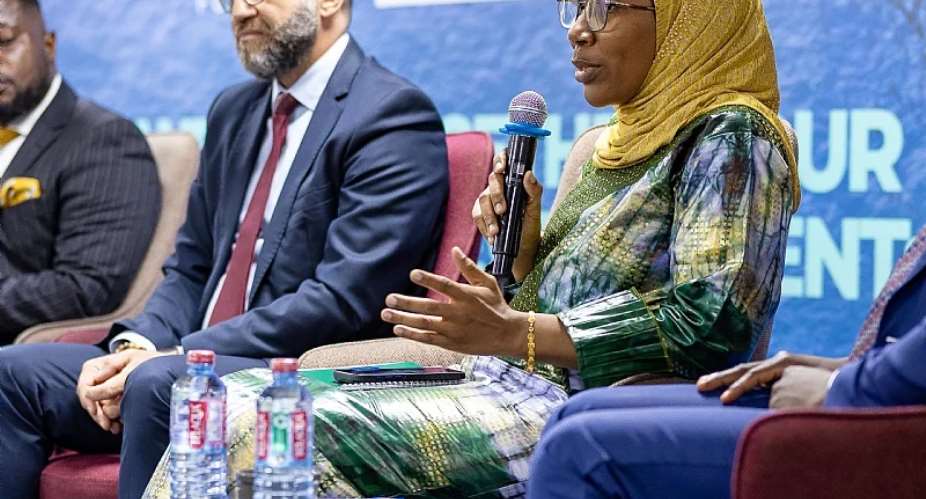
For many Ghanaian exporters, the biggest challenge is often framed as market access—finding buyers, entering new countries, and expanding reach. But according to Hajia Maria Adamu-Zibo, that narrative misses a more immediate and pressing reality.
Getting paid may matter more than getting the deal.
Speaking from an operator’s perspective during a panel session at a recent trade engagement organised by Coface and Activa International Insurance Ghana, the Managing Director of Federated Commodities PLC offered a perspective shaped not by theory, but by experience.
The Reality of Cross-Border Trade
Exporting is often seen as a growth opportunity—and it is. But it also comes with risks that are less visible to those outside the business. Among the most critical:
- delayed payments,
- buyer defaults,
- and uncertainty in international transactions.
For businesses operating across borders, these risks are not occasional—they are part of the daily reality. And when payments are delayed or fail altogether, the consequences go beyond a single transaction. They affect:
- cash flow,
- supplier relationships,
- and the ability to take on new opportunities.
Why Stability Beats Speed
From the perspective of Federated Commodities, growth is not just about expanding quickly—it is about sustaining operations over time. This is where tools like credit insurance begin to play a different role. Rather than simply protecting against loss, they create:
- predictability in transactions,
- confidence in extending credit to buyers,
- and continuity in business relationships.
In practical terms, this allows exporters to move from uncertain growth to structured expansion.
Trust, Backed by Systems
In many African markets, trade has traditionally been built on relationships and trust. But as businesses scale and transactions become more complex, trust alone is no longer sufficient. What Hajia Maria Adamu-Zibo’s experience highlights is the importance of system-backed trust—where:
- transactions are insured,
- risks are assessed,
- and outcomes are more predictable.
This shift is subtle, but significant. It transforms trade from a relationship-driven activity into a system-driven one.
The Working Capital Challenge
One of the immediate impacts of payment uncertainty is pressure on working capital. When funds are tied up in unpaid invoices:
- operations slow down,
- new deals are delayed,
- and growth opportunities are missed.
For many exporters, this becomes a cycle that is difficult to break. By securing receivables, businesses are better positioned to:
- maintain liquidity,
- negotiate better financing terms,
- and operate with greater confidence.
From Experience to Insight
What makes this perspective particularly valuable is that it reflects what is already working in practice. Businesses like Federated Commodities PLC are not adopting these tools as theory—they are using them as part of their operational strategy.
And in doing so, they are demonstrating a shift that may become more widespread across Ghana’s export sector.
A Broader Lesson for SMEs
For smaller exporters, the takeaway is clear. The challenge is not only about finding buyers—it is about building systems that ensure those transactions translate into actual revenue. This requires:
- a stronger focus on risk management,
- better financial structuring,
- and adoption of tools that support consistency.
My Final Thought: Growth Is Only Real When It Is Sustained
Ghana’s export ambitions are growing, and rightly so. But as insights from Hajia Maria Adamu-Zibo suggest, the future of that growth will depend less on how many markets businesses enter— and more on how reliably they can convert trade into cash. Because in the end, growth is not defined by deals signed.
It is defined by payments received.

 Court sets July 3 for judgment in Wontumi Akonta mining trial
 June 3 disaster case nears judgment as victims seek GH¢40 million compensation
 0.75% wallet-to-bank transfer levy was approved under Akufo-Addo gov't — Isaac ...
 Anti-LGBTQ Bill: Mahama citing procedural hurdles just to please Western partner...
 Ghanaian designer Master P urges ban on second-hand clothing now, warns of infec...
 National Chief Imam condemns Eid-day confusion among Ahlussunnah over parliament...
 Gifty Oware-Mensah directed transfer of NSA's funds to Blocks of Life company ac...
 Man threatens to curse Court, police after sentenced to 15-years for defilement
 Defilement case: Court issues bench warrant for arrest of father for failing to ...
 Interior Minister raises alarm over human trafficking through Aflao, Akanu corri...


