




Introduction
Iran has been launching retaliatory missile and drone strikes against United States Of America US military infrastructure, bases and personnel located in several neighbouring Gulf nations, including Bahrain, Saudi Arabia, Qatar, Iraq, United Arab Emirates UAE, Kuwait, Omar etc. In the process key US military facilities like the US Fifth Fleet headquarters and major airbases have been hit by 100 of missiles and drones. Unfortunately, in the attacks ,gas, oil infrastructure as well as civilian centres have been hit. Iranian officials have justified these retaliatory attacks on grounds that its neighbours were "bringing and housing the enemy" in the region. All these developments raised and continue raising a number of pertinent questions for Africa which of late has seen a surge in the number of foreign military bases on the African soil.
African Countries Hosting Western & Eastern Military Bases
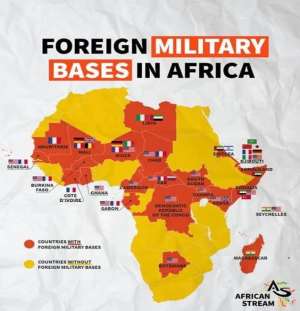
A number of African countries are host to foreign (Western & Eastern) military bases among these as of 2026 are;
Djibouti (Horn of Africa)
Djibouti a country of an estimated one (1) million people has a total of eight (8) foreign bases. This makes Djibouti, arguably the most militarized real estate in the world.Djibouti is described as the hub for Western forces . ... why? because it hosts a number of military bases for different foreign powers. Djibouti hosts the largest and permanent US military base in Africa, Camp Lemonnier. Camp Lemonnier is the only United States Navy base in Africa, which also serves as the headquarters for United States Africa Command (AFRICOM).Besides US military bases, Djibouti is host to military bases for France, Italy, Spain, Germany and also to the East Asian rivals, Japan and China, also having their first overseas military bases in Djibouti. Saudi Arabia also maintains military logistics presence in Djibouti.
Kenya (East Africa)
Kenya is home to Camp Simba in Manda Bay, located near the Somali border in Lamu County. Camp Simba was established in 2004 as a US Forward Operating Location (FOL). Kenya also hosts British army units.
Somalia (Horn of Africa)
In Somalia, US forces operate forward locations and rotational facilities, including Baledogle Airfield and areas near Mogadishu Airport. Somalia hosts a Turkish military training facility in Mogadishu.
Niger (West Africa - Sahel Region)
Traditionally, the US has two airbases. Firstly, Air Base 101 in Niamey and secondly , Air Base 201 in Agadez, both in Niger.French troops were also in Niger but saw significant US/French withdrawals in 2024-2025 following military coups.
Cameroon (West Africa)
Cameroon has French military presence supporting anti-Boko Haram operations.
Egypt (North Africa)
Egypt hosts US troops within the Multinational Force & Observers (MFO) in the Sinai Peninsula.
Eritrea (Horn of Africa)
Eritrea hosts UAE and Russian facilities; Russia was in talks to establish another off Sudan’s Red Sea coast.
Somaliland (Horn of Africa)
Officially, a break-away region of Somaliland which is largely not recognized as a state by African Union (AU) and many other world countries.Only Israel in December of 2025 begun to recognize Somaliland as a nation and there is "rumours" of Israel wishing to establish it's military base in this break- away state. Somaliland also hosts a second UAE military base in Africa.
Central African Republic (CAR) (Central Africa)
Since 2018, Russian forces (often associated with the Wagner Group or Russian defense ministry) have established a major training base in Berengo. They also operate in other regions, including Bria.France, formerly maintained a significant military presence (including Operation Sangaris), which largely ceased in 2016, with the final troops departing in 2022 following strained relations after a military coup in Niger.
US Other Smaller Rotational Bases In Africa
The US also has smaller facilities and rotational deployment bases in countries including Ethiopia, Ghana, Senegal, Tunisia, and Morocco.
Foreign Military Presence
Of the thirteen (13) known foreign powers with military bases in Africa, US and France have the most troops in Africa (outside United Nations UN,operations). Turkey off late is increasing it's military Presence in Africa. The Horn of Africa hosts more foreign military bases than any other region of Africa,with about eleven (11) known foreign military bases. Possible reasons may include proximity to the Middle East and Asia as well as the need to guide and control strategic Red Sea route. Thus, Horn of Africa has been described as the "epicentre of foreign military bases in Africa". .Southern Africa ,is the region of Africa with no notable foreign military bases as of now. And Djibouti is the country with the most foreign military bases in the Horn of Africaand Africa as a whole ,eight (8) of them( foreign military bases). And for that Djibouti has been described as the " hub of foreign forces in Africa". US alone operates bases across thirty - four (34) outposts across Africa. China, the UK, Italy, Japan, Germany, Turkey, the United Arab Emirates (UAE), Saudi Arabia and Russia all maintain military facilities or access arrangements in Africa.
At the moment Southern Africa, is the only region without notable foreign military bases. Though unverified reports suggesting China operates a naval/air base in Namibia, and Russia maintains military, naval, or maintenance attachments in South Africa and Zimbabwe.These are not true confirmed facts. Time and again, unsubstantiated rumours point to Botswana hosting US foreign military base at Thebephatshwa Air Base, again this is not true. Botswana does not have a US military base and the Botswana government has vehemently and publicly denied reports of a US base on its soil. This is also corroborated by the US Embassy which has time and again also denied having a military base in Botswana.
Concerns For African Nations Hosting Foreign Military Bases
First and foremost, sovereignty of African hosts can be seriously compromised,that is their ability to remain independent from the owner of military base/s . Otherwise, African hosts largely risk falling in the trap of a binary logic, reducing their ability to remain neutral or choose sides.
Secondly, such African host,just like Gulf states in the current US/Israel - Iran war face risks of retaliatory attacks.For example,Kenyan ,US military base, Camp Simba, face direct "blowback" from regional actors (e.g., al-Shabaab) who do not differentiate between the foreign power and the host nation.
Thirdly, African hosts are exposed to a possibility of a "proxy war". For example, Djibouti, is at high risk of at high risk of becoming battlegrounds for third-party wars.
Last but not least, in the event of "blowbacks" or future armed conflicts, African host nations risk exposing their populations to violence or attacks as part of collateral damage.
Lack of Continental or Regional Policy & Standards On Hosting Foreign Military Bases Is Problematic
Lack of continental or regional standards to be followed by an AU or regional member country to align to before accepting foreign military bases leaves individual countries making own bilateral agreements with military base owners with no continental or regional manual or template to follow. The result is that Africa is exposing itself, making itself subject to be drawn into future armed conflicts not of Africa making or interests, and subject to "proxy wars". The African Union’s Peace and Security Council in April 2016 called for member states to be “circumspect” when subscribing foreign base agreements. However, lack of a continental policy or consensus on binding modalities exists leaving individual African states to negotiate bilaterally, from positions of economic dependence, without the leverage to codify for their autonomy and sovereignty.This is security disaster for Africa.
Adversarial Assumption of Equal Belligerence
This is a strategic and legal persepective that assumes that, all parties involved in a conflict—or hosting foreign military bases—are equally committed to, and legally responsible for, the resulting actions and hostilities. This perspective holds that once a country hosts foreign military bases or engages in supporting a party to a conflict, it becomes a co-belligerent and loses its neutral status. It is precisely on such bases that Iran (Tehran admnstration) has been justifying retaliatory attacks on its neighbouring Gulf states harbouring US military infrastructure and bases. It is again from such perspective, that in future global armed conflicts, Africa can be vulnerable,find itself exposed and at risk of being legit targets by virtue of hosting foreign military bases for certain Western powers. Therefore, the danger is ....African countries hosting foreign military bases are exposed and risk being co-belligerents in future armed conflicts.
This goes beyond hypothetical assumptions. For example, UAE’s Assab base in Eritrea was used in the Saudi-led coalition campaign against Iran-backed Houthi rebels in Yemen, creating an adversarial relationship for Eritrea (Asmara) with Iran (Tehran)and the Houthis.
Kenya’s Camp Simba has faced blowbacks from al-Shabaab which. Djibouti’s rejection of Russia’s request for a base, citing the risk of becoming “a terrain of proxy war”, is an acknowledgement of the same structural reality. Thus, Africa, by hosting these foreign military bases risks, sometimes not only exposure to a conflict, but outrightly being dragged into a conflict not rooted in African interests.
Based on the Adversarial Assumption of Equal Belligerence persepective or framework which is currently and heavily influencing contemporary geopolitical dynamics, it is a very dangerous undertaking for a nation to host foreign military bases. Thus, Africa needs to question the value of hosting foreign military bases in an increasingly multipolar world. It is because of this that the AU , Security and Peace Council warned African member states. Precisely, ten (10) years ago to date ,in 2 April of 2016, African Union AU's Peace and Security Council called on African member states to be
"circumspect when entering into military base agreements"
that is to be very thoughtful and cautious when entering deals which ends with the establishment of foreign military bases in their countries.The council noted concern with growing number of foreign military bases on the continent and rumours of more new ones to be established. The council encouraged caution in light of the concerns, dangers and exposure to risks by virtue of hosting foreign military bases.
Managing Exposure To Security Risk/s Posed By Hosting Foreign Military Bases
African hosts of foreign military bases need to manage risk of exposure to conflicts due to them being co- belligerence by virtue of hosting foreign military bases.
HOW?
By Safeguarding Own Strategic Autonomy & Sovereignty
African hosts countries should maintain autonomy of decision making and not risk being dragged into conflicts not rooted in African interests by virtue of holding foreign bases. For example, even when Gulf states, (hosting US military infrastructure and bases) were critical of Iran and even publicly condemned Iran, still , such Gulf states refused to join US offense against Iran. In spite of the fact that the Gulf states were exposed to enormous pressure from factions within the US including the likes of Senator Lindsey Graham,who were pushing and compelling Gulf states to join offensive operations against Iran .... still, the Gulf states maintained their strategic restraint and were able to demonstrate a policy of autonomy free from the military bases owner (US ) and refused to follow the US into war against Iran. And African hosts should also be in position to refuse to be drawn into conflicts not of their own. Therefore, African hosts countries should prioritise the primacy of continental and regional order and stability.
By Demanding Consultation Rights In The Event Of Upcoming Military Action/s
When US launched it's military campaign on Iran ,"Operation Epic Fury" on 28 February 2026, no Gulf state hosting US military infrastructure and bases had received prior official notification of the "surprise" attack on Iran. So when "Epic Fury" commenced, Gulf states hurried to close their airspaces , alert their populations and activate their air defense systems.This " *consultation gap"* is likely to be wider for Africa hosts states meaning in the event of such similar future conflict with an African nation being a co- belligerent,the impact might be dire. Hence, African hosts nations, should demand Pre- notification of planned major operations or else, the risk of exposure and collateral damage can be tremendous on African host nations in the event of an African host becoming a justified legit target by virtue of hosting foreign millitary bases and infrastructure.
By Demanding Security Guarantees
Gulf host states have survived Iran’s missile and drone campaign better than they might have. Why?, because of years of investment in layered air-defense systems by bases owner ( US). Sadly, African countries hosting foreign military base lack such an arrangement (investment in their security & defense systems) which are crucial in the event of a conflict, where foreign bases in Africa can be seen as legit targets. Lack of such an arrangement makes African countries hosting foreign bases more and more vulnerable. Why African hosts lacks such a comprehensive security guarantees and formal mutual defense commitments and investments from base owners such as the case with Gulf states? Such lack of such an arrangement continues to baffle.
Conclusion
Developments in US/Israel - Iran conflict has necessitated the need for Africa to carefully think, consider and reconsider possible harmful impacts of hosting foreign military bases and foreign military infrastructure on their territories. Otherwise,the security risk is real, foreign military bases may increase "proxy wars" on the continent or Africa host countries may find themselves as co- belligerence in conflicts not rooted in African interests. Lack of continental or regional template on consensus in terms of hosting of foreign military bases complicates everything. There is need for African hosts countries to geopolitically renegotiate military bases hosting arrangements leveraging their autonomy and sovereignty. Also African hosts should emphasis security guarantees, demand consultation rights, and over above all, maintain their strategic autonomy and decision making to prevent a situation of being dragged into conflicts not of their own by military base owners.
F. Madondo (African Teacher) [email protected]


 Adu-Boahene’s lawyers ask court to strike out fabricated, invented evidence in D...
 'He is part of National Film Authority' – Kwasi Kwarteng exposes Obuasi SHTS hea...
 'Mahama should have appointed Edudzi Tameklo to EC to teach hypocrite NPP some s...
 'You have no moral right to complain about cost of living' – Prof Anankware to B...
 'You did the same thing' – Solomon Owusu defends EC appointment
 GFL vows to pursue justice for worker who lost five fingers at Afienya Industria...
 State to call first witness on January 12 in Canadian murder case
 Haruna Iddrisu refers Obuasi SHS headmaster's sexual misconduct allegations to C...
 Bawumia is a ‘prophet of pocket economy’ in opposition, ‘priest of paper economy...
 Bolgatanga Technical University Council Chairman allegedly locks up Vice-Chancel...


