




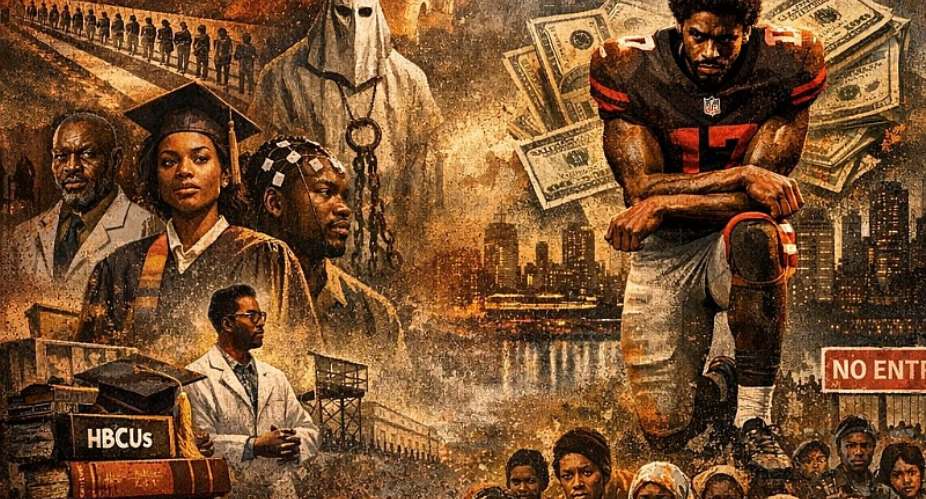
History is not neutral. It reflects power, and power shapes perception.
For over 500 years, people of African descent have occupied one of the most paradoxical positions in human history: among the most influential contributors to global civilization, yet among the most persistently devalued. The question is not rhetorical—it is historical and urgent: Why has Blackness been so systematically diminished across the modern world?
The answer begins with the rise of European colonization.
Colonial expansion was not simply about land—it was about hierarchy. In order to justify the transatlantic slave trade, forced labor, and the extraction of resources from Africa, a global ideology had to be created. That ideology—what we now understand as white supremacy—repositioned Africans from originators of civilization to subjects of exploitation.
Africa, the cradle of humanity, was recast as backward. Black people were stripped of identity and reduced to labor units. This narrative spread across continents, shaping how Asians, Latinos, Arabs, and even Africans themselves came to perceive Blackness. Colonization did not just occupy land—it occupied thought.
As Proverbs 18:21 reminds us:
“Death and life are in the power of the tongue.”
For centuries, the language of empire spoke death into the identity of Black people.
Yet, despite systemic barriers, Black people have consistently done the most with the least.
Consider Historically Black Colleges and Universities (HBCUs). Though they enroll roughly 3% of the nation’s college population, often operating with significantly fewer resources and funding compared to predominantly white institutions, they have produced a disproportionate share of Black professionals—doctors, lawyers, engineers, educators, and leaders who sustain entire communities. These institutions are not just schools; they are engines of resilience.
Black women offer another powerful example. In the United States, Black women are among the most educated demographic groups, yet they remain among the most underpaid. They are also the fastest-growing group of entrepreneurs, building businesses at higher rates than any other demographic, often without access to traditional capital. At the same time, they face higher vulnerability in the labor market—frequently among the first to be laid off and the last to be rehired.
This is not coincidence. It is structure.
As Ecclesiastes 1:9 states:
“There is nothing new under the sun.”
What we see today is the continuation of historical patterns, not isolated incidents.
Globally, the pattern persists. During international crises—whether in Ukraine, Afghanistan, or the Middle East—reports have repeatedly surfaced of African and Black individuals being treated as second-class evacuees or employees, delayed at borders, or denied equal passage compared to others. Even in moments of global emergency, hierarchy reappears.
In the United States, the historical record is equally clear. Black bodies have too often been used as sites of experimentation—from medical exploitation to environmental exposure—while protections afforded to others were withheld. From slavery to Jim Crow to mass incarceration, Black Americans have navigated systems that extracted value while limiting opportunity.
And still, the narrative of deficiency is projected onto them.
Why?
Because perception has long been tied to economic and political interests.
Black labor built America. Enslaved Africans provided over two centuries of unpaid labor that fueled the nation’s early economy. African-descended innovation—from agricultural techniques to medical breakthroughs—has shaped modern life. Even today, Black culture drives global entertainment, sports, and fashion industries.
Yet ownership and control remain disproportionately outside Black communities.
In professional sports, for example, leagues like the NFL and NBA generate billions annually, with rosters heavily composed of Black athletes. Still, team ownership remains overwhelmingly non-Black. Cultural production is celebrated, but structural power is often withheld.
This contradiction is not accidental—it is systemic.
Five recurring patterns help explain this dynamic:
- Maximum Output, Minimum Resource Allocation – Black communities consistently produce high impact with limited institutional support.
- Cultural Influence Without Economic Equity – Black creativity is global, but wealth accumulation remains restricted.
- Crisis Inequality – In moments of global conflict, Black populations are often deprioritized.
- Historical Exploitation Framed as Deficiency – Systems that created inequality are used to justify it.
- Globalization of Anti-Black Narratives – Colonial-era ideas about race continue to shape modern perceptions worldwide.
Even internal challenges—such as violence within Black communities—must be understood within this broader context. These issues are real and must be addressed, but they do not exist in isolation. They are linked to decades of redlining, economic exclusion, underinvestment, over-policing, and disrupted family structures through mass incarceration.
To ignore that context is to ignore history itself.
And yet, despite all of this, Black resilience remains one of the most powerful forces in human history.
From civil rights movements to entrepreneurship, from education to innovation, Black people continue to build, create, and lead—often without the structural support afforded to others.
As Amos 5:24 declares:
“Let justice roll down like waters, and righteousness like a mighty stream.”
Justice requires truth.
Truth requires history.
And history—when told fully—reveals not a people defined by deficiency, but a people defined by endurance, brilliance, and contribution.
So the question is no longer simply why this perception exists.
The real question is: How long will it persist in the face of overwhelming evidence to the contrary?
Because the proof is no longer hidden.
It is, as we say, in the pudding the dark chocolate pudding.
ABOUT THE AUTHOR:
Edmond W. Davis is an American social historian, international speaker, and Amazon #1 bestselling author. He is a global authority on the Tuskegee Airmen and serves as the founder of the National HBCU Black Wall Street Career Fest. A native of Philadelphia, PA, and currently resides in the Little Rock, Arkansas, area. Davis is committed to cultural empowerment and educational equity through storytelling and civic engagement. Davis is a Grand Marshal at the 38th Annual African American History Month Celebration Parade.


 Ayariga challenges BoG to cite law behind arrests over cedi money bouquets
 Trump targets tax-free diesel as Republicans approach midterms
 Govt releases GH¢9.1 billion covering six quarters of DACF to MMDAs - Ayariga
 Manhyia South MP charged over alleged GH¢9.85m loss to SIC Life
 'I didn’t know the process would be that fast' – Nana B explains missing NPP swe...
 'Who is Karbo to defy my orders?' – Buttey fumes over NPP conference clash
 'Kojo Bamba can’t stop NDC' – Gbande warns NPP against shielding anyone from arr...
 Mahama pardons 863 convicted persons, 11 from death sentence
 NDC confirms Dzifa Gunu’s disqualification from La Dadekotopon constituency secr...
 Nigeria's Tinubu confirms 32 dead after military plane crash


