




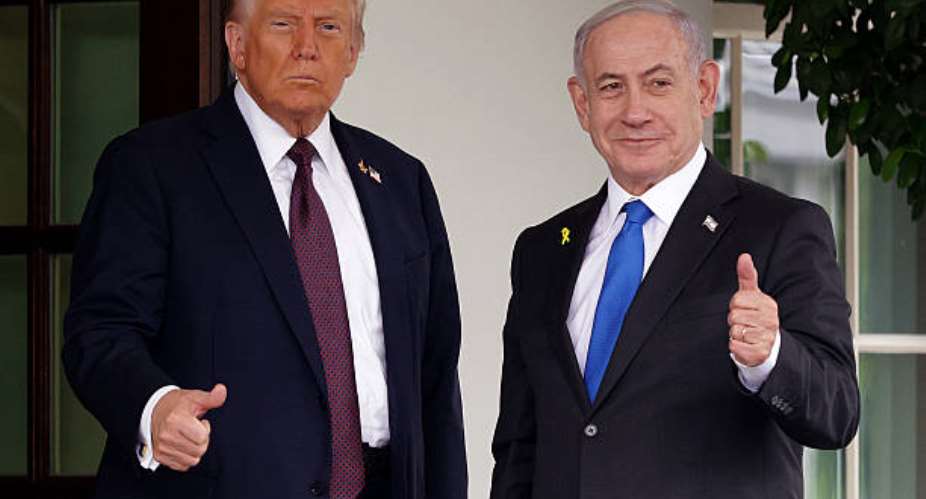
There is a particularly seductive kind of foolishness that flourishes in moments of geopolitical crisis: the belief that history can be ignored if only one repeats the word restraint often enough. That is the intellectual refuge now occupied by those insisting that the current US-Israel military campaign against Iran is merely “Israel’s war” and that the United States should somehow stand aside, untouched and unentangled, as though the Middle East’s most ideologically aggressive regime has not spent nearly half a century openly defining America as an enemy. It is an argument that sounds cautious, even noble, in the abstract. In reality, it is neither. It is a fantasy constructed out of selective memory, strategic illiteracy, and a refusal to confront how power actually operates in the Persian Gulf and across the wider Middle East. The uncomfortable truth is that the United States is not being dragged into a private quarrel between Jerusalem and Tehran. It is confronting, belatedly, imperfectly and at considerable risk, a long-maturing strategic threat that has already spilled across US bases, US alliances, US economic interests and US blood.
The first duty of serious analysis is to reject slogans that flatter emotion while obscuring reality. “This is Israel’s war” is one such slogan. It is not an argument; it is a form of strategic escapism. It invites Americans to pretend that if Washington simply disengages rhetorically, the regime in Tehran will cease to threaten US personnel, cease to harass maritime traffic, cease to hold global energy markets hostage, cease to arm transnational militias, and cease to expand the nuclear and missile capabilities that have transformed Iran from a difficult regional power into a revisionist engine of instability. That is not how the world works. The Middle East does not reward wishful thinking. It punishes it. And the people who continue to describe this as an optional conflict or worse, a personal vanity project of Donald Trump and Benjamin Netanyahu, are not practicing realism. They are practicing denial of the historical record, of the strategic geography, and of the cumulative cost of decades spent pretending Iran’s revolutionary ambitions could be indefinitely managed through euphemism and delay.
Trump and Netanyahu did not invent the threat
The most intellectually dishonest feature of the current criticism is the effort to personalize a structural conflict. It is easier, especially for a media culture addicted to personality, to turn a major war into a melodrama about Trump’s temperament or Netanyahu’s political survival than to confront the fact that the Islamic Republic of Iran has spent 47 years building the architecture of the very confrontation now underway. Donald Trump did not create the Islamic Republic. Benjamin Netanyahu did not build Iran’s missile network. Neither man founded the Islamic Revolutionary Guard Corps, cultivated Hezbollah into a heavily armed transnational force, armed Shiite militias from Iraq to Syria, empowered the Houthis to threaten shipping in the Red Sea and beyond, or drove uranium enrichment from the constrained levels of the 2015 nuclear framework towards a near-bomb-grade stockpile that no responsible strategist could ignore forever. Those were choices made in Tehran, over decades, by a regime whose foreign policy has never been primarily about coexistence. It has been about leverage, ideological projection, deterrence through terror and the gradual normalization of coercion.
That is the point the critics never quite answer because they cannot. If the threat long predates Trump and Netanyahu, then their role must be understood not as authors of the crisis but as inheritors of it. One may argue that they are blunt men, abrasive men, polarizing men, even deeply flawed men. Fine. None of that changes the underlying strategic reality. The danger was not manufactured in Washington or Jerusalem; it was accumulated in Tehran. The only real question, then, is whether leaders confronted it in time or preferred to postpone it for another news cycle, another election, another round of sterile diplomatic theater. Trump and Netanyahu, whatever else one thinks of them, belong to the first category. Their critics overwhelmingly belong to the second. That is why the present effort to frame the war as a reckless improvisation by two allegedly bellicose leaders is so unserious. It erases the central fact that what is being contested today is the culmination of a long campaign of Iranian military, ideological, and nuclear expansion that too many Western policymakers spent years minimizing because admitting its full implications would have required harder choices than they were willing to make.
This is not a hypothetical conflict
One of the most striking features of the “not our war” camp is the almost surreal detachment from the plainest evidence that the United States is already deeply implicated. This is not a scenario in which Washington is being asked to speculate about distant risks. The risks are not distant. They are immediate, measurable and lethal. Reuters has reported that the current US-Israeli campaign began on February 28, 2026, and that by mid-March, the war had already wounded about 200 US troops across multiple countries, with 13 Americans killed, while US forces had struck more than 7,000 targets inside Iran. Later Reuters reporting indicated that the number of US strikes had surpassed 7,800, while more than 120 Iranian vessels had been damaged or destroyed.
Those figures matter not merely because they are dramatic, but because they destroy the central illusion at the heart of the anti-involvement argument. A nation that has suffered casualties, conducted thousands of strikes, and committed substantial force across a multi-theatre campaign is not hovering at the edge of the conflict wondering whether to enter. It is already in it. That does not automatically make every operational decision wise, nor does it exempt policymakers from scrutiny over legal authority, objectives, escalation control or exit strategy. But it does mean that the suggestion that the United States can simply “stay out” is not a serious policy proposal. It is a slogan detached from reality. Once American service members are being killed and wounded, once US bases and installations are under threat, once the regional military architecture that Washington itself built is being tested by direct and proxy retaliation, the argument ceases to be about whether the United States should care. The United States is already being forced to care. The only remaining question is whether it acts from a position of strategic clarity or from the dazed improvisation that so often follows years of denial.
The historical record is devastating to the critics
To understand why this is not “Israel’s war,” one must begin where the critics conspicuously refuse to begin: 1979. The modern US-Iran confrontation did not start with Gaza, with Netanyahu, with Trump or with the current bombing campaign. It began with the Islamic Revolution and the 444-day hostage crisis, when American diplomats were seized and held in a humiliation ritual that permanently transformed the bilateral relationship. That was not a temporary rupture. It was the foundational act of the Islamic Republic’s strategic identity. Anti-Americanism was not incidental to the regime; it was constitutive of it. The revolutionaries who took power in Tehran defined themselves against Washington and against the regional order the United States supported. Ever since, the regime has repeatedly demonstrated that its hostility is not rhetorical ornamentation for domestic consumption. It is an operating principle.
The record since then is not ambiguous. In 1983, the Beirut barracks bombing killed 241 US service members, an attack widely associated with Iran-backed actors. During the Iraq War, Iranian-backed militias helped kill and maim American troops through a steady campaign of rockets, mortars and explosively formed penetrators. More recently, after the October 7 regional unraveling, Iran-backed militias launched repeated attacks on US forces in Iraq, Syria and Jordan. On January 28, 2024, a drone strike on Tower 22 in Jordan killed three US service members and wounded more than 40, prompting the Pentagon to confirm US retaliatory strikes against more than 85 targets in Iraq and Syria.
This is the point at which the “not our fight” argument becomes almost embarrassingly thin. If a regime and its proxies have spent decades targeting Americans, killing Americans and probing US regional credibility, then the burden of proof lies not on those who say America has a stake. It lies on those who insist, against the evidence, that it does not. Their position requires a willful erasure of history. It requires one to believe that the United States can be openly treated as an adversary, repeatedly attacked through proxies, economically blackmailed through energy chokepoints and strategically threatened through missile and nuclear expansion, and still somehow classify the resulting conflict as a matter of no direct national concern. That is not prudence. It is a refusal to think geopolitically at all.
Trump grasped a truth the foreign-policy establishment kept evading
What infuriates Trump’s critics most, and what they have still never fully forgiven him for, is not merely his style. It is that on certain hard strategic questions he has often been more willing than they were to say the quiet part out loud. In the case of Iran, the foreign-policy establishment spent years indulging a deeply comforting fiction: that Tehran could be indefinitely managed through ritual diplomacy, calibrated concessions and endlessly renewable optimism, even as it expanded its missile forces, entrenched its proxies and kept inching toward nuclear-threshold status. This was the pathology of the post-Cold War managerial class, mistaking process for progress, mistaking meetings for stability and mistaking temporary pauses for strategic transformation. Trump, for all his lack of polish, never fully subscribed to that illusion. He understood something far more elemental and far more uncomfortable: the Islamic Republic does not fundamentally respond to sentiment; it responds to pressure, cost and credible force.
That insight is precisely why his Iran posture: economic pressure, deterrent signaling and a demonstrated willingness to use military force, was always more coherent than the sterile pieties of those who preferred to describe Tehran as a misunderstood negotiating partner. One can debate tactics. One can debate sequencing. One can debate whether some steps hardened the regime’s resolve or accelerated escalation. Serious people should debate all of that. But the broad strategic premise was sound: a revolutionary state built on ideological expansion, proxy warfare, and coercive leverage does not abandon its ambitions because Western diplomats find the right adjective. It recalibrates only when the price of its behaviour becomes intolerable. That is why Trump’s critics so often substitute moral performance for strategic analysis. They are more comfortable condemning his tone than admitting that the regime he confronted has spent decades interpreting Western hesitation as permission.
The nuclear file
If there is one area where the argument for complacency has collapsed most spectacularly, it is the nuclear file. The 2015 Joint Comprehensive Plan of Action (JCPOA) imposed real constraints: Iran was limited to 3.67% uranium enrichment for 15 years, its stockpile was capped at 300 kilograms of low-enriched uranium and Natanz was restricted to 5,060 IR-1 centrifuges for 10 years, while enrichment at Fordow was sharply curtailed. The Arms Control Association has noted that these restrictions collectively extended Iran’s breakout time to roughly 12 months during the deal’s early years.
But that was then. The reality now is radically different and far more dangerous. Reuters, citing the IAEA, reported that Iran had amassed 440.9 kilograms of uranium enriched up to 60% purity, near bomb-grade, before the earlier phase of Israeli strikes, enough material, if further enriched, for roughly 10 nuclear weapons. Reuters also reported that more than 200 kilograms of that stockpile was believed to be stored in the tunnel complex near Isfahan, one of the sites not fully accounted for after strikes.
That single data point should end the pretense that time remained a luxury. This is no longer a conversation about whether Iran might one day approach dangerous thresholds. It is about a regime that, before the latest strikes, was already sitting on a near-bomb-grade stockpile measured in the hundreds of kilograms, with far weaker transparency and far shorter breakout potential than the architects of the original deal ever intended. One may reasonably argue over whether leaving the JCPOA hastened that deterioration or merely revealed how fragile the arrangement always was. But one cannot honestly argue that the nuclear problem remained stable, manageable or safely parked in the realm of future diplomacy. It did not. It accelerated. And at some point, a near-bomb-grade stockpile large enough for multiple weapons ceases to be a theoretical policy concern and becomes a strategic emergency.
Netanyahu was derided for years, but the facts now make him look prophetic
Benjamin Netanyahu’s critics have spent more than a decade portraying him as alarmist on Iran, too theatrical, too obsessive, too eager to see apocalypse in every enrichment chart and missile test. But history has a way of humiliating those who mock the man who noticed the trajectory first. Netanyahu’s central claim was never especially complicated. He argued that Iran’s nuclear ambitions could not be understood in isolation from its missile development, proxy network, ideological hostility and long-term bid for regional intimidation. In other words, he saw the Iranian challenge as a system, not a single issue. That is precisely why so many of his detractors misunderstood him. They wanted to compartmentalize. He insisted on synthesis.
Now the evidence overwhelmingly supports that synthesis. Reuters reported on March 21 that Iran had fired long-range ballistic missiles at a US-UK base on Diego Garcia, a major escalation that showcased missiles with an estimated 4,000-kilometer range. That is not a local nuisance. That is strategic depth. That is reach. That is the kind of capability that forces military planners across the Gulf, Europe and the Indian Ocean to rethink the map.
Netanyahu’s critics spent years dismissing his warnings because they found his politics abrasive and his rhetoric politically inconvenient. But geopolitical threats do not disappear because they offend the sensibilities of editorial boards. The reality is that Netanyahu saw what many preferred not to see: a heavily armed, ideologically hostile regime using time, tunnels, proxies, and Western indecision to build a military position from which deterrence would become vastly harder and vastly more expensive. That is not paranoia. That is strategic foresight. And if the present war feels dangerous, it is because the West spent years mocking the people who insisted the danger was maturing in plain sight.
Hormuz is not just Israel’s problem, it’s the world’s and America’s too.
At this point, even those who remain emotionally committed to the “not our war” thesis ought to be forced to confront the most unforgiving fact of all: geography. The Strait of Hormuz is not an abstraction, not a think-tank talking point and certainly not an Israeli-only concern. It is the single most important oil chokepoint on earth. According to the US Energy Information Administration, oil flows through Hormuz averaged 20 million barrels per day in 2024, about 20% of global petroleum liquids consumption and more than one-quarter of global seaborne oil trade. The EIA also notes that about 20% of global LNG trade passed through the strait in 2024, much of it from Qatar. When this war began on February 28, the EIA reported that the strait was effectively closed to most shipping traffic, helping push Brent crude from $71 per barrel on February 27 to $94 by March 9.
That is not a narrow regional shock. That is a global economic stress signal. It means that in under two weeks, a conflict involving Iran was capable of producing roughly a 32% jump in Brent prices while threatening a maritime artery through which one-fifth of the world’s petroleum consumption and one-fifth of its LNG trade move. To call that “Israel’s war” is almost comically unserious. If Tehran can squeeze Hormuz, menace Gulf infrastructure and weaponize shipping risk, it is not merely threatening Jerusalem. It is threatening Tokyo, Berlin, New Delhi, London, Seoul and every consumer economy whose inflation, transport costs and industrial energy inputs are sensitive to Gulf disruptions. It is also threatening Washington directly, because the United States has spent decades underwriting the security architecture of the Gulf precisely to prevent any hostile power from holding the global economy hostage through that chokepoint.
America’s military posture proves this was never optional
The notion that the United States can simply “decline involvement” also collapses under the weight of its own military geography. America is not an offshore moral observer to the Gulf. It is the principal external guarantor of the region’s maritime and energy security order. The Fifth Fleet in Bahrain, the CENTCOM structure and major installations such as Al Udeid Air Base in Qatar are not symbolic relics. They exist because successive administrations: Republican and Democratic alike, understood that the Gulf’s shipping lanes, airspace, energy arteries and balance of power are deeply tied to US strategic and economic interests. CENTCOM’s own 2025 command conference at Al Udeid underscored the base’s continuing centrality to US regional operations.
This is what the anti-involvement camp never honestly addresses. If US bases are already in range, if US forces are already deployed, if US naval architecture is already tasked with protecting maritime flow and if US alliances are already built around the assumption that Washington will not allow a hostile regional power to coerce the Gulf unchecked, then “staying out” is not a strategy. It is a delusion. The United States is already structurally in. The only real question is whether it uses the leverage that posture gives it or whether it allows that posture to be hollowed out by hesitation, mixed signals and the accumulated impression that it no longer believes in its own deterrent commitments.
The critics are confusing restraint with abdication
None of this means war should be romanticized. It should not. The human and strategic costs are real and severe. Reuters reports that the conflict has already killed more than 2,000 people in Iran and at least 15 in Israel, while producing significant regional disruption and escalating risks of wider spillover. That reality should weigh heavily on any serious commentator. War is not a slogan. It is a brutal instrument, and any leader who uses it should be judged not only by the justice of the cause but by the discipline of the execution.
But there is another cost, one the critics routinely understate because it is politically less theatrical than bombs and casualty counts. That is the cost of drift. The cost of allowing a revolutionary regime to normalize proxy attacks on Americans. The cost of treating a near-bomb-grade uranium stockpile as a problem for “later”. The cost of allowing a missile empire and maritime blackmail strategy to mature under the protection of Western timidity. The cost of signaling, year after year, that the US-led order in the Gulf exists more in speeches than in enforceable reality. That cost is not visible in a single headline, which is why so many pundits underestimate it. But it accumulates. It compounds. And eventually it presents itself all at once, in the form of a war that feels sudden only because so many people worked so hard not to notice it coming.
That is why the central criticism of Trump and Netanyahu rings so hollow. One may dislike them, distrust them or object to specific operational choices. One may be horrified by the scale of the confrontation and anxious about where it leads. Those are serious and valid concerns. But the caricature of them as reckless warmongers who somehow conjured this crisis out of personal ambition is intellectually bankrupt. Recklessness would have been continuing to pretend the Iranian problem was self-stabilizing. Recklessness would have been waiting until the nuclear clock had all but vanished, the missile envelope had expanded further, and the regime had grown still more confident that the West feared escalation more than it feared strategic defeat.
The final reality
Donald Trump did not create Iran’s anti-American ideology. Benjamin Netanyahu did not build Iran’s proxy empire. Neither man caused the 444-day hostage crisis, the Beirut barracks bombing, the militia wars in Iraq and Syria, the attacks on US personnel, the near-bomb-grade uranium stockpile, the long-range ballistic missile expansion or the weaponization of the Strait of Hormuz. They inherited a strategic threat that too many of their predecessors, and far too many of their critics, preferred to explain away rather than confront. Their great offense, in the eyes of the respectable class, is not that they invented the danger. It is that they finally treated it as real.
That does not guarantee success. It does not guarantee proportionality. It does not guarantee that the war will remain bounded or that the region will emerge more stable in the short term. But it does establish one crucial truth that history is unlikely to forget: when the moment came that pretense could no longer substitute for policy, Trump and Netanyahu acted while others were still drafting caveats. They may not be elegant men. They may not be fashionable men. But geopolitics is not scored on elegance or fashion. It is scored on whether leaders correctly identify a gathering threat before the cost of confronting it becomes exponentially greater.
So, call this war dangerous. It is. Call it costly. It is. Call it fraught, destabilizing and morally difficult. It is all of those things. But do not call it “just Israel’s war.” That phrase is not analysis. It is abdication dressed up as sophistication. And if the last 47 years have taught anything, it is that history is merciless towards those who confuse the two.
The writer is a journalist, journalism lecturer, and a member of the Ghana Journalists Association, the Society of Professional Journalists and Investigative Reporters and Editors.


 Ghana lost 1.1 million ounces of gold to smuggling in 2023 – GHEITI report
 Stranded Ghanaian fishermen narrate how they ate fresh fish, drunk sea water to ...
 How notorious armed robber died on the way whiles leading police to arrest accom...
 'We must continuously improve cargo handling, coordination among port operators'...
 GPHA honours industry players, former leaders and staff at 40th anniversary awar...
 Nii Lante Vanderpuye confident of winning NDC national chairmanship despite Gold...
 Agalga dismisses critics, assures Builsa North of progress on Sandema–Wiaga Road
 NDC Lawra constituency polls: We are not going to disappoint you – Chairman Bati...
 Ghana's President Mahama calls for new West African security accord, stronger AU...


