




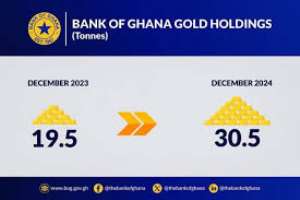
Public economic policy decisions must be defended with facts, not sentiments. People in government have offered a defense of the reported sale of gold reserves by the Bank of Ghana. The justification leaned heavily on reserve diversification and price volatility arguments.
On the surface, diversification is a sound central banking doctrine. But when examined through the lens of strategic reserve management, sovereign risk insulation, and long-term macroeconomic stability, the defense appears incomplete, and potentially short-sighted. This is not a partisan argument. It is a public policy argument.
Gold is not just a commodity; it is strategic financial insurance commodity. Gold is fundamentally different from other reserve assets. It is not simply another line item in a central bank’s portfolio. It plays a distinct strategic role in global finance.
Unlike foreign currencies, gold carries no counterparty risk; It is not subject to the policy decisions of any foreign central bank, it is immune to sanctions, sovereign default, and monetary debasement. It historically functions as a hedge against inflation and systemic crisis. When a central bank holds U.S. dollars, it is indirectly exposed to the monetary policy decisions of the Federal Reserve. When it holds euro-denominated assets, it is exposed to the decisions of the European Central Bank. When it holds gold, it is exposed to none.
This distinction matters in an era defined by geopolitical fragmentation, sanctions regimes, and currency weaponization. Central banks globally, including the central banks of China, Russia, India, and Turkey, have been increasing gold reserves, not reducing them. The trend reflects a broader strategic recalibration away from overdependence on fiat reserve currencies.
To treat gold as merely a volatile tradable asset is to misunderstand its sovereign insurance function. Insurance is not held for short-term gain. It is held for long-term protection. One of the central arguments advanced in defense of the sale of part of Ghana’s gold reserves is that gold prices fluctuate. And that the Bank of Ghana needs to reduce its concentration risks associated with holding too much gold. But there is not a universally accepted, officially determined or recommended benchmark for countries in building gold reserves. The IMF and the World Bank have not recommended reserve benchmarks in terms of gold and other assets for different categories of countries. There is no benchmark for building reserves, for instance, for advanced economies, high middle-income countries, upper middle-income countries, lower middle-income countries and low middle-income countries.
The 2025 sale, as it is being argued, was based on reducing risk related to price volatility. But volatility, in itself, is not a sufficient reason to dispose of a strategic asset. All reserve assets fluctuate. The U.S. dollar fluctuates; the euro fluctuates; bond yields fluctuate and even the Special Drawing Rights (SDRs) of countries with the IMF fluctuate in value relative to domestic currency.
If central banks were to rotate reserves based on short-term price movements, they would effectively become speculative traders rather than custodians of macroeconomic stability. Prudent reserve management is not reactive. It must be strategic. It considers long-term structural risks rather than short-term market behaviours. Selling gold because its price moves up and down risks confusing tactical adjustment with strategic planning. There are legitimate concerns about the long-term reserve portfolio positioning of the Bank of Ghana. Reserve management must account not only for liquidity needs but for intergenerational stability.
The concentration risks concerns of the Central Bank of Ghana were not resolved by the decision it took. There is dollar concentration risk too. If gold reserves are converted primarily into U.S. dollars, a new risk profile emerges. Increased dollar concentration exposes Ghana to: U.S. interest rate tightening cycles, dollar depreciation during future easing, global liquidity swings, geopolitical realignments. The Ghana cedi even appreciated against the USD in 2025. It is not prudent to invest in a currency that is depreciating against a local currency. Other currencies appreciated against the USD last year. The USD has not gained a momentum to reclaim its superiority in global exchange rate markets.
True diversification reduces concentration risk. It does not increase it. If the portfolio becomes more dollar-heavy after a strategy or decision, diversification has weakened, and not strengthened. Central banking doctrine emphasizes asset class balance. Gold, currencies, and sometimes sovereign bonds each serve different purposes within that balance. Reducing gold without proportionally expanding into multiple non-dollar assets may unintentionally narrow Ghana’s risk insulation.
If the rationale for the sale of part of Ghana’s gold reserves was liquidity enhancement, then certain questions arise: What precise liquidity constraint was binding? Was there an urgent balance-of-payments pressure? Were gold swaps or collateralized lending considered? What reserve adequacy benchmarks justified the move?
Gold can be mobilized without outright sale. Many central banks use gold-backed swaps to raise short-term liquidity while retaining long-term ownership. If such alternatives were not considered, the policy defense requires elaboration. If they were considered and rejected, the technical justification should be disclosed. Transparency strengthens credibility, therefore the Bank of Ghana must show its transparency and credibility.
Globally, gold has regained prominence in reserve strategies. Emerging markets, particularly those wary of geopolitical risk, are actively accumulating gold. The rationale is clear; it protects against sanctions exposure, it reduces dependence on western financial infrastructure, and it strengthens sovereign balance sheets during crisis.
Gold strengthens structural resilience. Over-concentration in any one currency introduces risk. Reserve strategy must be forward-looking and stress-tested. The issue is not whether gold should ever be sold or not. The issue is whether the decision was anchored in a clearly articulated strategic framework. Selling strategic gold reserves primarily due to short-term price volatility risks weakening long-term reserve resilience. Gold functions as sovereign insurance against systemic shocks and currency instability.
Increasing exposure to fiat currency particularly the U.S. dollar during an uncertain global monetary transition may introduce new vulnerabilities. Without transparent reserve metrics demonstrating adequate diversification thresholds, liquidity necessity, and stress-tested portfolio optimization, the public justification remains inadequate.
The monetary sovereignty of the Bank of Ghana is not preserved through reactive portfolio shifts. It is preserved through disciplined, transparent, and a structured long-term strategy. Ghana’s reserve policy should not be defended as a political talking point. It should be explained as a macroeconomic blueprint with comprehensive data, risk models, and scenario analysis. Gold is not merely a tradable asset. Gold remains a hedge asset because if FX and equities swing, investors and nations seek stability in bullion. It is a financial insurance asset and a shield that should not be discarded lightly.
Emmanuel Kwabena Wucharey
Economics Tutor, Advocate and Religion Enthusiast


 Kojo Bamba’s election will hurt NPP’s appeal to the middle class – Solomon Owusu
 Sidelining the Church is fuelling indiscipline in schools – Most Rev. Gyamfi
 Minority demands dismissal of Kofi Adams, GTA boss over alleged World Cup visa s...
 Ghana’s inflation hits 5.2% in September, up from 5.0% in August – GSS
 ‘I became their slave’: Israeli hostage recounts 500 days in Hamas captivity
 Finance Minister approves three quarters of rent allowances for security service...
 NDC cannot be written out of NHIS success story – Dr. Sammy Ayeh
 Mahama to cut sod for new 3,000-seater Accra Convention Centre – Felix Ofosu
 Kojo Bamba denies rift with Nana B, explains absence from NPP executives’ meetin...
 I have a strategy to win 70 'orphan' parliamentary seats for NPP in 2028 – Abang...


