




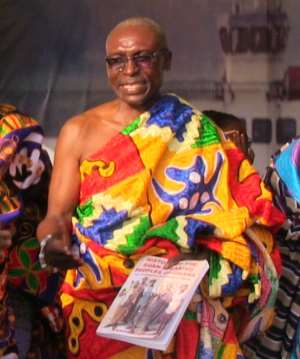
From their migration out of the four (4) Mossi Kingdoms (lands known today as Burkina Faso), the Guan Peoples reached empty plains and unsettle areas of lands 1000 A.D., to become Guan lands, 28 Guan ethnic groups— lands known today as the Republic of Ghana (including areas of Togo, Benin, Ivory Coast)
--to the Afram Plains and further the Guan People migrated, creating the enormous State of Ataara, the last Guan ruler King Ataara Ofinam VIII who fought a seven-year war against the Akans
--to the Guan Peoples’ who brought their culture, especially the Fontomfrom drums and Ntahera horns
-- to the “immigrants” i.e., Ga, Akan, Ewe…, arrivals from lands known today as Mali to Chad—entering into the hundreds of year-old Guan Peoples’ settlements, ethnic groups arriving between 1200-1300 A.D.
--also, the 1400s, the arrival of the Caucasoids/Europeans to colonialize to control the people and valuable resources; and the Chattel enslavement of Africans (Black Holocaust; Maafa), the first Africans stolen and placed in the bowel of a European slave ship and taken to Portugal
--to eventually, the Akans warred against King Ofinam VIII from 1690-1697 for territory
--to the Guon/Gonja Kingdom established fully in 1675, founded by Sumaila Ndewura Jakpa in northern Guan lands (also see Mande people), and the Guan People- man of the royals who did not speak the languages of the arriving immigrants from other lands
(Side note: Asante Kingdom built in 1701)
--1844 the signing of the Europeans’ Bond and establishment of European colonialism, and the making of the European Gold Coast aka ‘slave hub’
--1884/85 Berlin Conference Africa divided bordered lands
--to President Kwame Nkrumah, 1957 the Republic of Ghana, not a monarchy (Ancient Ghana Kingdom), but-- a democracy
--to date the Guans and Gonja Kingdom still exist. As published (2011) Kwame Ampene, QUOTE (Excerpt):
“Guan Congress: Background Information
(By K. Ntow Bediako: General Secretary, Guan Congress):
What has come to be known as ‘The Guan Congress’ was a spontaneous reaction to various research papers on the Guan people by eminent historians and archaeologists from the Universities of Ghana. The idea of creating a platform for the unification of the Guan-speaking peoples of Ghana was conceived by a Guan patriot – Mr. Kwame Ampene, a teacher-historian, in reaction to the challenging assertion by Dr. J. E. C. Sulton in 1979 at a historical seminar at Legon, that in Ghana the Guan as a people do not exist, but what do exist are some fifteen communities with related languages.’
I must emphasize that it was Dr. James Anquandah, another eminent archaeologist, who attempted more or less to refute the assertion that the ‘Guan as a people do not exist.’ In his Radio Talk on 5th May, 1980, Dr. Anquandah declared: “one of the fascinating but mysterious Languages and Cultural groupings in modern Ghana the group collectively known as the Guan” … He went on to observe that “the problem about the Guan is that in certain areas, such as Akuapem, they have been encouraged by their Akan rulers to forget or discard their culture and assume Akan cultural features. The result is that although as human beings the Guan survive physically, and are being absorbed by inter-marriage by the Akan, their culture and language are disappearing at a rapid rate in—especially in the south. One the other hand, in the north, GUAN people who outnumbered the Mande horsemen who invaded the country from Mali, were able to make the foreign invaders adopt the Guan language and culture. The truth is that we are far from deciphering the enigma of the Guan”.
Dr. Anquandah’s assertion, perhaps stimulated Kwame Ampene to translate his dream into reality and, on Sunday November 1, 1981, he organized the First Ever Delegates Conference of the Guan at Ajumako-Boso. Delegates mainly came from the Guan students at Ajumako School of Ghanaian Languages led by Mr. M. A. Mahama. They observed that only cure to the culture of silence was to organize regular conferences. …” (Ampene, p. 175-176).
“PRAISE FOR THE BOOK” –Prof. M. A. Kwamena-Poh, KNUST, Kumasi, Ghana, Africa (Book back cover— see K. Ampene, 2011).
References
Kwame Ampene (2011) History of the Guan-speaking peoples of Ghana: The undisputed aborigines of Ghana. StarSpirit Press, Philadelphia, PA
Henry Kwadwo Amoako (2020) Detailed History of the Guans: AD 2020 Marks 1,020 Years of their entry into Ghana. Retrieved January 3, 2026, from: https://african-research.com/research/african-contries/african-tribes/detailed-history-of-the-guans-ad-2020-marks-1020-years-of-their-entry-into-ghana/#.~.text=The%
20Guan%20speaking%20peoples%20live%mostly%20in%pockets%20in%20Togo%2C%20Benin%
20and%20cote%20d’Ivoire
S. Schwarz-Bart (2001) In praise of Black Women: Ancient African queens. Madison, WI: The University Press, Modus Vivendi Press.
S. Anyanwu (2011) The Mossi: A people of culture. Retrieved December 31, 2025, from: https://face2faceafrica.com/article/the-mossi-a-people-of-culture
Mole National Park. Retrieved January 4, 2026, from: http://molenationalpark.org/the-gonjas.php
Dr. K. Makeda Muhammad is a ‘Repatriate’/returnee to Africa via Ghana in 2011. Dr. Makeda’s field of study is Black Studies; she is an author, independent researcher, historian, educator, columnist, recipient of Ghana’s Education Community (EDUCOM) Award, MACPRI Helping Hands Community Award, Abibitumi & Marcus Garvey Foundation Citation. Dr. Makeda is a Pan Africanist, Africana WoManist (C. Hudson-Weems), community volunteer, and social media activist.


 Mid-Year Review: 'Ghana's economy moved from emergency room to the wellness cent...
 Mid-Year Budget Review: Gov't earmarks GH¢400m to purchase high-occupancy buses
 Pursue economic transformation to address youth unemployment — Solomon Owusu tel...
 Mid-Year Review: 'About 950,000 Ghanaians moved out of multidimensional poverty ...
 Mid-Year Review: 'Gov't collected more taxes in 2025 despite abolishing e-levy, ...
 Mid-Year Review: 'Economic recovery a result of superior economic management' — ...
 Mid-Year Budget Review: 'NDC inherited an economy on its knees' — Finance Minist...
 Mid-Year Budget Review: It has been excellent six months — Joe Jackson
 Wontumi's 20-year sentence is ridiculous, punishment for his criticism of NDC — ...
 KMA reports Police Officer over alleged gun threat during vehicle towing dispute

