




When Khalid, Julia and Benjamin won their immigration cases last year, they were all given a similar message by the judge:
You can now "can live freely."
"Congratulations."
"Welcome to America."
The three are now being held by armed guards in Equatorial Guinea, a small, authoritarian petro-state in Central Africa, after being secretly deported by the United States as President Donald Trump pursues an unprecedented immigration crackdown.
The three East Africans -- who did not want to disclose their real names or nationality, for fear of repercussions -- described their cases in interviews with AFP. They are part of a group of 20 deportees sent to Equatorial Guinea last month.
Twenty-nine people in total have been sent there as part of an opaque $7.5 million deal with the Trump administration, according to a report by Senate Democrats.
All 29 had deportation protections, according to Meredyth Yoon, a US-based attorney familiar with their cases.
Equatorial Guinea has already sent most of the deportees back to their home countries or onto yet another country, and is pressuring the three deportees to do the same, the East Africans told AFP.
Khalid, Julia and Benjamin don't have passports, and they've had to pay for things like toothbrushes out of pocket while detained in a hotel in Malabo, the economic capital.
"We can't leave the hotel," Khalid said.
Opaque deals around the world
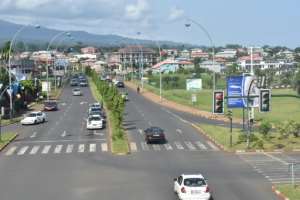 Twenty-nine people, mostly Africans, have been sent by the United States to Malabo, Equatorial Guinea's economic capital, despite US immigration judges giving them deportation protections. By Samuel OBIANG (AFP/File)
In his home country, Khalid said, he was arrested and tortured for being a suspected member of an opposition group. A US judge granted him a status called "withholding of removal" last year, he said, because it was likely he "would face the same situation" if he were sent home.
Benjamin and Julia also won withholding of removal, the two of them said. Benjamin was also granted deportation protection under the Convention Against Torture, a legally binding international treaty that has been ratified by Washington.
The Trump administration deported them anyway, as part of a sweeping expansion to deportations where the government has argued it can send people to a country that isn't their home nation.
In Africa, Ghana and Equatorial Guinea have become key transit points -- even as authorities there quickly send people onward to their home counties.
The Senate report tracked at least 25 countries that have received or made deals to take third country nationals as deportees, including remote Uzbekistan and impoverished South Sudan.
'They will kill me'
In Equatorial Guinea, only 11 of the 29 deportees remain in the country, with most having been sent back to their home nations, a lawyer representing those still held in Malabo told AFP. The deportees were mostly African nationals.
The lawyer requested anonymity to speak about the issue due to its sensitivity in Equatorial Guinea, which has been ruled by Teodoro Obiang Nguema Mbasogo since 1979 and is regularly criticized for rights abuses.
"They will kill me," Julia told AFP of her home country's government. She has already been beaten, jailed and raped by security forces because of her family's alleged ties to opposition groups.
Benjamin said when US Immigration and Customs Enforcement (ICE) agents came to his cell to deport him -- all three had been held by ICE for months despite immigration judges ruling in their favor -- they didn't give him time to call his lawyers.
They initially told him they were deporting him to his home country, which he thinks was done "to terrorize us."
Benjamin's account echoes those of deportees sent to Ghana and interviewed by AFP last year, who said ICE agents misled them about the flight destination and beat people who resisted boarding.
ICE did not respond to a request for comment.
Khalid, Benjamin and Julia all had applied for asylum. They were instead granted withholding of removal, which comes with less rights but in the past has been treated as a "win" in court, said the US-based attorney, Yoon.
Those with withholding of removal can't be sent back to their home country, and are allowed to live in the United States and seek work authorization.
The lawyer representing the detainees in Malabo said that it has been difficult to speak with his clients, because "authorization from the Ministry of Security is required to visit them."
Equatorial Guinean authorities have told the East Africans that "we can't seek asylum here," Khalid said.
According to the UN refugee agency, "there are no formal procedures for asylum seekers to apply for refugee status" in the country.
The deportees told AFP they are being pressured to return home -- or, once they're given passports, to go somewhere with visa-free access.
"We came to America," Khalid said. "But America has abandoned us."


 November 27: Cedi sells at GHS12.55 on forex market, GHS11.84 on BoG interbank
 Government has no power to destool chiefs – Justice Dennis Adjei
 Mahama arrives in Barbados for five-day state visit
 Galamsey threatens food security, public health and national security – Zanetor
 2027 Budget shifts focus to growth, jobs after economic stabilisation – Seth Ter...
 Ministries, state agencies risk sanctions for data privacy breaches – Sam George
 True definition of NDC's 'New Economy' is buying luxury jet amid high cost of li...
 Ghanaians don't eat paper, yet NDC keep touting paper-based economic gains – Osa...
 Akufo-Addo's NPP administration failed to retool security agencies – Agalga
 New presidential jet was not procured for luxury, but necessity – Agalga


