




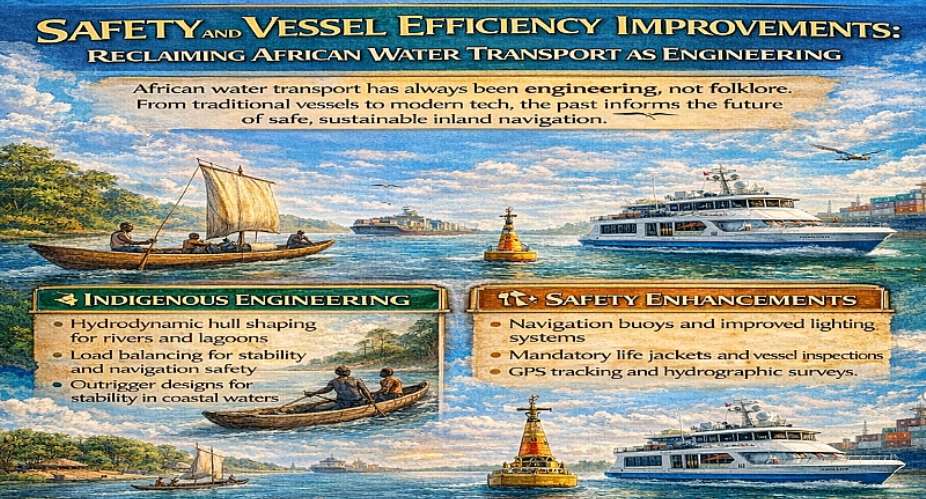
In discussions about maritime safety and vessel efficiency, the narrative often begins in Europe or North America, with steam engines, steel hulls, radar systems, and modern classification societies. Yet this framing overlooks a crucial truth: African water transport systems have long embodied engineering logic grounded in hydrodynamics, material science, risk management, and environmental adaptation. What is frequently dismissed as “traditional” or “folklore” was, in reality, applied engineering shaped by context, climate, and commerce. As Africa modernizes its inland and coastal water transport systems, it is not starting from zero. It is building on centuries of structured knowledge about vessel design, buoyancy, load distribution, navigation safety, and operational efficiency.
Indigenous Vessel Design as Hydrodynamic Engineering
Across West, Central, and East Africa, riverine and coastal communities developed vessel designs optimized for specific water conditions. The dugout canoe, widely used along the Niger River, Congo Basin, Volta Lake region, and coastal lagoons, reflects a sophisticated understanding of hydrodynamics. Its narrow beam and elongated structure reduce drag in calm inland waters, while its shallow draft allows navigation in fluctuating river depths.
In the Niger Delta, canoe builders incorporated stabilizing outriggers in certain coastal areas to improve balance in tidal and wave-prone waters. Along the East African coast, Swahili dhow construction integrated lateen sails that maximized wind efficiency during monsoon cycles. These were not aesthetic choices, they were aerodynamic solutions responding to predictable wind systems in the Indian Ocean.
Load distribution was carefully calculated. Cargo placement affected trim and stability. Experienced navigators understood that improper weight allocation increased capsizing risk. Over time, standardized loading practices emerged within communities, functioning as informal but consistent safety protocols.
This was engineering knowledge, empirical, iterative, and performance-tested
Safety Systems Before Formal Regulation
Long before codified maritime law reached African shores, water transport systems included embedded safety mechanisms. River pilots memorized sandbank locations and seasonal depth variations. Navigation routes shifted with flood cycles. Communities established designated landing points to reduce collision risks in congested river bends.
Collective risk management also played a role. Boats often traveled in groups in certain regions to mitigate threats from weather or piracy. In fishing communities, weather interpretation, cloud movement, wind direction, wave behavior, served as an early warning system. These observational systems functioned as decentralized safety monitoring frameworks.
Modern maritime safety systems formalize what these communities practiced: hazard identification, route planning, risk mitigation, and incident prevention.
Efficiency as Environmental Optimization
Efficiency in vessel performance has always been tied to environmental compatibility. African inland vessels were constructed using locally sourced hardwoods selected for buoyancy, durability, and resistance to water damage. The choice of material reduced maintenance cycles and improved operational lifespan.
Hull curvature often reflected current strength. In strong-flowing rivers like sections of the Congo, vessels required reinforced structures and deeper hull stability. In contrast, shallow floodplains demanded flat-bottom designs to avoid grounding. These design differences demonstrate adaptive engineering based on river morphology.
Even propulsion methods were optimized. Paddle positioning and sail orientation were refined to reduce energy expenditure. These adjustments improved travel time and reduced physical strain, an early form of operational efficiency enhancement.
Modern Safety and Efficiency Imperatives
Today, African water transport systems face renewed attention due to climate goals, regional trade expansion under the African Continental Free Trade Area (AfCFTA), and urban congestion challenges. Safety and vessel efficiency improvements are central to unlocking inland water transport potential.
- Modern safety upgrades include:
- Installation of navigation buoys and lighting systems
- Mandatory life jacket enforcement and safety audits
- GPS-based vessel tracking systems
- Hydrographic surveys to map depth and sediment patterns
Efficiency improvements involve
- Shallow-draft composite vessels to reduce fuel consumption
- Hybrid and solar-assisted propulsion systems
- Digitized cargo manifests and port coordination platforms
- Improved hull design using computational modeling
In Ghana, for example, Volta Lake operations could benefit significantly from modern navigation aids and standardized vessel inspection regimes. Similarly, along the Niger River corridor, enhanced hydrographic mapping could improve route predictability and reduce accidents linked to submerged hazards.
However, modernization should not erase indigenous engineering foundations. Instead, contemporary vessel design can integrate traditional shallow-draft principles with modern materials and propulsion systems. Indigenous knowledge about seasonal navigation patterns can complement satellite data and digital forecasting tools.
Reframing the Narrative
The mistake has been to treat African water transport history as cultural heritage rather than technical heritage. When examined through an engineering lens, indigenous systems reveal structured design logic, environmental adaptation, and safety-conscious operation. These systems evolved under constraints of material availability, hydrological variability, and trade demands, precisely the conditions that shape engineering innovation everywhere.
Recognizing African indigenous water transport systems as engineering knowledge changes the policy conversation. It suggests that training programs in naval architecture and marine engineering across the continent should incorporate historical vessel designs into curriculum analysis. It encourages research institutions to study traditional hull forms for modern efficiency applications. It reframes riverine communities not as relics of the past but as custodians of applied hydrodynamic expertise.
Safety and vessel efficiency improvements in Africa will require regulatory reform, investment, and digital integration. But they will also require intellectual continuity, an acknowledgment that innovation is not imported; it is extended.
Africa’s waterways have always demanded technical intelligence. The challenge now is to modernize without forgetting that the engineering foundation has been there all along.
Author: Joseph Fuseini ([email protected])


 NGSJF petitions Ghana Airports, IGP over Adwoa Safo travel records and 2021 parl...
 Transport Minister directs DVLA to deepen inter-agency collaboration towards enf...
 Famers at Anloga-Avume call for buyers, govt intervention as tomatoes rot in far...
 2026 World Cup: 'Minister’s driver, Chief Director’s secretary still in US' – Mi...
 Ho Central NPP threatens retaliation over demolition of party office fence wall ...
 Trump says 'major progress' made toward US military base in Poland
 US aid cuts are killing Kenyan sex workers
 37 suspected illegal miners die in custody in central Nigeria
 'When I go to sleep, I know I haven’t done anything wrong' – Finance Minister
 Trump threatens EU with tariffs over 'laughable' Canada association plan


