




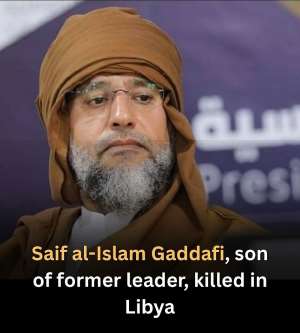
Zintan, Libya — 3 February 2026: Saif al-Islam Gaddafi, the 53-year-old son of Libya’s former leader Muammar Gaddafi, was killed in an armed attack at his residence in the western Libyan city of Zintan late Tuesday, multiple Libyan and international news agencies have reported.
Circumstances of the Attack
According to statements from family sources, his lawyer Khaled al-Zaidi and political adviser Abdullah Othman, the incident occurred at Gaddafi’s home in Zintan, a town located roughly 136 km southwest of Tripoli. Four unidentified armed men described in some reports as a “four-man commando” forced their way into his residence after disabling the security cameras, the attackers’ apparent first step to avoid detection.
Once inside, the gunmen confronted Saif al-Islam. A statement released by members of his political team called the killing a “cowardly and treacherous assassination,” and said there had been a direct confrontation between him and the assailants before he was fatally shot.
Death Confirmed, But Motive Unknown
Libyan authorities, including the Attorney General’s Office, have confirmed that Saif al-Islam died of gunshot wounds and have opened a criminal investigation to identify and pursue those responsible for the attack.
At this stage, no individual or group has claimed responsibility for the killing publicly, and investigators have not released verified evidence about who ordered or carried out the assassination.
Denials and Conflicting Accounts
In the hours following the reports, the 444th Combat Brigade, a Libyan militia group mentioned on social media in connection with the incident, issued a formal denial of involvement, saying it had no presence in Zintan and was not responsible for any clashes or the death of Saif al-Islam.
Some local media outlets have also reported conflicting accounts, including references to clashes in areas near Zintan or unverified claims about his death occurring outside the city. However, these accounts have not been confirmed by official sources.
Who Was Saif al-Islam Gaddafi?
Saif al-Islam was one of the most prominent surviving members of the Gaddafi family after the 2011 uprising that toppled his father’s four-decade rule. Once seen as his father’s heir apparent, he held significant influence within Libya’s government before 2011 and later became the face of a controversial attempt to return to national politics.
He was captured in 2011 following the fall of Tripoli and later imprisoned in Zintan. In 2017, he received a general amnesty and was released, remaining in Zintan while sporadically pursuing political avenues, including a 2021 presidential bid that was ultimately invalidated amid Libya’s ongoing political deadlock.
Political Context and Legacy
For over a decade, Libya has struggled with persistent political fragmentation, militias operating with autonomy, and repeated delays in national elections. Saif al-Islam’s return to political life had been seen by some observers as a potential focal point for unity, a possibility cut short by his assassination.
His death adds a dramatic coda to Libya’s post-revolution instability and will likely have significant ramifications for the country’s fragile political landscape in the coming months.


 US fears wider Middle East escalation after Houthi attack Riyadh
 Pop star Ed Sheeran calls Gaza situation “unjustifiable” amid controversy
 'We have spent 60years arguing about Nkrumah and rather less time doing what he ...
 Judge recounts attempted MoMo scam on him moments after jailing scammer
 'Systemic failure due to NACOC removal from port inspections' – Inusah Fuseini o...
 Police uncover alleged network behind Ghana Jollof videos
 NACOC says cocaine suspects were under surveillance for up to two years
 Suhuyini assures Accra-Kumasi Expressway won’t miss December 2028 deadline
 Foreign Affairs Ministry releases 200-page RTI response on GH¢49.7m South Africa...
 Chartered flights account for GH¢27.18m of South Africa evacuation cost


