




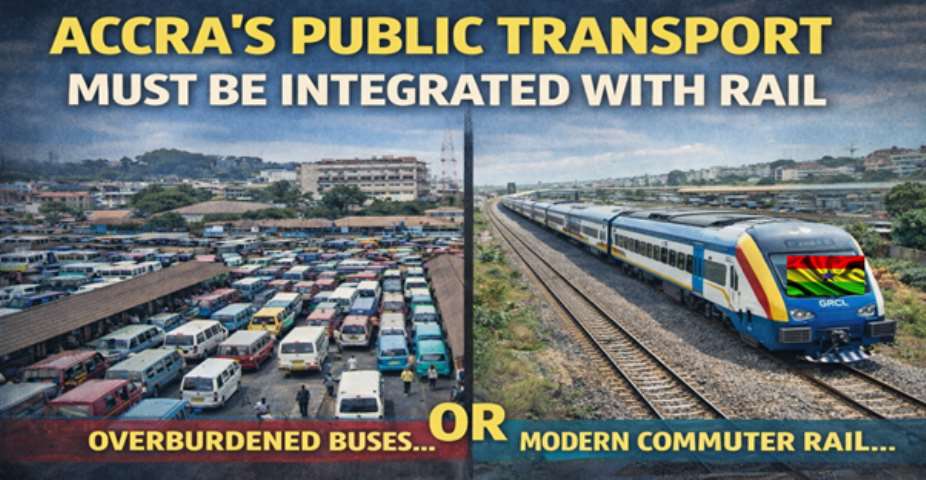
Accra’s public transport system is under constant strain. Daily scenes of endless queues and rising commuter frustration are no longer exceptional; they are routine. For years, policy responses have focused almost exclusively on buses: buying more, reallocating routes, or rebranding services. Yet the crisis persists. The uncomfortable truth is this: Accra’s public transport cannot succeed without rail at its core.
Buses alone cannot carry a rapidly expanding metropolitan region of over five million people. Even when well-managed, buses are constrained by the same congested roads as private vehicles. Every traffic jam turns a bus into a slow, unreliable service, undermining efficiency and discouraging use. This is why Accra keeps returning to the same problem: shortages, delays, and declining service quality despite repeated bus procurement drives.
Rail changes this equation fundamentally. Urban and suburban rail systems move large volumes of people quickly and predictably, independent of road congestion. An example of model cities in Africa, like Lagos and Addis Ababa, that do not rely on buses alone. They use rail as the backbone of mass transit, with buses acting as feeders, not substitutes. Accra, by contrast, has tried to make buses do everything, and they are failing under the weight.
The absence of rail integration has also made public transport expensive and inefficient. Because buses must cover long cross-city trips, fleets wear out faster, maintenance costs rise, and replacement cycles accelerate. The result is a perpetual shortage of operational buses. Rail shortens bus routes, concentrates demand, and improves fleet productivity. Without rail, Accra is locked into an unsustainable model.
Importantly, Accra is not starting from zero. Existing rail corridors, linking areas such as Accra, Tema, and Nsawam, already trace natural commuter patterns. These corridors represent opportunities, not obstacles. Integrating them and expanding to Kasoa, Adenta, Ayi Mensah, and Dodowa into a modern urban transport system would relieve pressure on key road arteries and reduce dependence on informal minibuses.
Integration is not just about infrastructure; it is about planning. Unified ticketing, coordinated schedules, intermodal terminals, a good maintenance culture, and clear institutional leadership are essential. Rail without buses fails, but buses without rail collapse. The two must function as one system, not competing or isolated services.
The cost argument against rail is short-sighted. While rail requires higher upfront investment, its long-term economic returns, reduced congestion, lower emissions, improved productivity, and predictable mobility far outweigh the costs. Continually buying buses to chase unmet demand is, in fact, the more expensive option.
Accra’s transport crisis is not a mystery; it is a policy choice. As long as rail remains peripheral, public transport will remain fragile. Integrating rail into Accra’s public transport system is not optional; it is the only sustainable path forward.
Author: Joseph Fuseini ([email protected])


 We have cut cost of capital by more than half since Mahama took office – Ato For...
 Dr Bertha Ayi on how parents hurt children by raising them only on English
 Customs intercepts three firearms, 610 rounds of ammunition at Tema Port
 NDC to open nominations for 2026 regional executive elections on October 6
 Africa will be mostly self-sufficient in fuel by 2030: Dangote to AFP
 PRETAG threatens to intensify strike over unpaid teacher entitlements
 Lands Minister exits GoldBod Board as Minister's Chief Director takes over
 Court refuses bail for six accused in 3.9-tonne cocaine shipment case
 Philippines to open first-ever embassy in Ghana
 1992 Constitution review: Prof. Atsu Ayee and Dr Osae-Kwapong explain why Consti...


