




“No girl should miss school because of her period. Let us turn our farms into factories of dignity.” — H.E. John Dramani Mahama, President of the Republic of Ghana
The Moment of Menstrual Justice Has Come
In April 2025, Ghana took a bold step toward menstrual equity by launching the Free Sanitary Pad Distribution Programme. With GH₵292.4 million allocated to provide pads to girls from Primary 5 through SHS, the initiative was a landmark in public health and education. But as demand grows and costs rise, a deeper question emerges: Can we sustain this vision with local innovation?
The answer lies in our farms—in the banana and plantain stems we discard every harvest season.
The Hidden Gold in Our Pseudostems
Banana and plantain pseudostems, long treated as agricultural waste, are rich in cellulose fiber—perfect for producing biodegradable, hypoallergenic sanitary pads. Across East Africa, countries like Kenya and Uganda are already turning this waste into dignity. Ghana, with over 4 million tonnes of plantain and banana output annually, is ripe for a similar revolution.
A District-by-District Solution
We propose the establishment of mini sanitary pad production facilities in all 261 districts, under the joint supervision of the Ministries of Health and Education, and powered by National Service personnel. This model will:
- Serve 15,000–20,000 girls per district with locally made pads.
- Utilize 25,000+ tonnes of agro-waste per district annually.
- Deploy 1,200–1,500 NSS personnel per district to manage production and distribution.
- Create thousands of jobs in fiber collection, processing, packaging, and logistics.
This is not just a health intervention—it is a national industrial strategy.
The Numbers Tell the Story
- GH₵292.4 million: Annual pad budget (2025)
- 1.2 million+ girls: Target beneficiaries nationwide
- 144 million pads/year: Estimated national demand
- 40% cost savings: Potential from local production
- 50,000+ jobs: Direct and indirect employment potential
Implementation Blueprint
- Repurpose TVET centers and school workshops as production hubs.
- Train NSS graduates in health, engineering, and entrepreneurship to run operations.
- Engage local farmers to supply stems, creating farm-to-fiber cooperatives.
- Sell surplus pads to NGOs, private markets, and ECOWAS neighbors.
- Monitor quality and hygiene through the Ministry of Health.
Why This Matters
- Girls stay in school.
- Youth gain skills and jobs.
- Agro-waste becomes national wealth.
- Ghana leads Africa in menstrual innovation.
A Presidential Call to Action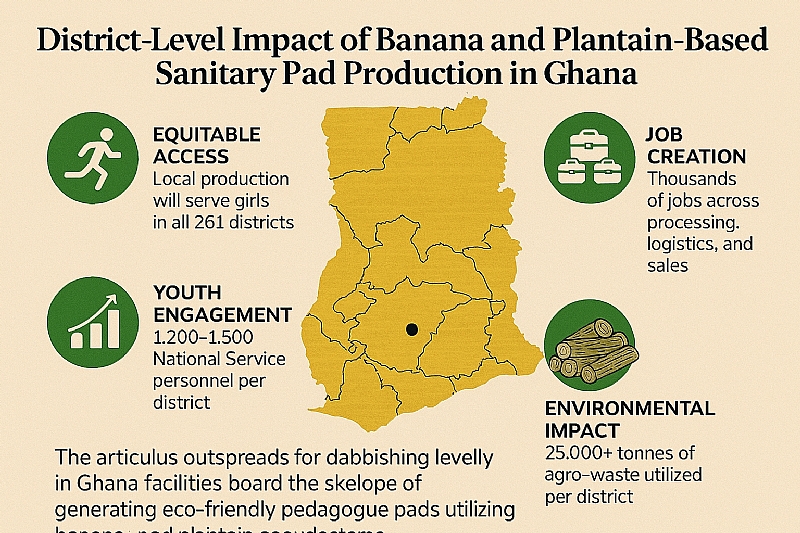
President Mahama, the time is now. We urge you to:
- Declare a National Menstrual Innovation Agenda.
- Pilot district-level production in 20 districts by mid-2026.
- Mandate a Menstrual Health Corps under NSS.
- Champion agro-waste valorization as a national priority.
Let us turn every district into a factory of dignity, every stem into a symbol of empowerment, and every girl into a confident, unstoppable force.
Retired Senior Citizen
Teshie-Nungua
[email protected]

 Government to introduce ID verification for access to porn sites — Sam George
 African governments failing on commitments to increase agriculture funding — Eri...
 45-year-old ex-convict arrested over alleged rape and murder of wife's 17-year-o...
 We’re working to provide shelter for police officers displaced after barracks fi...
 No arrests made over Accra Central Police Barracks fire yet — Police
 Mahama told UK Prime Minister anti-LGBTQ+ bill is far from becoming law — Minori...
 Leaked judgment? NDC activists confirms jail term for Wontumi on social media
 Minority demands passage of original 2024 anti-LGBTQ+ bill, accuses NDC of decep...
 "Flagrant disrespect" — Court remands Abronye over failure to surrender passport...
 High Court remands Abronye over failure to surrender passport


