




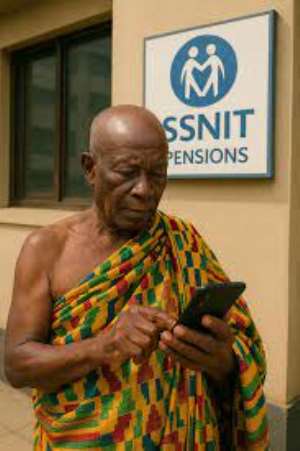
Ghana’s pensioner population is steadily growing. With improved life expectancy and decades of formal employment feeding into the Social Security and National Insurance Trust (SSNIT), retirees today number about two hundred and fifty thousand, if not more. Yet paradoxically, this expanding demographic, arguably one of the most vulnerable and policy-affected groups remains one of the least effectively represented in national decision-making.
For decades, the National Pensioners Association (NPA) has been the most visible body claiming to speak for pensioners, particularly SSNIT retirees. Its advocacy has occasionally drawn public attention to pension inadequacy, cost-of-living pressures, and welfare concerns. However, persistent questions linger. How representative is the NPA? How effective is its advocacy? And can pensioners do better? This article argues that Ghana needs to rethink pensioners’ representation, not necessarily by dismantling existing structures, but by introducing a stronger, more democratic, evidence-driven alternative model, one that reflects modern pension realities and commands policy respect.
The Pension Challenge: More Than Monthly Payments
Pensions are not merely administrative disbursements. They are a social contract, a promise that after decades of contribution to national productivity, retirees will live with dignity. Yet evidence suggests that many Ghanaian pensioners struggle to meet basic needs. Pension adjustments often lag behind inflation and rising living costs; health expenses increase sharply with age, while pension income remains largely fixed; and, pensioners have limited influence over decisions that directly affect benefit indexation, survivor benefits, and investment policies. The legal framework anchored in the National Pensions Act, 2008 (Act 766) and overseen by the National Pensions Regulatory Authority (NPRA) provides regulatory structure, but regulation alone does not guarantee fairness or adequacy. Effective advocacy is essential.
The Representation Gap: Where the Current Model Falls Short
It must be stated clearly and fairly that the challenge is structural, not personal. Several weaknesses undermine the effectiveness of current pensioners’ advocacy in Ghana:
- Voluntary and Uneven Membership: There is no comprehensive, transparent record of how many SSNIT pensioners belong to the NPA. Many retirees automatically assume representation without formal membership, weakening the association’s democratic legitimacy.
- Centralized Leadership, Weak Grassroots Power: Decision-making tends to be concentrated at the national level, while district and regional structures often lack autonomy, resources, and influence.
- Limited Technical Capacity: Advocacy frequently relies on emotional appeals rather than actuarial analysis, legal interpretation of pension law, or empirical cost-of-living data. In policy environments, emotion attracts sympathy, but evidence drives reform.
- Absence of Institutional Continuity: Leadership transitions often disrupt momentum, with advocacy styles shaped more by personalities than by enduring institutional frameworks.
These gaps suggest that representation exists, but influence is limited.
A New Vision: From Association to Institution
What Ghana needs is not merely another pressure group, but a modern pensioners’ institution, one that combines legitimacy, professionalism, and sustainability. At the heart of this vision is a Federated Pensioners’ Policy Association (FPPA), a concept that can coexist with existing bodies but raises the standard of representation.
The Founding Concept Note
- Mission: To advance the welfare, dignity, and economic security of pensioners in Ghana through democratic representation, evidence-based advocacy, and constructive policy engagement.
- Core Philosophy: Pensioners are rights-holders, not beneficiaries of charity. Representation must flow from the grassroots upward. Advocacy must be data-driven, non-partisan, and institutionally grounded.
- Target Constituency: SSNIT pensioners; CAP 30 pensioners (on policy matters of shared interest); and future retirees concerned with pension sustainability.
- Structural Innovation: A Federated Model - Unlike highly centralized associations, the proposed model adopts a bottom-up federation:
- District Pensioners’ Associations: The foundation of legitimacy, membership registration, and welfare feedback.
- Regional Pensioners’ Councils: Coordinating advocacy priorities and electing national delegates.
- National Secretariat: Focused on policy negotiation, research coordination, and national representation.
- Key Rule: National leaders derive authority from elected regional delegates, not from informal prominence.
This structure prevents elite capture, strengthens grassroots voice, and aligns leadership accountability with membership realities.
From Protest to Policy: Professional Advocacy Desks
A defining departure from older models is the creation of functional policy desks:
- Policy & Research Desk --- Pension adequacy assessments; inflation-pension gap analysis; comparative studies (ECOWAS and lower-middle-income countries).
- Legal & Rights Desk: Interpretation of pension legislation (Act 766 and amendments); engagement with NPRA guidelines; and strategic litigation where dialogue fails
- Media & Public Education Desk: Explaining pension issues in accessible language; publishing policy briefs and annual pensioners’ reports; and building public empathy for pension reform.
This professionalization transforms pensioners from petitioners into policy actors.
Financial Independence: The Backbone of Credibility
Advocacy without resources is rhetoric. A better-functioning association must diversify funding:
- Modest mandatory dues (kept affordable)
- Voluntary welfare contributions (ring-fenced from advocacy funds)
- Grants for ageing, social protection, and research projects
- Strict annual audits and public financial reporting
Independence ensures the association can challenge SSNIT, NPRA, and government without fear or favour. The proposed model does not thrive on perpetual confrontation. Instead, it promotes structured engagement. Constructive firmness, not hostility, is the path to reform.
Why This Matters: Pension Reform Is a National Issue
Pension adequacy affects intergenerational equity, public health costs, social stability, and trust in public institutions. A weak pensioners’ voice today signals a weak retirement future for today’s workers. By strengthening pensioners’ representation, Ghana strengthens its social protection architecture.
My Thoughts: Raising the Bar, Not Burning Bridges
This article is not an indictment of existing pensioners’ associations. It is an invitation to pensioners, policymakers, civil society, and the media to raise the bar of representation. Ghana’s pensioners deserve more than sympathy. They deserve competent advocacy, democratic legitimacy, and a seat at the policy table backed by evidence. The time has come to move beyond representation toward institution-building. And let us see an annual “State of Pensioners in Ghana Report” when we visit any library in this country.
References
International Labour Organization. (2019). Social protection for older persons:
Policy trends and statistics. Geneva: ILO.
National Pensions Act, 2008 (Act 766), Ghana.
National Pensions Regulatory Authority. (2023). Annual report. Accra: NPRA.
Social Security and National Insurance Trust. (2023). Annual report. Accra: SSNIT.
World Bank. (2020). Pensions and social protection systems in developing economies. Washington, DC: World Bank.
FUSEINI ABDULAI BRAIMAH
+233208282575 / +233550558008
[email protected]


 Attorney-General appeals ruling halting trial of former Buffer Stock CEO, wife
 NAIMOS destroys 1,970 changfans, 863 Illegal mining structures in three months —...
 Let's see how Asiedu Nketia becomes NDC flagbearer with same people he conspired...
 Asiedu Nketiah opts out of NDC chairmanship race amid flagbearership speculation
 NDC insists Nkwanta North elections will proceed despite court injunction
 'My side of the story will shock you; I'm waiting for court days' – Obuasi SHTS ...
 Obuasi SHTS sexual abuse: 'GES must distant itself, allow the law to work' — For...
 Upper East: Fear grips nine Kusaug communities over mysterious fish deaths in da...
 NDC suspends Amasaman Communications Officer over 'irresponsible' remarks on Obu...
 Parliament secures religious leaders’ support to end witchcraft accusations


