




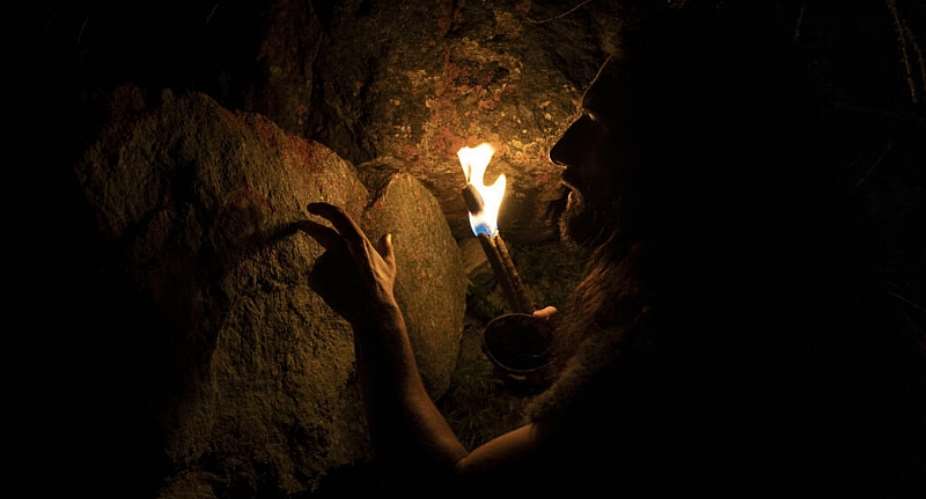
Scientists in Britain say ancient humans may have mastered the art of making fire far earlier than previously believed – and they have the scorched evidence to prove it.
how New research suggests deliberate fire-setting took place in what is now eastern England around 400,000 years ago, pushing back the earliest known date for controlled fire-making by roughly 350,000 years.
Until now, the oldest confirmed evidence had come from Neanderthal sites in northern France dating to about 50,000 years ago.
The findings, published in the journal Nature, centre on the Paleolithic site of Barnham in Suffolk, which has been excavated intermittently for decades.
This time, however, researchers believe they have finally cracked one of archaeology's most enduring mysteries – when humans stopped depending on natural fires and learned to create flame whenever they needed it.
French cave findings suggest Europe's first Homo sapiens arrived earlier than thought
A hearth, not a wildfire
A team led by the British Museum identified a distinctive patch of baked clay, flint hand axes fractured by extreme heat, and two fragments of iron pyrite – a mineral that produces sparks when struck against flint. Together, the clues point to deliberate, controlled fire-making rather than a chance blaze.
Researchers spent four years subjecting the site to detailed analysis, determined to rule out the possibility of natural wildfires. Geochemical tests showed temperatures had exceeded 700 degrees Celsius, with signs of repeated burning in the same location over time.
That pattern, the scientists say, is far more consistent with a constructed hearth than a lightning strike.
Rob Davis, a Paleolithic archaeologist at the British Museum, said the combination of evidence leaves little room for doubt. The high temperatures, controlled burning and pyrite fragments together show “how they were actually making the fire and the fact they were making it”.
Crucially, iron pyrite does not occur naturally at Barnham. Its presence suggests the people who lived there deliberately collected it, understanding its properties and how it could be used to ignite tinder – a clear sign of technological know-how.
Such evidence is exceptionally rare, as deliberate fire-making is seldom preserved in the archaeological record: ash disperses easily, charcoal decays and heat-altered sediments are often eroded over time.
At Barnham, however, the burned deposits were sealed within ancient pond sediments, effectively locking the moment in place and allowing scientists to reconstruct how early humans used the site.
Oldest known Neanderthal engravings found in French cave
Fire, food and the rise of social life
The implications for our understanding of human evolution are substantial.
Fire transformed daily life. It allowed early populations to survive colder climates, deter predators and cook food. Cooking breaks down toxins in roots and tubers and kills pathogens in meat, improving digestion and releasing more energy – energy that could help support larger, more demanding brains.
Chris Stringer, a human evolution specialist at the Natural History Museum, said fossils from Britain and Spain suggest the inhabitants of Barnham were early Neanderthals. Their cranial features and DNA, he noted, point to growing cognitive and technological sophistication at this stage in human evolution.
Fire also reshaped social life. Evening gatherings around a hearth would have created time and space for planning, storytelling and strengthening group bonds – behaviours often linked to the development of language and more organised societies.
Archaeologists say the Barnham site fits into a wider pattern seen across Britain and continental Europe between 500,000 and 400,000 years ago.
During this period, brain size in early humans began to approach modern levels, while evidence for increasingly complex behaviour becomes more visible in the archaeological record.
For those involved in the excavation, the discovery is nothing short of career-defining.
Nick Ashton, curator of Paleolithic collections at the British Museum, called it “the most exciting discovery of my long 40-year career”.
(With newswires)


 'Go after financiers, not just couriers' – Catholic Bishops to NACOC after Franc...
 Man beaten to death after alleged machete attack on elderly woman at Tamso
 Two arrested over kidnapping, murder of Senegalese goalkeeper in Ghana
 Ministers should answer legitimate questions regarding promises, public expendit...
 Mahama has done well for stabilising the economy but the real litmus test is sus...
 Chief Justice Paul Baffoe-Bonnie chairs 11-member Council for Legal Education an...
 Man reportedly commits suicide over inability to raise money for son's SHS prosp...
 Wontumi’s GH¢30m Exim Bank case adjourned to October 13
 Euro Spa CEO, three others remanded over €225m cocaine shipment bust in France
 Fresh South Africa drug arrest puts Ghana’s border controls under scrutiny


