




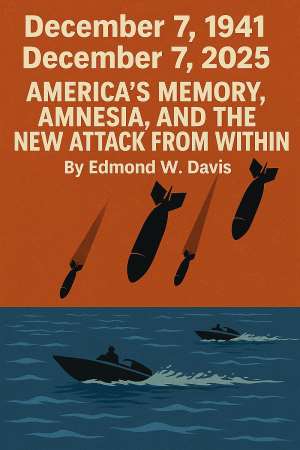
December 7, 1941—a date which will live in infamy—marks the 84th anniversary of the attack on Pearl Harbor. It was a moment of national crisis that forced the United States to confront the reality that the world was larger, more dangerous, and more interconnected than the walls of isolationism allowed us to believe. It was an attack from abroad.
December 7, 2025, tells a different story—one just as dangerous, but far more insidious. This time, the attack is not from foreign aircraft but from domestic policy, politics, and power. It is an attack from within, waged not by a foreign empire but by Americans with authority over other Americans. The contrast is socio-historically chilling.
Before America Entered WWII: A Nation in Denial
Leading up to 1941, the United States pretended that distance equaled safety. Fascism rose. Democracies fell. The League of Nations failed because the world’s leading powers refused to enforce collective peace. America watched the storm but did not prepare for the rain.
Then came Pearl Harbor, and with it a national transformation—military, economic, and moral.
Yet even in its moment of unity, America practiced inequality.
Japanese Internment and Today’s Treatment of Brown & Black Communities
After the Pearl Harbor attack, the Roosevelt administration forcibly interned 120,000 Japanese Americans, most of them U.S. citizens, simply because of their ancestry. Entire families—farmers, teachers, veterans—were uprooted and imprisoned in camps in Arkansas, California, Arizona, Utah, and several other states. Executive Order 9066
This was not national security.
It was national scapegoating.
It was racism with paperwork.
Today, in 2025, we see an eerily familiar pattern. Brown Americans—Mexican, Central American, South American, Afro-Latino—and Black Americans are facing heightened surveillance, immigration raids, voter suppression, mass deportations, and the ‘end of civil rights. The National Park Service (NPS), under the Trump administration, has removed Martin Luther King Jr. Day and Juneteenth from its 2026 fee-free days, replacing them with dates tied to President Trump’s birthday (Flag Day) and other patriotic observances. According to Newsweek, the change has sparked strong backlash from civil rights leaders and lawmakers, who view it as an attack on Black history and public access.
The difference? In the 1940s, America reacted to an external attack. In 2025, the government initiates the attack itself. This time, the threat was not Pearl Harbor. This time, the threat became public policy, political ideology, and a culture of sanctioned hostility.
DEI Rollbacks, Shrinking Civil Rights, and “No Black Rights” in Practice
The dismantling of DEI programs, the weakening of civil rights protections, the rise in hate crimes, and the political boldness of openly discriminatory rhetoric have created a 2025 landscape where justice is no longer blind—it is selectively sighted.
We have traveled backward. Civil rights are optional. Black rights are conditional. Belonging is negotiable. The scales of justice have flipped upside down.
The Transformation of 1941 vs. the Transaction of 2025
The early 1940s were transformational because America—despite its racism—mobilized with purpose. The year 2025 is transactional. Everything has a price tag: citizenship, truth, humanity, voting rights, even education.
In 1941, we asked: How do we protect democracy?
In 2025, we ask: Do we still believe in democracy at all?
The Green Book as Hand Sanitizer Against American Racism
During WWII and after, Black Americans used the Negro Motorist Green Book the way we now use hand sanitizer—to protect ourselves from exposure. Only the virus wasn’t biological. It was hatred.
The Green Book disinfected travel routes through sundown towns, hostile police departments, and Jim Crow economies. It saved lives, marriages, and memories on 20th-century highways built for commerce but not equality.
Marijuana, “Mexi-cons,” and the Criminalization of Culture
In the 1930s, the U.S. government intentionally renamed cannabis as marijuana to associate it with Mexicans. Overnight, language became legislation, and Mexicans were transformed into “Mexi-cons” while Black Americans were pushed toward chain gangs.
Racism has always had a legal department.
Black Wall Streets: Proof of What Black America Built
According to Black Girl in CLE, nearly 100 Black Wall Streets—Little Rock’s West 9th Street among them—show that African Americans built thriving, self-led economies across the nation. These communities demonstrated financial discipline, cultural pride, business sophistication, and social cohesion unmatched in many American towns today.
They succeeded not because America supported them, but because Black America supported each other.
Marriage, Family, and the Changing Black Household
In the 1940s, Black marriage rates surpassed 60%. Today they are significantly lower, affected by:
- The rise of mass incarceration
- economic instability
- educational inequity
- and the social dislocation engineered by discriminatory policy
Family structure did not collapse on its own—it was pushed.
UN Success vs. The League of Nations Failure
The League of Nations failed because its strongest nations refused to back their promises with action. The United Nations, born after World War II, has been far more effective: mediating conflicts, delivering humanitarian aid, and shaping global norms around human rights. The world learned from 1941. America, in 2025, appears not to have.
Conclusion: “When America Was Great Again”—For Whom?
On this 84th Anniversary of the Attack on Pearl Harbor, we must confront a hard question: Which America are we longing to return to?
The America of internment camps?
The America of segregated armies?
The America of lynchings and legally enforced inequality?
In 1941, America was forced toward unity by an enemy abroad.
In 2025, America is being forced toward division by leaders at home.
If America was ever great, it was not because of its treatment of Black and Brown people, but because Black and Brown people still believed America could one day align with its ideals.
December 7, 1941, was a time that transformed a nation.
December 7, 2025, is a time we must ask ourselves and country, are we transactional?
ABOUT THE AUTHOR:
Edmond W. Davis is an American social historian, international speaker, and Amazon #1 author. He is a nationally recognized authority on the Tuskegee Airmen. He serves as Founder and Executive Director of America’s only National HBCU Black Wall Street Career Fest, based in Little Rock, Arkansas. A Philadelphia native and former homeless youth, Davis has dedicated his career to education, social impact, and the empowerment of underrepresented communities.

 Ayariga challenges BoG to cite law behind arrests over cedi money bouquets
 Trump targets tax-free diesel as Republicans approach midterms
 Govt releases GH¢9.1 billion covering six quarters of DACF to MMDAs - Ayariga
 Manhyia South MP charged over alleged GH¢9.85m loss to SIC Life
 'I didn’t know the process would be that fast' – Nana B explains missing NPP swe...
 'Who is Karbo to defy my orders?' – Buttey fumes over NPP conference clash
 'Kojo Bamba can’t stop NDC' – Gbande warns NPP against shielding anyone from arr...
 Mahama pardons 863 convicted persons, 11 from death sentence
 NDC confirms Dzifa Gunu’s disqualification from La Dadekotopon constituency secr...
 Nigeria's Tinubu confirms 32 dead after military plane crash


