




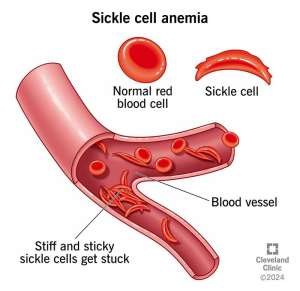
Sickle Cell Disease (SCD) is a serious inherited blood disorder that affects the structure of haemoglobin, the protein in red blood cells responsible for transporting oxygen throughout the body. The condition causes red blood cells to become misshapen and sticky, blocking blood flow and leading to pain, organ damage, and increased risk of infection. SCD is most prevalent in India, the Middle East, the Mediterranean Basin, the Americas and Sub-Saharan Africa, where it poses a major public health concern.
In Ghana, the statistics are alarming. About 2% of all newborns—an estimated 14,000 to 18,000 babies each year—are born with SCD, according to data from PubMed Central. This makes Ghana one of the countries with the highest birth prevalence globally. Moreover, around 25% of Ghanaians carry the sickle cell trait (HbAS), meaning they can unknowingly pass the gene on to their children. If both parents are carriers, there is a one in four chance their child will inherit the disease (HbSS), the severest form.
Child mortality associated with SCD is also high. Many children with HbSS die before their fifth birthday due to a lack of early diagnosis and effective treatment. A 2020 study published in the Pan African Medical Journal highlighted that in low-resource settings like Ghana, late diagnosis, poor access to care, and limited health education contribute to this tragic loss of life.
Causes
Sickle cell is not contagious; it is inherited. If a child receives one sickle cell gene from each parent, they are born with SCD. If only one parent passes on the gene, the child becomes a carrier but usually shows no symptoms. Genetic counselling and testing are key to reducing the number of high-risk births, but public awareness remains low.
Current Interventions by the Government
Recognising the severity of the situation, Ghana has taken some notable steps. The government recently launched the National Sickle Cell Disease Strategy (2024–2028), which outlines plans to improve screening, treatment, education, and research. This strategy has been supported by partnerships with organisations such as the Sickle Cell Foundation of Ghana and the global pharmaceutical company Novartis.
One of the most promising developments is the increased availability of essential medications like Hydroxyurea, Folic Acid, and Penicillin, now covered under the National Health Insurance Scheme (NHIS). These drugs have been shown to reduce pain crises, prevent infections, and improve the overall quality of life for patients.
The Need for Early Diagnosis
Though a permanent cure exists through bone marrow transplants and, more recently, gene therapies, these options remain out of reach for most Ghanaians due to high costs and complex medical requirements. For now, prevention and effective management remain the most viable strategies.
Health experts stress that the most effective way to reduce mortality is through universal newborn screening. Early diagnosis allows for timely treatment, parental education, and preventive care. Countries that have implemented such screening, like the United States and Brazil, have seen dramatic reductions in SCD-related deaths in children.
Equally important is the decentralisation of care. Many parts of Ghana still lack access to specialised services. Strengthening the healthcare system by training more haematologists, Paediatricians and establishing SCD clinics in every region could ensure more equitable care.
Raising Awareness
Public education is another crucial piece of the puzzle. Misconceptions and stigma surrounding SCD are common, and many families delay seeking care. Experts recommend the inclusion of genotype education in school curricula and launching nationwide awareness campaigns to promote early testing, especially before marriage or childbirth.
The Way Forward
Sickle cell disease continues to place a heavy burden on Ghanaian families and the health system. However, with committed implementation of national strategies, expanded screening programs, improved access to medication, and sustained public education, Ghana can take meaningful steps to reduce the impact of this disease. The challenge is significant, but so is the opportunity to save thousands of lives each year.
By Hafizdeen Akram, A freelance Journalist and member, Media for Drugs for Neglected Diseases Initiative, Africa

 Israel must win 'because we’ve got no other choice’, PM Netanyahu tells UN
 Mahama reiterates Ghana's commitment to two-state solution to Palestine-Israel c...
 Ablakwa calls for Return of African Artefacts held abroad
 Madina MP Francis-Xavier Sosu reportedly collapses while speaking at GIMPA
 Kumasi drivers, passengers react to 8% transport fare increase
 I will unite Africa, Caribbean and Latin America into world's biggest trading bl...
 Mahama petitioned to halt Sentuo Airport Garden City construction after sod cutt...
 Government should not fund the $4 billion Accra-Kumasi Expressway project — Alan
 Democracy must deliver tangible social benefits to citizens – Mahama
 Court to rule on bail applications of six accused in 3.9-tonne cocaine seized in...



Comments
You forgot to mention that fetal hemoglobin resists the sickling process, a fact that is currently being exploited for therapy. You mentioned hydroxyurea as one of the current therapeutic agents. That is how it works: promoting the fetal hemoglobin phenotype in the carrier. What Ghanaian scientists should consider for serious research: which endogenous herbal products can promote the fetal hemoglobin phenotype in the human body?