




Introduction
Nigeria's religious crises are complex. Simplistic genocide claims not only fuel propaganda but can be used by foreign imperial forces as scapegoat to entrench their ulterior motives.Though not denying the attacks, the killings, the Nigerian Christian persecution problem is not just a purely faith thing, it is also about resources, an economic problem also.The reasons why United States of America (US) under President Donald Trump's admnstration wants to intervene is to be treated with caution, not to treat US proposed military intervention as saviours of persecuted Christians in Nigeria, far from it, the military intervention may be pushing as history has taught us some ulterior, darker motives- access to control and use of resources (gold lithium, rare earth metals) common in the northeastern Nigeria, the conflict zone, where Boko Haram is trouble some. The drivers of religiuous strife in Nigeria as well as why Washington DC is mooting military action in the name of protecting christians has everything to do with resources and not only about religion or faith.
(US)'s Particular Concern List
On the 31st of October 2025, United States of America (U.S) President Donald Trump branded Nigeria "a country of particular concern", joining other countries on the list like China, Myanmar, North Korea, Russia and Pakistan. Nigeria' s issue as United States of America US President Donald Trump alleges is failure of Nigeria to stop or "to rein in the persecution and killing of Christians in Nigeria". U.S. President Donald Trump on Saturday... said ordered the Pentagon to begin planning for potential military action in Nigeria a "disgraced country" (as Trump also described the West African state).
The Fiery Speech (Threat)
"...we will immediately stop all aid and assistance to Nigeria If the Nigerian Government continues to allow the killing of Christians, the U.S.A. will immediately stop all aid and assistance to Nigeria, and may very well go into that now disgraced country, ' guns-a-blazing,' to completely wipe out the Islamic Terrorists who are committing these horrible atrocities,"
Trump posted on social media.
Donald Trump even pointed out that he had instructed the U.S Defense Department to “prepare for possible action” in Nigeria over the country’s alleged killing of Christians.
"I am hereby instructing our Department of War to prepare for possible action. If we attack, it will be fast, vicious, and sweet, just like the terrorist thugs attack our CHERISHED Christians! WARNING: THE NIGERIAN GOVERNMENT BETTER MOVE FAST!”
And Secretary of Defense Peter Hegseth replied to Trump's social media post with a
"Yes sir."
In support of Trump statement and Hegseth wrote on X;
"The Department of War is preparing for action, either the Nigerian Government protects Christians, or we will kill the Islamic Terrorists who are committing these horrible atrocities."
Adding that,
"The killing of innocent Christians in Nigeria and anywhere must end immediately,"
Bola Tinubu (Nigerian President) Pushes Back
Nigerian President, Bola Tinubu pointed out that in Nigeria religious freedom and tolerance,
"have been a core tenet of our collective identity and shall always remain so"
further stating that,
" Nigeria is a country with constitutional guarantees to protect citizens of all faiths..._ _the characterization of Nigeria as religiously intolerant does not reflect our national reality, nor does it take into consideration the consistent and sincere efforts of the Nigerian government to safeguard freedom of religion and beliefs for all Nigerians".
Yusuf Tuggar, Nigerian Minister of Foreign Affairs said,
"The Federal Government of Nigeria will continue to defend all citizens, irrespective of race, creed, or religion. Like America, Nigeria has no option but to celebrate the diversity that is our greatest strength."
Nigeria's Foreign Ministry, in a separate statement, vowed to keep fighting violent extremism and said it hoped Washington would remain a close ally, saying it,
"will continue to defend all citizens, irrespective of race, creed, or religion"
Nigerian foreign ministry Permanent Secretary Dunoma Umar Ahmed had this to say about Nigerian state,
"The state continues to wage a comprehensive counter-terrorism campaign against groups that target Nigerians of all faiths"
Ahmed said, adding that
"(US) rhetoric had been disparaging and that dialogue and cooperation should remain the standard in engagement between and among sovereign states ."
Religion in Nigeria
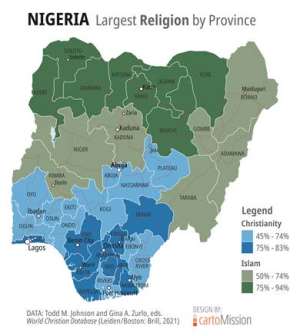
Nigeria has an estimated population of 220 million and the population is split almost equally between Christians and Muslims. With an estimated 200 ethnic groups practicing Christianity, Islam and traditional religions, Nigerià has a long history of peaceful coexistence, but it has also seen flare-ups of violence among groups, often exacerbated by ethnic divisions or conflict over scarce resources.
Economics Of Religious Violence In Nigeria
Many scholars and authorities have time and again pointed out that the primary and fundamental causesd of religious extremism and violence are found in economic reasons- struggle and competition for access, control and use of resources. Pervasive poverty, unemployment responsible for creating an environment where disenchanted youth become vulnerable and prone to radicalization by religious extremist groups. Significant resource scarcity results in competition over access, control and use of such (land, water, grazing pastures). For longer time disputes over fertile land water has been a key driver in the long- standing between predominantly Muslim Fulani herdsmen and Christian farmers in the Northern parts of Nigeria. When they clash, the clashes has a tendency of taking on a religious, ethnic dimensions and manifest as a religious - ethnic clash but in reality, the root cause is economic- fight for control and use of resources.
According to International Crisis Group in 2018, while
“the conflict is fundamentally a land-use contest between farmers and herders across the country’s Middle Belt ,”
it has taken on
"dangerous religious and ethnic dimensions-however, because most of the herders are from the traditionally nomadic and Muslim Fulani who make up about 90 per cent of Nigeria’s pastoralists, while most of the farmers are Christians of various ekkthnicities”.
Making it clear that an economic struggle for competition, access and control of pastures end up assuming an ethnic and religious dimension... passing out as a religious conflict but in essence an economic crisis.
Weak Governance As A Factor
It has been pointed out that poor or bad governance is fuelling religious extremism and violence in Nigeria.The most commonly known extremist Islamist armed group is Boko Haram. Boko Haram has terrorized northeast Nigeria, an insurgency that has killed tens of thousands of people over the past fifteen (15) years. A study by (Casimir, Nwaoga, Chrysanthus, Ogbozor, 2014) using Boko Haram as a special case study highlight that Boko Haram is not just a religious phenomenon but a reflection of a socio-economic, political and ethnic problem caused by bad governance.The same study argues Boko Haram has its roots fundamentally in poverty caused by bad governance in the Northern Moslem bend,in Nigeria and the West African Region where corruption, human rights violations, marginalization of cultural, political and religious groups have created the sitiuation whereby weak state structures have abysmally failed to deliver on the development promises made during elections.In reality, the study argues, religious dimension is just but a marginal factor, the real culprits are poverty, economic inequality and weak governance.
Genesis Of Religious Strife In Nigeria
The Kano Riot of 1953
Religious conflict in form of Christian - Muslim strife in Nigeria can be traced back to 1953, seven (7years) before Nigeria attained its independence from Britain in 1960. In May of 1953, four days of violent clashes broke out in Kano, North of Nigeria.
Why the 1953 riots?
Pace of the process of Nigerian independence was the sticking point which led to four (4) days of riots in May of 1953. Riot was a result of a major political disagreement over whether Nigeria should gain 5ygt independence immediately, as supported by the Southern ethnic groups (Yoruba and Igbo) primarily Christian,or at a later date, as advocated by the Northern ethnic groups (Hausa and Fulani) primarily Muslim.Though the riot was political, fueled by regional and ethnic tensions, it assumed a religious component in the country's struggle for self-rule. A factor which continued up to this very day especially when it comes to ethnic and religious differences. This laid seeds for future conflicts in Nigeria along religious- ethnic lines between the predominantly, Northern Hausa-Fulani Muslim people and the Southern Yoruba-Igbo Christian populations.
Is There Christian Genocide In Nigeria?
It is a fact that Nigeria especially the Northern part has been afflicted since 2009 by the scourge of terrorism and religious insurgency. Thousands have been killed, millions displaced and communities traumatized. To show how problematic this phenomenon has come for Nigeria, in 2023 and 2024 Nigeria was in the 8th position according to the Global Terrorism Index but this year, 2025, Nigeria has moved up to 6th with a score of 7.658, (IEP ,2025).
When discussing Nigeria, U.S congressman Riley Moore, alleged that there is s an “alarming and ongoing persecution of Christians ” in the west African country.The congressman stated that 7,000 Nigerian Christians had been killed in 2025 alone, an average of 35 killed a day.
Data from an independent violence monitor, Armed Conflict Location & event Event Data (ACLED) points out that " *it is difficult if not impossible, to delineate the killings based on religious affiliations* ". ACLED went on to declare that, "all religions in Nigeria have been affected, and there have been fatalities across several ethnic and religious lines ".
According to Africa Centre For Strategic Studies, since 2010 more than half of Boko Haram victims have been Muslims . It needs to be noted that *Muslims are being killed too*. Many of Boko Haram victims tend to be Muslim too.Those who are according to Boko Haram are "not Muslim enough" and those who refuse Boko Haram's fundamentalism & extremism.
In order to also answer to the question... is there a Christian genocide in Nigeria?, lets go through the statistical data given by an independent violence monitor Armed Conflict Location & Event Data Project (ACLED).
According to Armed Conflict Location & Event Data Project (ACLED)'s 2022 report, although Christians constitute roughly 50% of the population, violence explicitly targeting Christians on the basis of religion accounted for only 5% of reported civilian-targeting events, (ACLED, Fact Sheet, 2024
However, ACLED noted that violence aimed at Christians "increased by 21% in 2021 compared to 2020",(ACLED, 2022).This includes murder, as well as the abduction of Roman Catholic and Methodist clergy.
According to the Armed Conflict Location & Event Data Project (ACLED) reported that, as of 2025, just under 53,000 civilians, including Christians and Muslims, had been killed in targeted political violence since 2009, (BBC News,6 November, 2025)
Today, religious violence in Nigeria is mostly dominated by the Boko Haram insurgency, which aims to establish an Islamic state in Nigeria, (BBC News, 24 November, 2016) University of Johannesburg law professor Werner Nicolaas Nel has noted that this has resulted in the persecution of Christians in Nigeria, (Werner Nicolaas, 2020).
Explaining (US)Interests in Nigeria
Trump's outburst against Nigeria raises a lot of uncomfortable questions. Especially after the fact that it came after (US) intelligence report pointed to the fact that .terror groups like ISWAP, Boko Haram were funding their activities through illegal mining operations in conflict zones. Areas rich in gold, lithium and rare earth minerals, which are critical in global technology and defense industry.Was Trump outburst because of religion or resources? History has taught us that when that part of the world says "Freedom"- minerals are not far behind. Now Washington DC is threatening military action (war). But an African proverb teaches and warns us,
"when the drum beats for war, there is always a dancer waiting/lurking in the shadows", African Proverb.
In Libya it was about oil, in Democratic Republic of Congo (DRC) its about cobalt, in Venezuela it is about oil, now Nigeria, is it not about its lithium,gold and rare earth metals?. Minerals in the Northeast Nigeria, conflict zone, controlled by the Boko Haram. Now military action (war) is being sounded and the dancer (US) is waiting to dance and lay its imperial hands on those Nigerian resources.
From a Pan-Africanist perspective, this move by Washington DC admnstration of considering military action in Nigeria must be understood not as an act of humanitarian concern, but as a calculated manoeuver by the (US) war machine operating through its Department of Defense (often euphemistically called the Department of War) and its Africa Command (AFRICOM) to secure resource dominance, maintain strategic regional hegemony.
Creating Problems In Order To Offer Solutions With Conditions
Troubling reports have been reported for example, about Boko Haram attacks on villages.Its said sometimes when Boko Haram attacks, helicopter/s piloted by white people appear. And when these militants are captured, it's not uncommon for them to have thousands of hard cash (US dollars). All this may point to foreign funding and support for Boko Haram to cause mayhem. Recently, Scott Perry a (US) Congressman in a shocking exposure alleged that the (US) are creators and funders of most so called terrorist groups the Al Qaeda, ISIS, Boko Haram etc and many more of the so called terror organizations are being funded through the eUnited States Agency For International Aid (USAID) funds. Scott Perry alleges that an average of US $697 million is spent annually under the guise of funding development projects but in reality the money funds terrorist groups like the Boko Haram which has carried devastating aNigeriattacks in , Cameroon, Niger and Chad. This is disturbing and Africa need to be wary.
Unmasking The Dangers Of Proposed Trump Guns-a-Blazing Solution
The (US) President Donald Trump in a fiery speech against the so - called Nigeria' s failure to stop genocide of Christians promised to go in Nigeria guns-blazing, in a to use President Trump's own words fast, vicious, sweet attack/s. (US)- Nigeria conflict can be the largest in history of modern Africa.Nigeria is one of the largest economy in Africa with an estimated 230 million population. A conflict there can affect the whole of West Africa, from Nigeria to Ghana, from Mali to Cameroon.This won't augur well for West Africa and African development
Also, a number of key questions still longer on how a guns a blazing approach in form of fast, vicious, sweet attack (to use President Trump's own words) solve the problem of religious insurgency at hand. The Washington DC admnstration has to answer certain key fundamental questions on the military action it is mooting against Nigeria
Firstly, which specific place or territory in Nigeria the Americans believe there is a group called Boko Haram so that they can airstrike and bomb? Or its conviniently Northeastern Nigeria were American intelligence pointed illegal mining operations for the area is rich in resources like gold, lithium and rare earth minerals
Secondly, has President Trump consulted the Federal Government of Nigeria for permission, for intelligence so that should the strike occur it will be a coordinated strike? For Africa needs collaboration not command to help it address it's challenges.
Thirdly, have Americans understood what Boko Haram is, what it stands for? Experience and history has shown that military supremacy cannot defeat ideology, Vietnam, Afghanistan are all practical lessons.
For Boko Haram is an ideology. An ideology held by people embedded in communities, in families. Going out guns a blazing without knowing the real intriguing issues will bring destruction of infrastructure, unnecessary loss of lifes defeat and humiliation. Have the Americans not yet learned the bitter lesson that you can defeat people who are ideologically inclined.... Vietnam, Afghanistan all are the bitter lessons.
Guns a blazing approach wont solve the problem of religious violence in Nigeria. What is guranteed should this guns a blazing approach go forward is destruction, destabilisation of West Africa and emboldment of insurgency groups. Look at the destruction visited upon Iraq, Libya, Syria, Yemen, all in the name of fighting terrorism.
Offcourse, airstrikes and bombing may silence an extremist group but surely it won't address a system creating religious extremism and violence that is, unemployment, poverty, inequality and bad governance.
Can airstrikes and bombs strike out or bomb out poverty, economic inequality, resource scarcity from part of this world? Or it will simply exarcabate and complicate an already complex conflict - definitely such a way would not address the problem but only to leave a deeper wound. And Africa in particular and the world in general ought not to forget the Libya disaster, when North Atlantic Treaty Organization (NATO) convinced the world that it was bombing dictatorship out of existence by bombing Gaddafi Libya...what happened afterwards to Libya...is it now much safer, much secure, much stable, much prosperous? What gurantees are there that after (US) or President Trump's fast, vicious, sweet attack/s , Nigeria will be cleaned of it's religious insurgencies. Africa does not need another Libya disaster.The case of Libya is a practical example which Africa needs to take note and be wary of on the dangers of Trump proposed military action in addressing Christian security problem in Nigeria.
Nigeria, just like the rest of Africa need partners who cooperate with her in addressing her security challenges like this Nigerian christian quagmire. Sadly, what President Trump's actions in response to the christian killings in Nigeria is not paternship but it is paternalism and Africa does not need that at this juncture.
The idea that (US) can march in any country.. .African country for that matter, uninvited to solve problems in that country is not dialogue or cooperation,which should be the standard of sovereign nations of Africa in particular and the world in general. What Africa needs at the moment are not saviours, Africa needs solidarity, strategy and strength from within. Africa needs partners who collaborate not masters who command....like exactly what President Trump is doing. Africa needs no foreign takeovers but allies.
The danger is that, the moment a superpower like (US), frames an African crisis like the Nigerian christian persecution and unconvincingly and inadequately reduces it to battle between good & evil, then, that superpower automatically position itself as a saviour (which off course is not true). Africa needs no saviors, what Africa needs is solidarity in addressing her plethora of problems. The problem is when a so called savior appears, sovereignty becomes negotiable, and the results are more harm than good.
Global attention is fine but what is needed in Nigeria is African solution grounded in understanding of African realities. Experience has shown that when Africa bleeds, the world rushes in not only to help but to control, to manipulate and to exploit and even make the wound deeper.This is why Africa should be careful and push back against Washington DC proposed military action in Nigeria. Trump first wrongly claimed "White farmer genocide" in South Africa and now its claim of " Christian genocide in Nigeria". A pattern is now clear... first it was South Africa, Africa's largest economy threatened for "white farmer genocide", now Africa's most populous country, Nigeria, is being threatened with guns - a- blazing by the same Washington admnstration of Donald Trump. Whats going on? Are we missing something?Two of the most significant African powerhouses threatened with economic sanctions by (US) Is Trump really trying to protect Africa or cripple it?
Conclusion
This religious conflict in Nigeria is not just about faith but about resources.This conflict can't be simply reduced to good versus evil or Christianity versus Muslim. Doing so means loosing the jist and essence of this conflict. Relegating everything to faith is loosing sight of real key drivers of the conflict which are poverty, competition for resources, land, water, pastures in the context of weak governance and absence of justice. These are the key drivers of religiuous insurgency in Nigeria.This Nigerian problem is a religious problem as much as it is an economic and political one. Proposed Trump's fast, vicious and sweet attack/s wont resolve religiuous insurgency in Nigeria or any part of Africa for that matter. Foreign bombs or airstrikes wont strike out or bomb out poverty, economic inequality, competition for resources or absence of justice. Therefore, (US) and Washington admnstration need to rethink, reassess, and reconsider the perilous path of military action Trump is proposing in dealing with Nigerian religious conflict. And Africa need to be wary of those acting or purporting to save her, their intentions may not be sincere and humanitarian after all.
F. Madondo (African Teacher) [email protected]
References
Ani Casimir, C. T. Nwaoga, Rev. Fr. Chrysanthus Ogbozor, Religion, Violence,Poverty and Underdevelopment in West Africa: Issues and Challenges of Boko Haram Phenomenon in Nigeria. Open Journal of Philosophy
Vol.04 No.01(2014), Article ID:43300,8 pages 10.4236/ojpp.2014.41009
"Donald Trump says Christians are being persecuted in Nigeria - is he right?". BBC News. 2025-11-06.
"Fact Sheet: Attacks on Christians Spike in Nigeria Alongside Overall Rise in Violence Targeting Civilians | ACLED". acleddata.com. 2024-03-15.
Cite error: The named reference ACLED, 2022 was invoked but never defined, O'Connor, Tom (6 November 2025). "
"Who are Nigeria's Boko Haram Islamist group?". BBC News. 2016-11-24.
Nel, Werner Nicolaas (29 December 2020). Grievous Religious Persecution: A Conceptualisation of Crimes Against Humanity of Religious Persecution. Wipf and Stock Publishers. p. 33. ISBN 978-1-7252-9514-8.

 Adu-Boahene’s lawyers ask court to strike out fabricated, invented evidence in D...
 'He is part of National Film Authority' – Kwasi Kwarteng exposes Obuasi SHTS hea...
 'Mahama should have appointed Edudzi Tameklo to EC to teach hypocrite NPP some s...
 'You have no moral right to complain about cost of living' – Prof Anankware to B...
 'You did the same thing' – Solomon Owusu defends EC appointment
 GFL vows to pursue justice for worker who lost five fingers at Afienya Industria...
 State to call first witness on January 12 in Canadian murder case
 Haruna Iddrisu refers Obuasi SHS headmaster's sexual misconduct allegations to C...
 Bawumia is a ‘prophet of pocket economy’ in opposition, ‘priest of paper economy...
 Bolgatanga Technical University Council Chairman allegedly locks up Vice-Chancel...


