




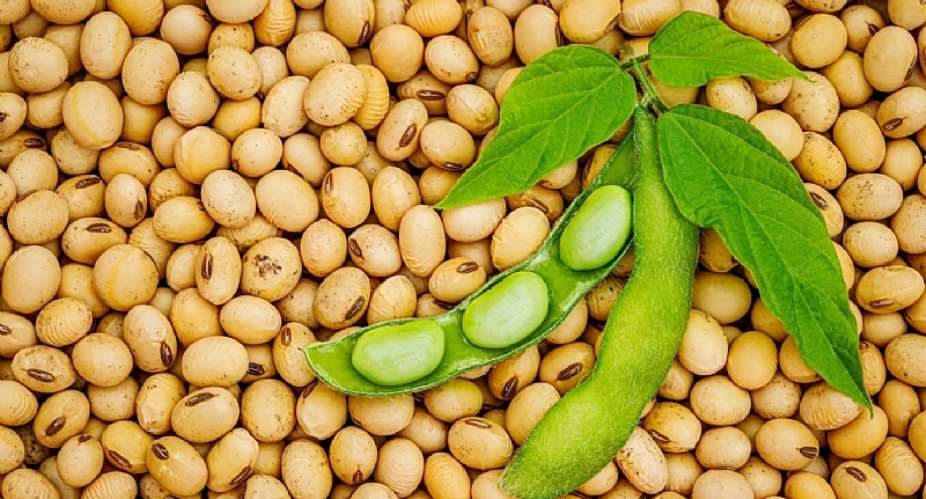
In Ghana, the cultivation and consumption of soybean (Glycine max) present significant opportunities for improving nutrition, enhancing small-holder incomes, and promoting sustainable agriculture.
Nutritional value
Soybeans are a rich source of plant-based protein, providing essential amino acids. In rural Ghanaian households, soy can help fill the gap where animal-source proteins are limited. Beyond protein, soybeans contribute other nutrients (e.g., fats, fiber, micronutrients) and therefore serve as a relatively inexpensive way to improve dietary quality.
The crop is being utilized in Ghana not only for direct human consumption (soy flour, fortified foods) but also for animal feed, which helps strengthen livestock/poultry value chains, thereby indirectly improving food security. From a growth-development perspective, improving the diets of children, pregnant and lactating women by including soybean products can help reduce malnutrition, stunting and micronutrient deficiencies, especially in rural areas where diets are limited.
Agricultural and environmental benefits (which also support growth/development)
Soybeans fix atmospheric nitrogen via their root nodules, helping to improve soil fertility. This is particularly relevant in Ghana, where many soils are nutrient-depleted. For example, one study in northern Ghana noted soybeans’ role in improving soil fertility and thus benefiting subsequent crops. Crop rotation or inter-cropping with soybean can reduce reliance on expensive inorganic fertilizers, thereby lowering input costs for smallholder farmers and improving sustainability. Soybean residues can serve as livestock feed or organic matter return to soil, thereby strengthening mixed farming systems and increasing resilience.
National & societal benefits
The cultivation and processing of soybean contribute to national food security, nutrition security, and help diversify agricultural production beyond traditional staples. By stimulating local agro-processing (soy flour, soy snack products, animal feeds), soybean production offers opportunities for job creation especially for youth and women and for value addition within Ghana rather than simply exporting raw crops.
Economic & income-potential for farmers
Scale of production and market opportunity
Ghana has an estimated potential annual production of around 700,000 metric tons of soybean, but actual production is significantly lower (about 250,000–350,000 tones in recent years). Current cultivated area is far below the land deemed suitable (e.g., 102,000 ha used vs. 250,000 ha suitable in one assessment). Local demand is growing both for direct consumption and for livestock/poultry feed. Ghana even imports soy-meal worth millions of dollars because domestic processing capacity and supply are inadequate.
Income per farmer / per hectare
A study in the Upper West region looked at small-holder soybean farming and found: average marketed output 731.73 kg/ha, average price GH₵1.62/kg (in that dataset) giving total revenue GH₵1,185.40/ha. Variable costs GH₵1,005.10/ha so gross margin GH₵181- GH₵191/ha in some districts; net margin GH₵172/ha.
When non-market benefits (e.g., soil fertility, home consumption) are included, the “overall economic benefit” for households rises significantly. In one district it was GH₵808.70/ha; returns on investment up to 68% in some cases.
Another data point: a report indicated average total income per acre from soybean for surveyed farmers was GH₵1,937 (USD 201 at the time) for one survey.
Implications
Although per hectare returns are modest in the low-input systems; soybean offers a genuine income-earning crop for smallholder farmers. With improved inputs, yields and markets, income can become more substantial. The fact that soybean improves soil fertility means that even when returns from the soybean itself are moderate, the follow-on benefit to other crops boosts overall farm profitability.
Given the large untapped potential (both in land and yield) and growing demand for soybean both domestically and for export/processing there is scope for incomes to increase if value-chain bottlenecks are resolved.
Growth development in Ghana: broader impact
From a rural development perspective, increased soybean production helps shift smallholder farmers into more diversified cropping systems rather than mono-cropping cereals, which can help enhance resilience, reduce hunger, and stabilize incomes. By linking soybean to agro-processing (soy flour, snack foods, feeds), Ghana can capture more value locally, create jobs (especially for women and youth), boost rural enterprise development and reduce rural-urban migration.
With improved incomes and nutrition, households are better placed to invest in health, education and productive assets supporting human development outcomes. Environmentally, better soils, improved crop rotations and reduced reliance on heavy fertilizer input help promote sustainable agriculture a key element of growth with long-term viability.
Challenges & constraints
Low yields: Yields in Ghana are significantly below potential (often 1.2-1.5 t/ha versus potential 3-3.5 t/ha) owing to limited improved varieties, inadequate inputs, mechanization, and climate-risks. Access to improved seeds, inoculants, and mechanization and extension services remains limited for many smallholder farmers. Post-harvest handling, storage, processing and linkages to reliable markets are weak. This reduces profitability and increases risk for farmers.
Value chain constraints: Even though there is demand, local processing capacity is still limited; Ghana exports raw soybeans and imports soy-meal, meaning lost value-addition opportunities.
Market fluctuations and input cost/risk: without secure contracts, farmers face price risk; costs of inputs, labour and mechanization can erode margins. Climate change and soil degradation remain pressures in many savannah zones of Ghana, affecting consistency of production.
Recommendations for scaling and maximizing benefits.
- Improve yields: Invest in improved soybean varieties, better seed systems, inoculation (for nitrogen fixation), and mechanization (land preparation, harvesting) and extension.
- Strengthen value-chain linkages: Develop local processing for soy-flour, snack foods, animal feed; ensure stable market contracts for farmers; promote agribusiness for women and youth.
- Promote crop rotation and integrated farming: Encourage soybean inclusion in cropping systems not only for its market value but for soil fertility improvement and sustainability.
- Enhance nutrition programming: Integrate soybean into school-feeding programs and small-scale processing to promote its consumption for improved health outcomes.
- Support access to finance and storage: Ensure farmers have access to credit, warehouse receipt systems, and improved storage to reduce post-harvest losses and improve bargaining positions.
- Policy support & investment: The government and development partners should prioritize soybean as a strategic commodity given its promise for nutrition, incomes and export potential.
- Market and export development: Ghana should aim to raise production closer to potential, build processing capacity and capture more value domestically rather than exporting raw soy or importing soy-meal.
Conclusion
Soybean in Ghana holds triple-benefit potential:
Improving human nutrition and health, especially for vulnerable rural households; Boosting smallholder incomes and rural livelihoods; and Enhancing sustainable agricultural systems (soil fertility, crop diversification) and national economic growth via value-chains and exports. While current yields and incomes are modest, the large untapped potential and growing demand mean that with the right investments and support, soybean can play a transformative role in Ghana’s agricultural and rural development agenda.
Mustapha Bature Sallama
Medical/Science communicator ,Private Investigator, Criminal Investigation and Criminal Analysis
International Conflict management and Peace Building. Alumni Gandhi-King Global Academy United State Institute of Peace Building USIP


 Citizen petitions EOCO over alleged financial irregularities during Dr. Frank Ba...
 November 28: Cedi closes trading at GH¢12.50 on forex market, GH¢11.85 on BoG in...
 Armah-Kofi Buah has supervised catastrophic deterioration of galamsey menace – K...
 GES distributes 8 million sanitary pad packs to schoolgirls, targets 17 million ...
 Ablakwa must name accounts used for GH¢49.7m South Africa evacuation funds – Asa...
 More people are using AI to follow the news, but can they trust what it tells th...
 Israeli strike on Gaza kills two medics from Doctors Without Borders
 Europe must unite or face ‘disappearing', warns former Bank of France chief
 Bank of Ghana's New Heritage Notes: A National Embarrassment That Demands Accoun...
 Consumer Protection Agency CEO Kofi Kapito dies


