




“My people perish for lack of knowledge.” — Hosea 4:6
“The borrower is slave to the lender.” — Proverbs 22:7
“Write the vision and make it plain.” — Habakkuk 2:2
The clock is ticking, and the race is on. A new time is coming, and an old one will be reborn. The federal government may have shut down this week, but make no mistake — that’s not the real story. Washington gridlock is only the smoke. The real fire is burning beneath the surface, where the same old structure keeps defining who rises, who stalls, and who falls. This moment is not simply about budgets — it’s about power, ownership, and the reawakening of a people who once built thriving economic ecosystems before the nation ever offered them a seat at the table.
For more than 60 years, since African Americans were finally allowed full access to the ballot and public life, the promise of equality has too often been packaged in new chains. Economic dependency replaced forced labor. “Diversity” replaced true ownership. We fought to enter the building, not realizing they had quietly moved the boardroom upstairs.
Today’s distraction is political chaos. But the true emergency is economic memory loss.
While the oversaturation of sports, reality shows, trending skits, and celebrity drama numbs our collective attention, we must wake up. Entertainment has become both brilliance and blindfold — a cultural gift and a civic sedative. Meanwhile, our power sits quietly in the place America respects most: the dollar.
The Good Side of Segregation — and the Lesson It Left Us
Before forced integration, Black America did not wait for permission to build. Durham’s Black Wall Street. Tulsa’s Greenwood. Little Rock’s Ninth Street. Macon, Birmingham, Memphis, Chattanooga. Ninth Street in Junction City, Kansas. Augusta, Georgia. Wichita. Wherever we gathered, we built banks, stores, theaters, schools, farmlands, funeral homes, newspapers, taxi companies, doctors’ offices, dance halls, baseball teams, and bus lines.
America, before our cultural contribution, was bland — socially, musically, and spiritually. Our existence enhanced it, yet our economic autonomy threatened it.
The U.S. government did not always assist its Black citizens; we assisted ourselves. Church credit unions, mutual aid societies, community savings circles, and farmers’ cooperatives were our safety nets long before Washington discovered “equity.”
History reminds us: our true strength was never in access. It was always in agency.
So if America can turn the clock back on progress, we reserve the right to turn ours back to community-centered economics — not for nostalgia, but for strategy.
Economic Boycotts Work — Five Proven Examples
Economic withdrawal has always been a weapon of dignity and discipline:
- Montgomery Bus Boycott (1955-56): 381 days — no timeline, just resolve — changed federal segregation law.
- Delano Grape Strike (1965-70): Latino and Filipino farm workers reshaped labor rights through sustained boycott pressure.
- South Africa Anti-Apartheid Sanctions (1980s): Global divestment helped topple apartheid.
- Woolworth Sit-Ins (1960 Greensboro): Student-led action forced corporate desegregation.
- Georgia NAACP Economic Boycott (1990s): Targeted spending freeze helped remove white supremacist symbols and shift local power dynamics.
Not hashtags. Not slogans. Economics.
If the Montgomery movement waited for convenience, we would still be at the back of the bus. Sweat equity was the litmus test then — and discipline must be the litmus test now.
BLACKOUT 2025: A Modern Turning Point
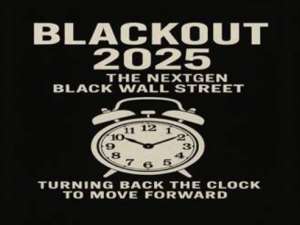
Beginning November 25 through December 2, 2025, Black America will execute a peaceful, powerful economic pause. No Halloween binge. No Black Friday frenzy. No Cyber Monday clicks. No Christmas warm-up shopping.
If you must spend — spend local, buy Black, buy small.
This is not anger — it’s alignment. Not protest — purpose. Not hate — self-respect.
Because every dollar is a vote. And far too often, we’ve been voting against our future with our own wallets.
Corporations profit from our culture, our creativity, our voices, and our influence — yet rarely invest in our upward mobility. Schools crumble, grocery deserts spread, Black-owned banks remain limited, farmland shrinks, and the same communities that fuel the economy reap crumbs from the banquet table.
So for one week, we say: Pause. Re-center. Redirect.
From Boycott to Blueprint
Imagine a trillion-dollar spending community deciding to grow its own gardens again — economic, educational, technological, agricultural, and spiritual. Imagine community banks swelling. Imagine small businesses doubling revenue in seven days. Imagine young people watching adults choose discipline over distraction.
That vision is not a dream — it is a return.
A return to West Ninth. To Greenwood. To Jefferson Avenue. To Parrish Street.
To Beale Street. A return not to segregation, but to self-determination.
The next blackout will not be temporary. It will be foundational — a permanent ecosystem shift.
Black Wall Street never died — it was attacked. Bombed. Burned. Buried under highways and urban renewal — “Negro removal” by ink and eminent domain. But seeds survive fire, and this thought will ignite change.
This time, we’re rebuilding with broadband and blockchain, not bricks alone — with discipline, digital banking, cooperative economics, land trusts, and generational literacy.
The Outcome: A New American Dawn
We are not withdrawing from America. We are withdrawing from dependency.
We are not isolating. We are insulating.
The federal shutdown is political theater. Our blackout is an economic reality.
We hold the receipts — and soon, America will feel the missing revenue.
“Faith without works is dead.” — James 2:26
Blackout 2025 is not just a week — it is a warning shot and a warm-up drill.
Because this time, the currency isn’t just green. It’s melanated. And melanated money moves differently; it's self-sustaining.
ABOUT THE AUTHOR
Edmond W. Davis is an American Social Historian, Speaker, Collegiate Professor, International Journalist, and former Director of the Derek Olivier Research Institute. He is an expert on various historical and emotional intelligence topics. He’s globally known for his work as a researcher regarding the history of the Tuskegee Airmen and Airwomen. He’s the Founder and Executive Director of America’s first & only National HBCU Black Wall Street Career Fest.

 Ayariga challenges BoG to cite law behind arrests over cedi money bouquets
 Trump targets tax-free diesel as Republicans approach midterms
 Govt releases GH¢9.1 billion covering six quarters of DACF to MMDAs - Ayariga
 Manhyia South MP charged over alleged GH¢9.85m loss to SIC Life
 'I didn’t know the process would be that fast' – Nana B explains missing NPP swe...
 'Who is Karbo to defy my orders?' – Buttey fumes over NPP conference clash
 'Kojo Bamba can’t stop NDC' – Gbande warns NPP against shielding anyone from arr...
 Mahama pardons 863 convicted persons, 11 from death sentence
 NDC confirms Dzifa Gunu’s disqualification from La Dadekotopon constituency secr...
 Nigeria's Tinubu confirms 32 dead after military plane crash


