




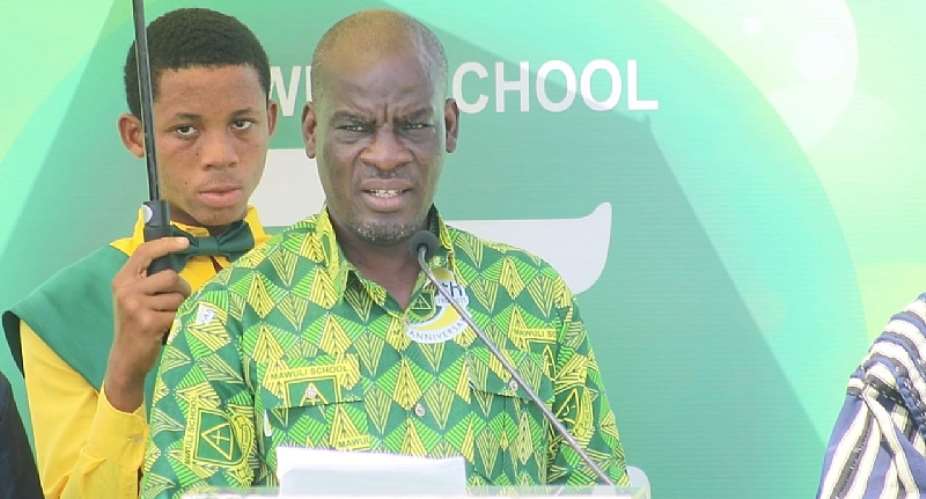
At the heart of Ghana’s education transformation stands a renewed call that speaks not just to policy but to identity. During the 75th Anniversary Celebration of Mawuli School in Ho, Minister for Education, Hon. Haruna Iddrisu, reaffirmed the government’s unwavering commitment to promoting local language instruction in basic schools. His message was clear and profound: for Ghanaian children to learn effectively, they must first be taught in a language they understand.
The Minister’s declaration comes as part of the government’s broader Reset Agenda, a national effort to reform basic education, strengthen foundational learning, and restore the culture of excellence in Ghanaian schools. Citing both research and experience, Hon. Iddrisu emphasised that teaching in the mother tongue improves comprehension, nurtures creativity, and builds confidence among pupils who often struggle when introduced too early to a foreign language.
“A child who learns in his or her mother tongue grasps faster, understands better, and grows in confidence.”
— Hon. Haruna Iddrisu, Mawuli @ 75
Beyond Language – Restoring Cultural Pride
In addition to his call for local language instruction, Hon. Iddrisu also touched on issues of personal identity and cultural pride, stressing the need for schools to move away from outdated colonial standards that suppress cultural expression. He particularly mentioned the issue of female haircuts, urging schools to stop the practice of forcing female students to cut their hair short as a sign of discipline.
According to the Minister, grooming and neatness should not be confused with uniformity. He maintained that students can keep their natural hair in a tidy and respectful manner without being compelled to conform to arbitrary rules that strip them of confidence and individuality. This statement has since sparked nationwide discussions on gender equality, personal freedom, and cultural self-expression within the education system.
“Let our girls wear their confidence with pride — whether their hair is short or natural, neatness is not defined by conformity.”
— Hon. Haruna Iddrisu
A Return to Roots, A Leap Toward Progress
For decades, Ghana’s classrooms have faced an invisible barrier: language disconnect. Many pupils begin their education in English, a language foreign to their daily lives. This early struggle contributes to low literacy rates, poor comprehension, and, in some cases, school dropout. Haruna Iddrisu’s remarks echo global studies and national data which show that children who learn in their first language during the early years develop stronger literacy and numeracy skills than those who do not.
Reports from the Ghana Broadcasting Corporation (GBC) and Graphic Online confirm that the Ministry is enforcing the use of local languages as the medium of instruction at the basic school level. The Minister has also revealed plans to revise outdated textbooks and produce new learning materials in Ghanaian languages such as Ewe, Twi, Fante, Ga, and Dagbani, ensuring that no child is left behind due to linguistic or cultural barriers.
CREP’s Position
The Centre for Research, Education and Policy (CREP) commends this visionary initiative as a bold and necessary step toward inclusive and equitable education. Language and culture, CREP asserts, are not merely tools for communication or appearance; they are the foundation of thought, identity, and belonging. By valuing local languages and embracing natural identity, the Ministry is restoring confidence in the Ghanaian child and affirming that learning is most effective when it begins from the learner’s own cultural and linguistic context.
However, CREP acknowledges that policy without structure is aspiration without impact. The success of these initiatives will depend on the ability of the Ministry of Education and the Ghana Education Service to address several pressing challenges, including:
1. Inadequate teaching and learning materials in many indigenous languages.
2. Limited teacher training and proficiency in the languages of their regions.
3. Multilingual classrooms in urban centres that require adaptable teaching models.
4. Insufficient investment in linguistic research and curriculum development.
5. Lack of uniform policy guidance on student grooming, especially regarding natural hair.
To overcome these barriers, CREP calls for a national framework on local language instruction and cultural inclusion, supported by teacher training colleges, universities, and language experts. This framework should ensure the development of culturally relevant learning materials, the standardisation of orthographies, and the integration of local language and identity-based pedagogy into teacher education curricula.
From Policy to Practice
The success of this vision also depends on public support. Parents and guardians must see indigenous languages and cultural identity not as barriers to global competitiveness but as bridges to understanding and intellectual growth. Studies by UNESCO have repeatedly shown that bilingual and multilingual learners grounded in their first language — and comfortable with their cultural identity — often achieve higher academic success when transitioning to second languages like English.
CREP therefore urges families, community leaders, and local assemblies to champion mother-tongue education and cultural pride both at home and in schools. Encouraging children to speak, read, and write in their native languages while respecting their natural appearance fosters pride, identity, and cognitive development.
The Promise of the Reset Agenda
Hon. Haruna Iddrisu’s speech at Mawuli @ 75 was not just a ceremonial address; it was a declaration of purpose — a pledge to reform how Ghana educates and empowers its children from the ground up. His emphasis on foundational learning, local language use, and respect for student identity aligns with the Reset Agenda’s goal of rebuilding public confidence in Ghana’s education system.
The policy’s implementation will undoubtedly face challenges, but its intent is deeply transformative: to ensure that every Ghanaian child, regardless of location or background, begins their learning journey in a language they know, understand, and cherish — and in an environment that respects who they are.
“When we teach our children in the language of their heart, and let them wear their culture with pride, we teach them to believe in themselves.”
— CREP Statement
CREP stands ready to collaborate with the Ministry of Education, the Ghana Education Service, and development partners to monitor, evaluate, and support this vital policy. The Centre also commits to conducting research on its impact across regions to guide continuous improvement.
As Mawuli celebrates its 75 years — a symbol of discipline, excellence, and transformation — the nation is reminded that true progress in education begins with understanding. And understanding begins with language, identity, and pride.
By Centre for Research and Education Policy (CREP)

 Attorney-General appeals ruling halting trial of former Buffer Stock CEO, wife
 NAIMOS destroys 1,970 changfans, 863 Illegal mining structures in three months —...
 Let's see how Asiedu Nketia becomes NDC flagbearer with same people he conspired...
 Asiedu Nketiah opts out of NDC chairmanship race amid flagbearership speculation
 NDC insists Nkwanta North elections will proceed despite court injunction
 'My side of the story will shock you; I'm waiting for court days' – Obuasi SHTS ...
 Obuasi SHTS sexual abuse: 'GES must distant itself, allow the law to work' — For...
 Upper East: Fear grips nine Kusaug communities over mysterious fish deaths in da...
 NDC suspends Amasaman Communications Officer over 'irresponsible' remarks on Obu...
 Parliament secures religious leaders’ support to end witchcraft accusations


