




The Vision
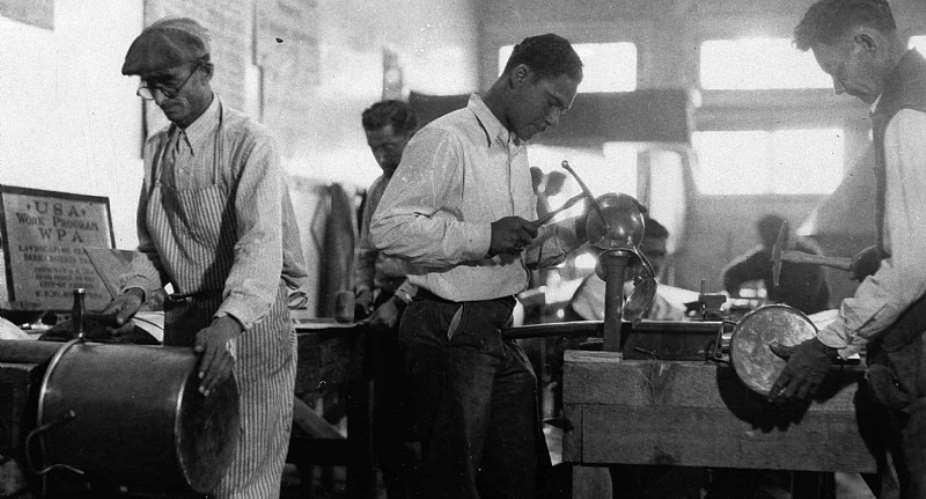
After independence, Ghana under Kwame Nkrumah (1957-66) embraced a model of “African socialism” that sought to break from colonial economic structures and foreign dependency. Some of the key features were:
Large-scale state ownership of enterprises, nationalization of key industries or major public enterprises.
Heavy investment in social services (education, health, infrastructure) with the state playing the primary economic role.
Import substitution industrialization (ISI) attempting to build domestic manufacturing rather than just export raw commodities.
Emphasis on pan-African solidarity, self-sufficiency and reducing foreign (especially former colonial) control of the economy.
The Implementation & Outcomes
The 1963/64-1969/70 “Seven-Year Development Plan” in Ghana was one such effort to modernize via state-led investment.
For example, the government created state farms via the “State Farms Corporation” to boost agriculture under socialist logic.
But despite the high ambition, results were mixed: external reserves declined, output stagnated or declined in certain sectors, and the macro-economic position weakened.
The Challenges & Critique
Some scholars argue that the socialist model in Ghana (and elsewhere in Africa) failed because of structural constraints: weak institutions, commodity dependence, external shocks, and inefficient state enterprises.
The heavy state role often led to bureaucratic expansion, resource misallocation, and vulnerability when commodity prices fell.
Key takeaway
The socialist “hitmen” period in Ghana (and by extension parts of West Africa) was driven by high ideals economic independence, social welfare, state-led industrialization but often ran into practical constraints: fiscal pressure, foreign debt, global commodity cycles, and governance issues.
The Capitalist/Neoliberal Turn: Market Liberalization & Structural Adjustment
The Shift
By the late 1970s and early 1980s, many West African states (including Ghana) faced severe economic crisis falling commodity prices, debt burdens, stagnant growth. In Ghana, under Jerry Rawlings’s administration in the 1980s, the government adopted the International Monetary Fund (IMF) and World Bank sponsored structural adjustment programmes (SAPs) that emphasized market liberalization, privatization, reduced state sector, and deregulation.
Also, Ghana later embraced “antcolonial capitalism” as part of its paradigm shift: moving from socialism to a market-led development theory.
The Features
Reduction of the size and role of state enterprises, increased private sector role.
Trade liberalization, deregulation, emphasis on export growth, foreign direct investment.
Fiscal austerity: cutting state spending, reducing subsidies, often raising user-charges for formerly public services.
Impacts & Critiques
Some positive signs: Ghana saw export earnings improve, inflation in specific years decline, and growth in certain sectors.
But major issues: social services were cut, unemployment and informalization rose, inequality increased, and many ordinary people experienced hardship as a result of the adjustment.
Critics argue that the capitalist “hitmen” model, especially when externally imposed, entrenched dependency and left many low-income groups vulnerable.
Key takeaway
The market/ capitalist phase was characterized by liberalization, privatization and the retreat of the state from many areas. While it brought structural change and some macro-economic stabilization, for many citizens it also meant rising vulnerability, cutbacks in social protections, and shifting burdens.
Duality & the “Two Hitmen” in Practice
In Ghana and broadly in West Africa, one can view the economic policy history as a sequence (or sometimes overlap) of two “hitmen” (metaphorically):
A socialist hitmen: state-led, welfare-oriented, anti-colonial, heavy public investment.
A capitalist (or neoliberal) hitmen: market-led, privatize-and-liberalize, and external-finance-driven.
These models were not purely sequential cleansed of the other; rather, hybrid combinations occurred. For example:
Even during the first socialist era under Nkrumah, there were free-market tendencies and export reliance.
During the market liberalization phase under Rawlings and beyond, some social policies were retained (wage supports, state involvement) even as the trend shifted.
Thus, the two “hitmen” operate as contrasting frameworks but with considerable interplay and overlap.
Specific Examples in Ghana & West Africa
Ghana
Under Nkrumah: Nationalization, state farms, large industrialization plans.
Post-1966 coup (when Nkrumah was overthrown): successive governments tilting more to external finance, liberalization.
Under Rawlings (from 1983): Embrace of IMF/World Bank SAPs, deregulation, private sector emphasis.
West Africa (more broadly)
While Ghana provides a clear case, the pattern is similar across other West African states: initial post-independence experiments with socialist or state-led development, followed by structural adjustment and market reforms as crisis hit, often under the guidance of external lenders. For example, the general literature on African socialism vs. capitalism emphasizes this pattern.
Why This Matters
Ideological framing: The conflict between socialism and capitalism in West Africa is not just abstract it shaped how states organized production, distribution, trade, and welfare.
Policy legacies: Decisions made decades ago (state-enterprises, infrastructure investment, export orientation, debt accumulation) still colors today’s economic realities (public debt, infrastructure deficits, informal sector size, vulnerability of youth employment).
Balance and trade-offs: The socialist model emphasized equity and social welfare but often had low efficiency and heavy fiscal cost. The capitalist/neoliberal model promised growth and export, but often at the cost of social protections and increased inequality.
Dependency and sovereignty: Many of the shifts (especially to neoliberalism) were driven by external pressures (debt, commodity shocks, conditionality). This raises questions about how much control states really have over their economic trajectories.
Critical Reflections & Current Relevance
One must avoid simplistic “failure vs. success” narratives: both models had successes and failures, and both were shaped by external constraints (commodity prices, colonial legacies, global finance).
In Ghana, the combination of state-led investment with later market liberalization suggests that pure socialism or pure capitalism rarely operated in isolation. Instead, mixed economies with shifting emphasis were the norm.
Currently, debates in Ghana (and West Africa) still carry echoes of these two frameworks: Should the state invest massively in industry and infrastructure? Or should the private sector and markets lead? How to finance social services? Which role for foreign capital?
Recognizing the two “hitmen” can help policymakers and citizens ask: Which model fits current conditions? How to balance growth with equity? How to preserve sovereignty while engaging global markets?
Conclusion
In Ghana (and broadly in West Africa), the economic story over the past decades can be viewed as the interplay of two major ideological/policy frameworks: one rooted in socialism, state-led development and social welfare; the other rooted in capitalism, markets, liberalization and private enterprise. Each was a kind of “hitmen” in its own right pursuing transformative change, but also engendering new challenges and trade-offs.
Understanding this duality helps illuminate why Ghana’s economy is in its present state: the successes and the struggles both reflect legacies of both socialist and capitalist economic paradigms. For those seeking deeper reform, it is essential to recognize that neither framework alone offers a silver bullet the key lies in adapting, blending, and innovating based on local context.
By Mustapha Bature Sallama
Medical / Science Communicator
Private Investigator, Criminal Investigation and Intelligence Analysis
International Conflicts Management and Peace Building
Alumni Gandhi- King Global Academy, United State Institute of Peace USIP
[email protected]
+233555275880

 Germany’s far-right AfD landslide winner in key Saxony-Anhalt vote, early result...
 'The height of absurdity' — Ayew Afriye slams BNI over invitation of Efya Royal ...
 US envoys arrive in Moscow to thrash out plan to end war in Ukraine
 'Chief Justice was talking as a citizen; you have to look at the context in whic...
 Mandatory towing to remove broken-down, stationary vehicles from roads to begin ...
 Domelevo backs OSP probe into alleged GH¢70,000 payment to Appiagyei despite den...
 WAEC releases 2026 WASSCE results, cancels entire results of 861 candidates for ...
 Baffour Agyeman-Duah explains why profitability may not be only reason behind SO...
 5-year-old girl dies after falling into water-filled manhole at Winneba
 Sierra Leone ex-president to return after treason case dropped

