




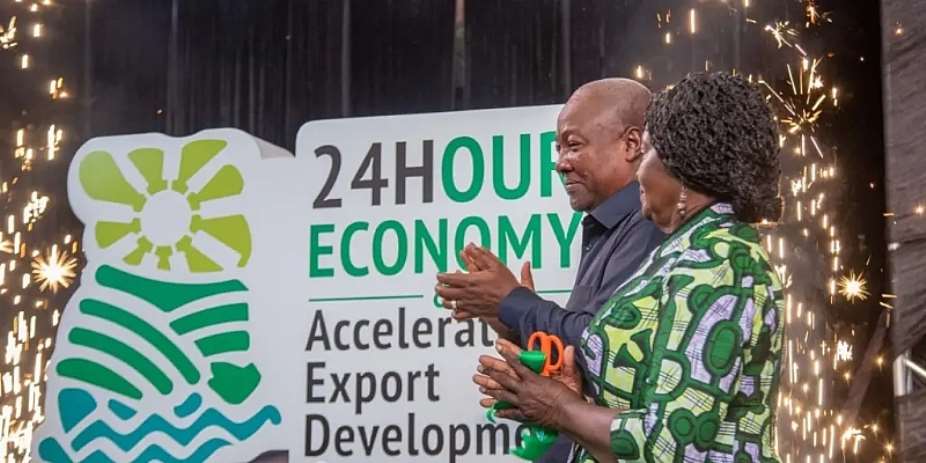
The Alliance for Development and Industrialization (ADI) has urged the Government of Ghana to strengthen its collaboration with the Government of Germany and the KfW Development Bank to accelerate the implementation of the 24-Hour Economy initiative through agriculture, agro-processing, and renewable energy development.
According to ADI, Ghana’s 24-Hour Economy—an initiative designed to boost productivity, industrial expansion, and job creation—can only be sustained if powered by reliable, affordable, and renewable energy sources such as solar and biofuels, supported by robust agro-industrial value chains.
“Germany and KfW have long played a crucial role in Ghana’s development story,” said Dr Richard Mensah, Convenor of ADI. “They have helped modernize our agricultural systems, strengthened technical and vocational education, and established major institutions such as the Development Bank Ghana (DBG) and the Outgrower and Value Chain Fund (OVCF). These are exactly the kinds of partners Ghana needs to advance its 24-Hour Economy.”
Dr Mensah explained that ADI is advocating for the expansion of Germany’s successful KfW Outgrower and Value Chain Fund, which has provided financing and technical support to smallholder farmers and agribusinesses. He said the initiative should be broadened to cover high-value commodities such as palm, coconut, citrus, and other tropical fruits that can drive industrialization, add value to exports, and create jobs.
He further noted that the expansion should include value addition, processing, and export linkages to ensure that farmers and local processors benefit directly from international markets while creating sustainable employment opportunities in rural communities.
Dr Mensah stressed that a true 24-hour production and service system depends on renewable energy. He said solar farms, mini-grids, and biofuel systems could provide affordable and clean energy to agro-processing zones, cold-chain facilities, and rural industries, reducing production costs and ensuring continuous operations.
“The 24-Hour Economy must be powered by clean, renewable, and low-cost energy that enables factories, farms, and logistics hubs to operate efficiently around the clock,” he stated. “This will make Ghana’s exports more competitive and environmentally sustainable.”
Germany remains one of Ghana’s most reliable development partners, having supported agricultural modernization, technical and vocational education, renewable energy projects, and industrial financing through the Development Bank Ghana.
ADI believes that building on this foundation through a formal Ghana–Germany–KfW partnership would create a unified framework to promote agro-industrial zones, renewable energy infrastructure, and export-oriented manufacturing.
Dr Mensah said such a partnership would expand agricultural and value chain financing through the OVCF, develop agro-processing industrial parks powered by renewable energy, and promote exports of palm, coconut, citrus, and other fruit-based products. It would also enhance youth training and enterprise support through technical and vocational education programs.
“Germany and KfW have the technology, expertise, and capital to make Ghana’s 24-Hour Economy a global model,” Dr Mensah concluded. “With the right partnership, Ghana can transform from a raw commodity exporter into a renewable-powered, industrialized, and inclusive economy.”

 Rihanna Hails Mahama's UN Address During Warm Encounter in Barbados
 Citizen petitions EOCO over alleged financial irregularities during Dr. Frank Ba...
 November 28: Cedi closes trading at GH¢12.50 on forex market, GH¢11.85 on BoG in...
 Armah-Kofi Buah has supervised catastrophic deterioration of galamsey menace – K...
 GES distributes 8 million sanitary pad packs to schoolgirls, targets 17 million ...
 Ablakwa must name accounts used for GH¢49.7m South Africa evacuation funds – Asa...
 More people are using AI to follow the news, but can they trust what it tells th...
 Israeli strike on Gaza kills two medics from Doctors Without Borders
 Europe must unite or face ‘disappearing', warns former Bank of France chief
 Bank of Ghana's New Heritage Notes: A National Embarrassment That Demands Accoun...


