





Narratives, Place and Identity
A city’s location, culture, history, community events connote a Narrative and the Narrative is the perception. Constructed narratives in whatever forms, either wrapped in negative or positive attributes are frames of social reality intended to influence human actions within a society. Again, narratives about a place, city, culture, current events are not just anecdotes but constructions of reality intended to influence public opinion, social reaction and change. An agent for such social constructions is the media through which the public builds either a negative or positive perceptions based on the consistent projection of a type of story-slide and angles within a community. It is very significant to appreciate the media as social-change process in terms of how it weaves news narrative about a place and what it presents as the social truth in time.
Similarly, the continuous projection of a place with a certain angle of media narratives tend to influence and contribute to the identity of the place and its associated brand. A positive media narrative about a place impact on businesses, investments, tourism, communal pride, institutional trust and external relations while negative media narrative sentiments stall all economic gains of a place, dumps communal pride, citizens moral and repel potential investors. It is therefore imperative for city mayors and planners to pay attention to media narratives about their cities, mayoral leadership commentaries, and social behavioral patterns by adapting strategic media monitoring tools to daily track and map out negative narratives in order to offset negative media narratives. City mayors are reminded to view their city as place brand that thrives on perceptions.
This analysis report employing media narrative content analysis on Colorado’s Top 10 cities online media news headlines analyzed a total of 1584 which resulted in 183 negative news headline types associated with the cities’ media narrative from January to June 2025 (Q1 – Q2, 2025), inter-coder validity was reported at 85%. As reflected in the chart, shootings, migration raids, gang terror among others were projected as the negative narrative types. In terms of the Top 10 cities negative associations, Aurora ranked high followed by Fort Collins, Colorado Springs with Westminster recording no negative narrative sentiments.
Chart A: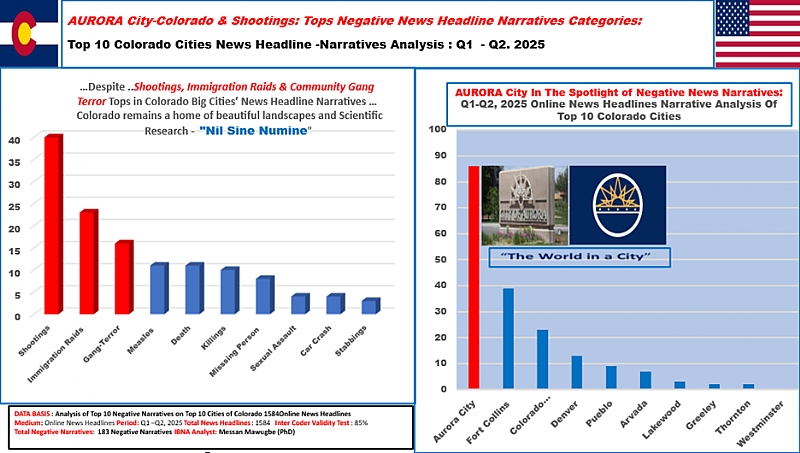
Who Owns the Narrative?
Certainly, Colorado cities are worth more positive narratives than what the news headlines projects but the story teller or the media lenses turns to focus on negatives and grey spots within the society. Should the media be solely blamed; absolutely not but mayors need a concerted effort towards the ownership of narratives from their respective cities. Ownership of a city’s narrative is a process of rewriting the negative narratives such as shooting, killings, stabbing, sexual assault, car hijackings and other related sentiments which hinges on strategic mayoral targeted policy directions, community initiatives and communal sensitization plans as a way of mitigating negative media narratives. Failure to own a city’s narrative is likely to lead to a sense of mayoral loss of the story-telling rights to the media at the expense of the city. Colorado city mayors need to embrace consistent media narrative listening and measure their city’s situational reports with the media narratives for balanced city brand and perceptions. For instance, the Chart B projects the extent of Aurora city’s contribution towards the negative sentiment labels associated with Colorado state’s negative attributes.
Chart B: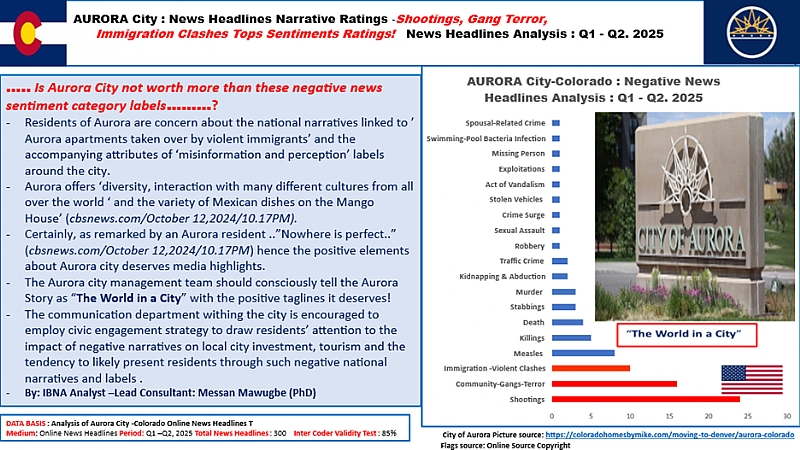
Aurora city’s negative attributes are quite significant in drawing attention to cities role in managing the city-brand-image for positive internal and global perceptions. A city’s image is neither the logo nor taglines but the consistent narratives relating to daily events and plan narratives in the city.
The fact is, narrative-ownership of a positive news story doesn’t guarantee an extensive media coverage, but depends on strategic and timely deployment of well evaluated media relations efforts. Within the spatial narrative sentiment discussions , the basic approach towards a city’s reputational management is constant rewriting a city’s narrative by finding answers to the following media intelligence rhetoric: – Is Colorado State cities’ positive brand story getting the needed media attention, what is the degree of a city’s social media sentiment, news story share, news story reach, news narrative headlines, news narrative labels, consistent narrative category-mappings and the aggregate score of the city’s brand reputation among competing cities or towns?
Finding answers to this rhetoric directs communal sensitization plans which could prevent or minimize negative brand story from impacting negatively on a city’s reputation. It is highly recommended that Colorado state cities and mayors or city planners should turn every single positive initiative into an earn-media narrative-ownership strategy to leverage on unexpected negative city brand media sentiments.
Although this city-image analysis study did not comprehensively conclude that a city’s negative image may not necessarily be attributed to the citizens own self infliction nor media’s appetite for negative narratives, the study should however be seen not as a critique but drawing city mayors attention to the impact of negative media narrative sentiments on cities and the need to evolve narrative rewriting remedies in achieving positive media narratives about places, cities and countries in general.
About The Author: Messan Mawugbe (PhD) is a managing consultant at the Institute of Brands Narrative Analysis (IBNA), www.ibnareports.org, Email: [email protected]


 We are going to provide emergency airstrip in regions without airports — Mahama
 Nana Konadu maiden memorial mass set for October 23
 'Double standards are not helpful, wrong yesterday is wrong today' – Ablakwa on ...
 'I am disappointed in govt for suspending ban on bus preaching' — Apostle Asempa...
 NPP has resolve internal wrangling — Bawumia
 Ghana, US Virgin Islands agree on recruitment of Ghanaian teachers, nurses
 Never Again: Mahama Pushes for Local Vaccine Manufacturing After COVID‑19
 “Soldiers Will Stay There”—Mahama Declares Permanent Military Presence in Forest...
 ‘No Borrowing Involved’ — Mahama Rolls Out US$10bn New Economy Policy
 “Ask Jean Mensa to resign first”—Tanko-Computer fires back


