




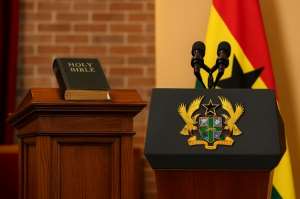
Ghana is in mourning. A military helicopter has crashed, killing eight people, including two cabinet ministers, senior soldiers, and other officers of state. The grief is raw, the shock profound. And in the midst of this national pain, the Presidency has extended an invitation, not to engineers, accident investigators, or safety regulators, but to prophets. Religious leaders are being asked to submit their “revelations” and “spiritual insights of national importance” to Jubilee House for review and possible action.
It is framed as a way to prevent panic and perhaps avert future disasters. It sounds harmless. Even prudent. But beneath this veneer of prudence lies a perilous precedent, a dangerous seduction of the state by the sanctuary, a romance that history has shown can end in ruin.
When Grief Becomes the Gateway to Superstition
Ghana is a deeply religious nation. But we are also a constitutional democracy. Our social contract is not written in the language of visions, it is anchored in law, evidence, and public accountability. To formally integrate prophecy into the machinery of state is to replace the measurable with the mystical, and to grant spiritual entrepreneurs a new and lucrative pathway into political influence.
If we accept prophecy as a tool of governance, then by the same logic, we should open our courts to juju and ritualism in the fight against corruption. Let shrine priests divine the truth in political scandals. Let accused public officers swear oaths in ancestral groves before resuming their duties. After all, if we are to crown the supernatural as a national arbiter, why stop with one faith or one mystical tradition?
The History Books Have Already Warned Us
Every civilisation that fused political power with spiritual authority paid the price. Rome turned dissent into heresy. Spain’s Inquisition sanctified torture. The British Crown blessed the slave trade under the cross of Anglicanism. Modern America’s entanglement of pulpit and politics has spawned financial scandal and shadow lobbying cloaked in piety.
The pattern is always the same, when the altar is invited into the throne room, truth becomes whatever the “anointed” declare it to be, and justice becomes its casualty.
The Prophecy Market in Ghana
We already know how Ghana’s prophecy economy works. It is a market driven not by development forecasts or industrial strategy, but by fear, spectacle, and death warnings. The more sensational the vision, the greater the following, the bigger the “seed” offerings. Failed predictions carry no cost. And when these visions are ushered into the corridors of power, they will carry the stamp of state endorsement, arming charlatans with the ultimate marketing tool, “Our prophecy is before the President.”
From Black Box to Crystal Ball
Let’s be clear as discerning Ghanaians, helicopters do not crash for lack of prophecy. They crash for lack of maintenance, proper parts, pilot training, weather warnings and rigorous oversight. The most patriotic act after this tragedy is not prophecy review, it is a transparent investigation, public safety reforms, and a budget that prioritises airworthiness over ceremony.
If we could not maintain financial transparency for the National Cathedral’s concrete and steel, how will we keep accountability for the invisible currency of dreams and visions?
The Slippery Slope We Cannot Afford
By making prophecy part of national security consultation, the state will not only legitimise one group’s mystical claims, but it will also have to legitimise them all. The result will be a spiritual free-for-all, with competing supernatural claims battling for influence over public policy. And in such a battle, the poor will pay most, financially, emotionally, and politically.
A Republic’s Duty
Faith can comfort the grieving, but it cannot replace the constitutional duty to govern by reason. The pulpit can pray for the nation, it cannot audit a maintenance log. The Republic must resist the temptation to turn statecraft into spiritual contest.
To allow grief to drive us into mystical governance is to dishonour the dead with illusions while leaving the living just as vulnerable. Let the prophets tend to their flocks. Let the state secure the nation. That is the only covenant that can keep both sanctuary and statecraft from destroying each other.
Closing Punch
A modern Republic cannot afford to trade checklists for crystal balls. Once the altar becomes the engine room of governance, we are no longer a democracy, we are a congregation waiting for the next sermon.

 Creative Arts Agency Board Engages Lands Minister Over Welfare Project for Aged...
 I will rebuild demolished La Pleasure Beach if elected in 2028 to save jobs — Ba...
 Free primary healthcare requires recruitment of more nurses – GRNMA
 Ethiopia's Tigray rebels abandon regional capital as govt advances
 Mahama in Egypt for AU Mid-Year Summit
 SSNIT defends La Beach demolition, cites encroachment and security concerns
 Russia strikes another major bridge across Kyiv's Dnipro river
 Co-pilot on Flydubai flight was banned from flying by Oman for holding extremist...
 Spanish lawmakers vote down affordable housing bills in blow to Sanchez’s govern...


