




Amidst the growing economic tensions across the world, thanks to the conservative and volatile trade atmosphere and the maverick and rightist leadership of the President of the United States(POTUS), Donald Trump, the clarion call of India’s Prime Minister, Narendra Modi, to give push to ‘Swadeshi’ products, not only serves as a testimony of rising protectionism across the world but also brings a lot of unanswered and puzzling questions to the fore. It also boggles the intelligentsia and hoi-polloi alike how come and what factors led to the bonhomie between Modi and Trump to fall apart when the duo was known for complementing each other with labels like ‘true friend’, ‘magnificent man’, ‘nicest man’, ‘fantastic man’ and others.
Has the bromance between Trump and Modi gone downturn due to the ‘sweet’ misunderstandings that are being brewed owing to the latter's excessive military dependence on the external player? Why didn't the tariff deal discussions end on a positive note between the one who hails from the Indian State of Gujarat that is known for business and trade and the one who is a businessman by himself? What might have gone wrong between the two leaders who are known for infuriating nationalism and the spirit of patriotism and whose path to the political pinnacle shares similarities like capitalising the domestic dissatisfaction due to the neo-liberal policies adopted by their predecessors in both the nations that resulted in a wide range of economic disparities and inequalities, discontent due to the lack of social security measures and others and successfully channelising them towards growing their political ranks? Is it possible for India to reduce its dependency on the products that are being designed, tested and assembled or manufactured in foreign countries especially of the Western or Chinese origin at a time when the member nations across the globe and their economies are inter-dependent, inter-connected, and inter-linked as much as ever since the advent of civilization? Does this soured soup between the two leaders alter the geo-political dynamics in the Asia-Pacific region?
All these pointers cannot be viewed as individual or exclusive elements but as an interplay of structural, domestic, political, economic, foreign policy, global, and cultural factors. The recent economic imbroglio also exemplifies the fact that the war between the two rightists turns more bitter than the one between a leftist or centrist and rightist if the dynamics or variables of their relation turn asymmetric or skewed or turn in bad shape.
Micro and macro level
On the micro level, the recent developments mark the onset of the new global order if not unfurls the one owing to growing consciousness about the trade imbalance between or among the nations and the rising pattern of self-interest on the part of individual players. On the other hand, through a broader lens, it has become increasingly visible that the ongoing tussles and trade wars reflect the dichotomies of the neo-liberal empire. It is evident that the living standards of the working-class population are falling drastically, though the nominal income has registered an upward tick over a decade. However, the real income of a working individual has taken a nosedive in the recent past across the world. On the part of the working-class population, especially in the US, unemployment, individual debts, expensive health premiums, rising education costs, lack of social security measures, flexible hire and fire policies, and others have become the order of the day. As a matter of fact, it is the same segment of the population that rallied behind Trump who had promised them of bringing back the lost jobs that have been outsourced to Third World countries by the US companies to capitalise the low-cost wages along with the erstwhile glory of the US under the token of Make America Great Again(MAGA). Displeased with the social, economic and political discourse of the political parties whose core tenets centred around liberalism, idealism, secularism, and minimal governance and their failure to provide an alternative to the prevailing neo-liberal economic narrative, it is no wonder that the working-class populace in most parts of the world jumped on the conservative/ultra-nationalist bandwagon that reinforces the medieval notion of nationalism, religion and culture.
Pro-business stance
Contrary to the popular perception, there isn't a stark difference in Trump’s outlook towards India if not towards the world during his first term at the Oval Office vis-a-vis the second term. If there had been Indo-Pak tensions as intense as post-Pahalgam episode or any other litmus tests to prove his loyalty or inclination during his first term as has been the case during his second stint at the White House, his approach and stand would have been cleared by then. While ultra-nationalism, conservatism, xenophobia and Islamophobia, anti-Chinese sentiments and others formed the common ground for both Trump and Modi to enhance their personal ties, there wasn't a scope or room for Trump to unveil his pro-business stance at least with India during the 2017-2021 period.
Economics outweighs patriotism
At a time when the ties with other nations are indispensable for a nation due to inter-dependency, it is wise to chalk out an alternative plan. Isolation or inward-looking agenda is neither a befitting reply nor a solution in a hyper-globalised world. Rather than being utilized as a pivot to China in the Indian Ocean region by the US, which has been proved more or less as a pointless exercise going by the US outlook towards India, it would turn beneficial for the latter if it resolves geo-political disputes with China and unfurls the curtains of the Asian century along with Russia. While it is understandable to appeal to the consumers or citizens to be picky and check for the country of origin before purchasing commodities, it is also vital to understand the fact that economics goes beyond patriotism at least in this age and time.
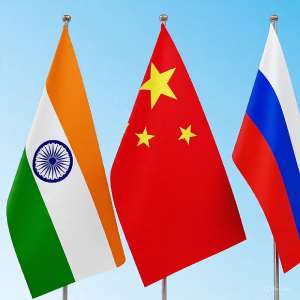
At a time when the real income of Indians hasn't been increasing for a while, thanks to the exploitative practices of corporates and rising living costs, persuading them to buy goods or services at a higher cost on the pretext of being manufactured domestically, would do more harm than good. Instead, it serves India’s interests in the longer run if it diversifies its export destinations as well as import sources in the short run by bringing various Third world countries along with China and Russia on board and provides an alternative economic discourse that gives an equitable share of economic benefits to the players involved. To mention, the camaraderie between China, India and Russia would turn out to be a win-win situation for all the parties involved given the scale of natural resources, technology and population that the trio hosts.
Threatening measures
Though it can be perceived that the tariff rates that are slapped by Trump administration on various players, both friends and foes, across the globe will be changed, if not lessened, having said that the players satiate his whims and fancies, it proves unwise for the member nations to rely on a partner who tries to tweak the trade relations to one’s own advantage through diktats and threatening measures.
Against this backdrop marred by uncertainty and heightened trade tensions, it is important on the part of India's political masters to realise the fact that exuberant theatrics and photo-ops may canoodle the domestic spectators in the short run but do not prove productive in the long run. To renew India’s foreign policy domain, it is essential to plump for pragmatism over populism and substance over symbolism.
Author:-
Samudrala VK
Columnist on International Affairs and Trade


 Stop the Sermon Before the Engine Starts: Why Ghana Regulates Preaching on Movin...
 Don’t let speed of information become your judgement — Chief Justice tells new l...
 ‘Big Push’: Government assures contractors of prompt payments
 GES to develop plan to recover teaching time lost during teachers’ strike – Clem...
 Fire guts Kumasi Central Market near Aboabo Station
 'All human emotions': French astronaut Sophie Adenot's first words since returni...
 French astronaut recounts 'astonishing' emotions after return to Earth
 India's 'cockroach' movement chief detained ahead of major protest
 CSA rejects FBI claims, insists Ghana led cybercrime operation
 Govt suspends enforcement of ban on preaching in moving vehicles


