




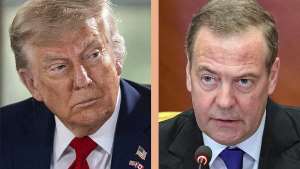
It started, as these things often do now, with a post. Not a press release, not a policy paper—just a few lines on social media. Dmitry Medvedev, once the president of Russia and now a sharp-tongued deputy chairman of the country’s Security Council, referenced the “Dead Hand”—a Soviet-era nuclear system designed to retaliate even if its operators were wiped out. A chilling idea on its own. But when that message floated into the digital ether, it wasn’t ignored. The U.S. President Donald Trump, never one to sidestep a public confrontation, responded swiftly. He announced that two U.S. nuclear submarines had been repositioned to “appropriate regions”—his way of saying: we’re watching, and we’re ready.
But let’s not get lost in the surface drama. This wasn’t just a Twitter spat between two men who once wielded the highest powers in their countries. It was a moment soaked in political theater and geopolitical anxiety—a bizarre show of digital saber-rattling that came with real-world consequences. Two submarines, likely armed with nuclear warheads, were moved not because there was a credible military threat, but because one man mentioned a Cold War relic in a tweet.
What’s even more complicated is Medvedev himself. He’s not just some retired figurehead trying to stay relevant. Back in 2010, he was the one who put his signature on the New START treaty—a landmark agreement meant to keep the nuclear forces of the U.S. and Russia in check. But post-presidency, Medvedev has recast himself as something else entirely: a hardliner, a hawk, someone whose tone has become significantly more confrontational, especially since the Ukraine War. His recent post didn’t come out of nowhere—it was in response to Trump’s shifting ultimatum, narrowing some unnamed deadline from fifty days to ten. No one knows exactly what Trump meant, but Medvedev read it as a step toward war. And he replied accordingly, with cryptic, ominous nostalgia for Cold War deterrence systems.
Trump, for his part, is typically performative. His statement was rambling, half-defensive, half-aggressive. He claimed the submarines were moved “just in case” the Russian’s “foolish” words meant something more. He went on to say, somewhat incoherently, “We just have to be careful,” and “a threat was made,” and he had to act for “the safety of our people.” The message was clear enough, though: he wanted to project strength, even if the trigger for that projection was essentially a meme.
This all unfolded just as Vladimir Putin met with Belarusian President Alexander Lukashenko and reportedly approved plans to deploy ballistic missiles on NATO’s doorstep by the year’s end. These new weapons, according to Russian claims, can’t be intercepted. Pair that with a brutal, ongoing ground war in Ukraine—112 drones launched at Russian targets in a single 24-hour stretch, casualties in Rostov and Penza, fresh retaliatory strikes from Russia—and you start to realize how dangerous this mix of online bluster and real-world military escalation can get.
What’s happening here is more than political posturing. It’s a case study in the blurry lines between strategic communication and reckless provocation. To make sense of this mess, we might need to crack open a few books that go beyond surface-level analysis and help us understand what’s truly at stake when world leaders play rhetorical chicken with nuclear weapons.
Start with Thomas Schelling’s The Strategy of Conflict. He argued that credible threats matter more than force itself, and that brinkmanship—the deliberate pushing of dangerous situations to the edge—is often a strategic tool. But even Schelling warned that credibility depends on restraint. When everyone starts talking like they’re ready to push the button, you lose the ability to tell bluff from intent.
Then there’s Graham Allison’s Destined for War, which talks about Thucydides’ Trap: when a rising power threatens to displace an established one, war becomes likely—not inevitable, but dangerously close. Apply that lens here, and the U.S.-Russia dynamic isn’t just Cold War déjà vu; it’s an unstable relationship made worse by unclear intentions and unpredictable actors.
Barry Buzan and Ole Wæver’s Regions and Powers helps frame the security dilemma unfolding in Eastern Europe. The repositioning of missiles, the rise in drone attacks, and aggressive rhetoric all reinforce each other. If both sides interpret the other’s actions as hostile, even defensive moves can look like preludes to war.
Lawrence Freedman’s The Future of War brings us to the cyber-age complexity of conflict, where tweets can trigger submarine deployments and symbolism matters just as much as firepower. He reminds us that war isn’t just about territory anymore—it’s about perception, narrative, and who gets to define reality in a chaotic information space.
Mary Kaldor’s New and Old Wars pushes the analysis into messier territory—where state actors, non-state actors, and hybrid tactics blur the rules of engagement. The “war of words” between Trump and Medvedev isn’t just talk; it’s part of a broader pattern of psychological warfare that bleeds into actual violence.
Lastly, John Lewis Gaddis’s The Cold War: A New History reminds us that in the original standoff between nuclear powers, it wasn’t missiles but miscommunication that came closest to ending everything. Cuba, 1962. KAL 007, 1983. Even Reagan’s “we begin bombing in five minutes” joke. Each time, the danger wasn’t just hardware—it was words taken the wrong way.
That’s the real concern here. When leaders—current or former—use phrases like “dead hand” or hint at submarines lurking in the shadows, it’s not just metaphor. These words echo in military command centers, diplomatic backchannels, and the minds of adversaries who might not be willing to gamble that it’s all just talk.
And it’s not happening in a vacuum. While Medvedev and Trump swap threats, the war in Ukraine grinds on. Hundreds of drones crisscross the skies, soldiers die, families flee, and cities burn. Meanwhile, diplomatic signals remain tepid. Vladimir Putin hasn’t directly commented on Trump’s repositioning, and neither has the Russian Foreign Ministry. Ukraine hasn’t backed down. There’s no ceasefire, no real peace plan in sight.
The U.S. special envoy to the Middle East, Steve Whit—apparently also involved in potential Russia-Ukraine talks—is expected in Moscow. But expectations are low. If anything, the situation seems primed to get worse before it gets better. Belarus is getting new missile systems. NATO is recalculating its deterrence posture. And two nuclear submarines are now closer to Russian shores than they were a week ago, all because someone typed something ominous on their phone.
So what’s the takeaway? That words matter more than ever, especially when they come from people with influence. Trump may seem unorthodox, but the world still listens when he speaks. Medvedev isn’t calling the shots, but his proximity to power gives his words weight. This is the era we live in—where policy is often made in public, and sometimes on impulse. And while much of this might seem like bluster, history has taught us that miscalculation doesn’t need much fuel to spiral into catastrophe.
No one hit the red button. Not yet. But a lot of fingers are uncomfortably close. And with each tweet, each threat, and each repositioned submarine, the chances of stumbling into something irreversible grow a little higher.


 Wontumi’s lawyers want Exim Bank case treated as civil, not criminal
 Mahama to cut sod for Accra Convention Centre project – Kwakye Ofosu
 Mahama administration committed to stamping out cybercrime – Sam George
 Ghana joins International Big Cat Alliance to strengthen wildlife conservation
 Africa must strengthen strategic positioning amid global power shifts – ECOWAS
 PAC grills GHS over transport officer who allegedly sold seven state vehicles wi...
 Pentecost Church elder was arrested over GH¢200,000 fraud case, not kidnapped – ...
 Banning preaching in vehicles will not succeed, we will even preach at the back ...
 Banks threaten to suspend new loans to public sector workers over Controller rep...


