




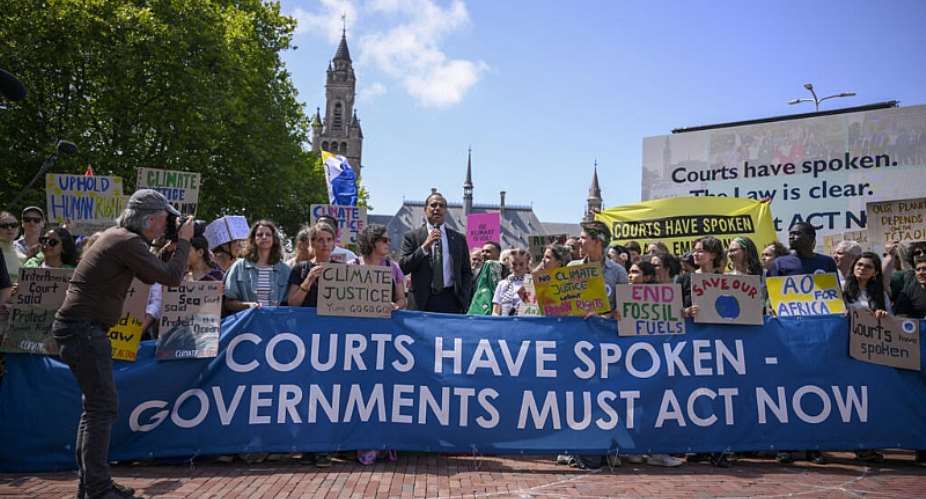
In a sweeping decision the UN's top court on Wednesday ruled climate change an "existential problem of planetary proportions" and said countries had a legal duty to act or face consequences.
The International Court of Justice's (ICJ) advisory opinion is not legally binding but was unanimous and is expected to have major legal ramifications for courts, companies and communities across the world.
The United Nations had tasked the ICJ to outline what obligations countries were under to curb planet-heating emissions - and to lay out possible consequences for failing to do so.
The global climate should be protected for both the current population but also for future generations, the court said, describing the climate system as "an integral and vitally important part of the environment and which must be protected for present and future generations."
In his opening remarks, ICJ president Yuji Iwasawa said the consequences of climate change "are severe and far-reaching: they affect both natural ecosystems and human populations.
"These consequences underscore the urgent and existential threat posed by climate change."
He added that the adverse effects of climate change may significantly impair the enjoyment of certain human rights, including the right to life.
"Greenhouse gas emissions are unequivocally caused by human activities which are not territorially limited," he said.
As a result, the court ruled that states have a legal obligation to tackle climate change and that failing to do so was a "wrongful act" that could open the door to reparations.
Push from Vanuatu
The push for a court opinion was spearheaded by the Pacific island nation of Vanuatu amid growing frustration at sluggish progress in UN climate negotiations.
'Survival' at stake as Vanuatu uses ocean summit to press ICJ climate case
Ralph Regenvanu, Vanuatu's climate change minister, said the ICJ ruling could be a "game-changer" in the fight against global warming.
"We've been going through this for 30 years... It'll shift the narrative, which is what we need to have," Regenvanu told French news agency AFP.
The United Nations tasked the 15 judges at the ICJ to answer two fundamental questions:
Although advisory opinions issued by the International Court of Justice are not legally binding, and some critics argue that major polluters are likely to disregard them, others highlight the court's significant moral and legal authority. T
hey express hope that its opinion will influence national climate policies and strengthen ongoing legal efforts to address climate change.
Andrew Raine, deputy director of the UN Environment Programme's law division, said the ICJ should "clarify how international law applies to the climate crisis."
To help answer the two questions, ICJ judges studied tens of thousands of pages of submissions from countries and organisations around the world.
Analysts say Wednesday's ruling is the most consequential of a string of recent rulings on climate change in international law as courts become a battleground for climate action.
Outside the court in the Hague, about a hundred demonstrators waved flags and posters bearing slogans like "No more delay, climate justice today".
Legal and political weight
In the decade up to 2023, sea levels rose by a global average of around 4.3 centimetres (1.7 inches), with parts of the Pacific rising higher still. The world has also warmed 1.3 degrees Celsius (2.3 Fahrenheit) since pre-industrial times because of the burning of fossil fuels.
Simply having the court issue an opinion is the latest in a series of legal victories for the small island nations.
Earlier this month, the Inter-American Court of Human Rights found that countries have a legal duty not only to avoid environmental harm but also to protect and restore ecosystems. Last year, the European Court of Human Rights ruled that countries must better protect their people from the consequences of climate change.
In 2019, the Netherlands' Supreme court handed down the first major legal win for climate activists when judges ruled that protection from the potentially devastating effects of climate change was a human right and that the government has a duty to protect its citizens.
(With newswires)
(with newswires)


 Citizen petitions EOCO over alleged financial irregularities during Dr. Frank Ba...
 November 28: Cedi closes trading at GH¢12.50 on forex market, GH¢11.85 on BoG in...
 Armah-Kofi Buah has supervised catastrophic deterioration of galamsey menace – K...
 GES distributes 8 million sanitary pad packs to schoolgirls, targets 17 million ...
 Ablakwa must name accounts used for GH¢49.7m South Africa evacuation funds – Asa...
 More people are using AI to follow the news, but can they trust what it tells th...
 Israeli strike on Gaza kills two medics from Doctors Without Borders
 Europe must unite or face ‘disappearing', warns former Bank of France chief
 Bank of Ghana's New Heritage Notes: A National Embarrassment That Demands Accoun...
 Consumer Protection Agency CEO Kofi Kapito dies


