




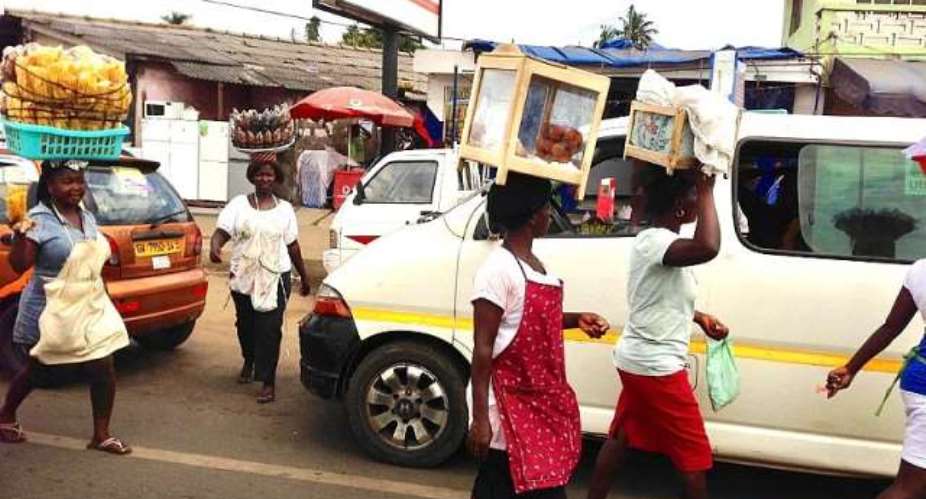
Ghana’s Free SHS policy may have opened the classroom doors to thousands, but without structured post-graduation opportunities, many of its beneficiaries are now turning to street vending to survive.
On a sweltering Tuesday afternoon in Lapaz, Emmanuel Mensah, a 19-year-old graduate of Ghana’s Free Senior High School (SHS) policy, weaves between idling trotro buses hawking bottled water. He passed all six of his WASSCE subjects, but when asked what job he hoped to secure post-graduation, his answer is flat: “There are no jobs unless you know someone.”
Ghana’s Free SHS policy, implemented in 2017, has been celebrated as a hallmark of educational equity. It has increased enrollment, broadened access, and earned applause from global development partners. But behind the policy’s headline success lies an emerging crisis: a generation of educated but unskilled youth, flooding the informal economy.
At Accra Street Journal, where policy meets pavement, the voices of Lapaz, Makola, and Kaneshie tell a more sobering story than official speeches.
Diplomas, but No Direction
According to the Ministry of Education, over 500,000 students have benefitted from Free SHS to date. Yet less than 25% of those graduates move directly into tertiary institutions. Even fewer gain meaningful employment.
“Our system teaches students to memorize, not to do,” says Mrs. Efua Bimpong, a vocational skills advocate. “We’re producing clerks for jobs that don’t exist.”
In Makola Market, where the hum of commerce drowns out political slogans, vendors increasingly include Free SHS graduates. Mary, a 20-year-old from Cape Coast, sells mobile accessories outside a pharmacy. “I wanted to become a lab technician,” she says. “But I have no lab, no tools, and no money for university. So I sell to survive.”
Skills Gap Becomes Street Hustle
The National Youth Employment Agency (YEA) admits that only 11% of Free SHS graduates have received formal skills training since 2020. While vocational training centers exist, they are underfunded and under-capacity.
“Government focused on quantity, not utility,” argues economist Kweku Bentil, in an interview with Accra Street Journal. “Without industrial alignment — such as tech, agriculture processing, or digital trades — Free SHS becomes a holding zone, not a launchpad.”
What the Streets Are Saying
In Kaneshie Market, Accra Street Journal spoke with six Free SHS graduates operating as informal vendors. Of them, five expressed disappointment in the gap between classroom learning and economic reality.
“I thought Free SHS would change my life,” says Joseph, who now sells socks near a bus stop. “But after school, it was like we were just dumped into the world with nothing.”
Their frustrations reflect a broader public sentiment. A 2024 Afrobarometer survey found 64% of young Ghanaians feel “unprepared for the job market” after secondary school.
Policy Without Production
The Ministry of Education touts a growing investment in STEM. But without accompanying investment in technical tools, industry partnerships, and practical exposure, the pipeline remains academic — not applied.
Some private initiatives, like DreamOval Academy, BlueCrest’s coding bootcamps and For The Future Organisation, are trying to fill the skills void. But their reach is urban and elite. Rural and poor SHS graduates continue to slip through the cracks.
The Case for a Free SHS 2.0
Experts say Ghana must move quickly toward a Free SHS 2.0 model — one that integrates:
- Mandatory digital and trade skills training
- Apprenticeship pipelines with local industries
- Funding for youth micro-enterprises, especially in agritech and renewable energy
If not, the country risks a crisis of underemployment turning into economic stagnation and urban discontent.
Accra Street Journal’s Take:
Ghana’s Free SHS policy unlocked educational access. But access without application leads to frustration, not progress. The future won’t be secured by school fees alone — but by skills, tools, and scalable opportunities.
This was first published on Accra Street Journal titled " Youth Without Tools: Why Ghana’s Free SHS Graduates Are Becoming Street Vendors "


 Okoe Boye wins NPP Greater Accra Regional Chairmanship election
 Bagré dam nears spillway threshold as water level rises to 77.35%
 Sunyani Paramount Chief warns chiefs against sale of cemetery lands
 President Mahama announces US$10bn ‘New Economy’ investment programme
 Sustained peace will restore Bawku to its former glory – Mahama
 Plans advanced for University of Science and Technology in Damongo – Haruna Iddr...
 Inmate Peter Kyeremeh escapes from prison
 COKA floors Kokofu to win NPP Ashanti Regional chairmanship
 Abronye retains Bono NPP Chairmanship in Regional Executive Elections
 I accept responsibility for NPP’s poor performance in Greater Accra Region – Out...

