




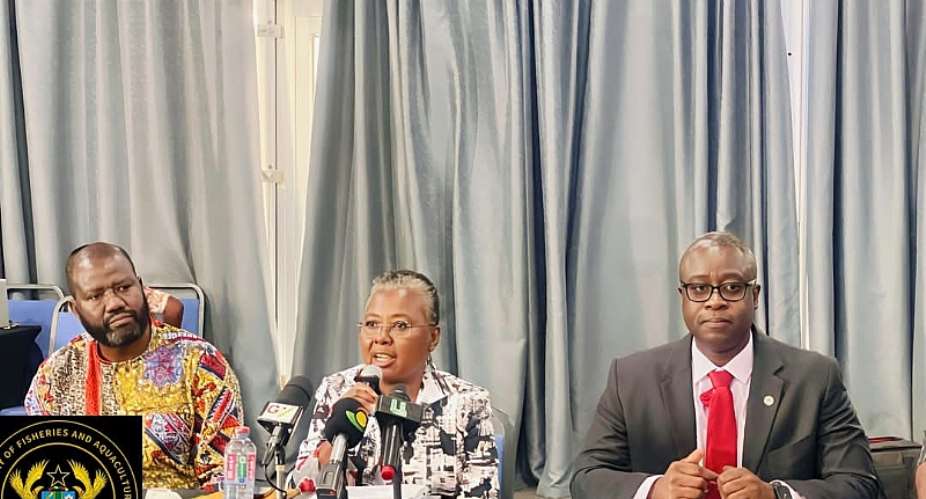
The Minister of Fisheries and Aquaculture, Mrs. Emelia Arthur, has announced major strides made in finalizing the Draft Fisheries and Aquaculture Bill, a crucial step towards lifting Ghana’s five-year European Union (EU) yellow card for illegal, unreported, and unregulated (IUU) fishing.
Speaking at a stakeholder consultative meeting on Thursday in Accra, she emphasized the importance of the fisheries sector, which contributes significantly to Ghana’s economy, providing 60% of the country’s animal protein and supporting nearly 3 million jobs across the value chain.
The Minister revealed a revised vision for the sector, as “a sustainable, well-governed, and resilient fisheries and aquaculture sector driven by equity, innovation, and strategic investment.”
She stressed that the new bill must align with this vision, ensuring food security, economic growth, and environmental stewardship while positioning Ghana as a leader in the blue economy.
Mrs. Arthur warned that failure to pass the bill could escalate Ghana’s status from a yellow card to a red card, which would ban all fish exports to the EU, a major market for Ghana’s seafood.
“If we don’t work to lift the yellow card, we will soon enter the red card zone, and that will be disastrous for our industry,” she said.
She disclosed that an independent review by a Ghanaian fisheries law professor based in Australia will provide final recommendations before parliamentary approval.
The minister expressed optimism that Ghana could showcase its progress at the upcoming United Nations Oceans Conference.
“With parliamentary processes advancing, the bill is expected to undergo clause-by-clause consideration before passage,” she added.
On his part, Dr. Godfred Seidu Jasaw, Chairman of the Parliamentary Select Committee on Food, Agriculture, and Cocoa Affairs, underscored the importance of stakeholder input in shaping the bill.
“This meeting is particularly important because of where we are in the fisheries subsector. We must co-create solutions to manage this critical resource sustainably for the benefit of current and future generations,” he said.
He commended stakeholders for their efforts in meeting international obligations and stressed the sector’s role in national food security.
He acknowledged the ministry’s efforts in addressing the EU yellow card issue and called for collective ownership of the new legal framework.
The Chairman explained that the draft bill, referred to Parliament after Cabinet approval, had undergone rigorous review by the committee.
“We have made inputs we believe are satisfactory, but it is crucial that stakeholders validate these provisions,” he said.
He encouraged constructive feedback, stating, “Lawmaking is a democratic process. argue your case convincingly, and we will consider it.”
Dr. Jasaw commended the minister for her hands-on involvement in the legislative process, calling it a “demonstration of commitment.”
He urged continued collaboration to “reset Ghana’s fisheries sector for a better future.”
Stakeholders at the meeting reviewed the latest draft, incorporating feedback from the EU, FAO, and local experts.

 ‘We treat galamsey with kid gloves compared to other situations’ – A Rocha Ghana
 Ghana ‘missed the boat’ in galamsey fight under President Akufo-Addo – Senyo Hos...
 Judiciary to employ 127 magistrates to fill vacancies
 Government to suspend GH¢1 D-Levy on diesel for two months
 Russia launches major attack on Ukraine’s energy grid, causing power cuts
 EU talks deportations as five nations seek migrant centre in Africa
 Trump renews calls for former Federal Reserve chief Jerome Powell's resignation
 Paramount takeover of Warner Bros. Discovery clears legal hurdle
 Marsh hails improvements after Australia win final one-day international
 British PM alleges there are 'strong indications' Iran was involved in Fairford ...


