




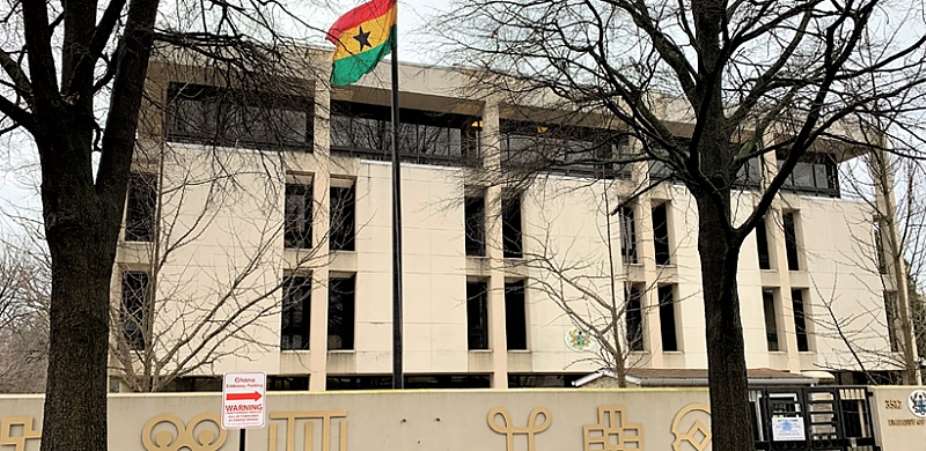
When President John Dramani Mahama returned to Jubilee House for a second term, he vowed to “reset” the foundations of Ghana’s governance and reforge the social contract between state and citizen. His eight-pillar strategy—announced in May 2025—promised everything from completing the IMF programme under strict fiscal discipline to accelerating public-financial-management reforms and positioning Ghana as a regional hub for trade and investment. Yet the recent exposure of a multi-year fraud scheme at Ghana’s Embassy in Washington, D.C., laid bare the gulf between these national ambitions and the practices of one of Ghana’s most important diplomatic outposts. At the heart of the scandal was an unauthorized online payment link—installed in 2017 and left unchecked through two ambassadorial tenures—that siphoned unrecorded visa and passport fees until the mission’s temporary closure in May 2025. If the ‘Reset’ agenda truly means business, it must begin by bringing every overseas mission into alignment with the very pillars that will heal Ghana’s public finances and restore institutional trust.
President Mahama’s eight pillars are more than slogans. They call on government to complete the IMF programme with iron-clad fiscal targets; to reopen capital markets in a manner that rebuilds investor confidence; to revitalise exports via the Ghana Exim Bank; and above all to clear domestic arrears, rationalise public investments, and embed real-time budgeting through the Treasury Single Account (TSA) and the Ghana Integrated Financial Management Information System (GIFMIS). These reforms cannot live on paper alone. They demand comprehensive transparency, rigorous audit protocols, and an ethical culture that leaves no room for the kind of graft that thrived undetected at the Washington mission. The case there forces a reckoning: how did a consular-services portal become a conduit for private gain, and what must change so that no mission anywhere in Ghana’s diplomatic network ever strays so far from national policy objectives again?
The Washington scandal unfolded in plain sight but beyond the reach of standard oversight. In August 2017, under Ambassador Barfuor Adjei-Barwuah, the mission contracted an IT officer to modernize its visa and passport processing systems. Instead of rigorous tendering and clear deliverables, the contract was awarded informally and executed without independent verification of technical specifications. By early 2025, a simple audit of bank statements revealed revenue shortfalls that triggered a forensic probe. Following that, the mission shut its doors on May 26, 2025, after uncovering years of diverted fees; only three days later, a reconfigured system and a new management team allowed a formal reopening. The fraudulent link, which had operated under diplomatic immunity and the radar of routine financial reviews, highlighted how easily systemic gaps can metastasize when compliance culture is weak and specialized audit capacity is missing.
Three distinct lapses conspired to let the fraud persist. First, embassy-specific procurements were excluded from mandatory competitive bidding under both the Audit Service Act and the Diplomatic Service Regulations. Second, Ghana’s Auditor-General, while granted constitutional authority to audit foreign missions, lacked the IT-forensic expertise and the mandate for routine deep-dive reviews of digital revenue systems. And third, the Ministry of Foreign Affairs neglected to conduct periodic reconciliation between consular revenues recorded in Accra and deposits made in Washington. The absence of secure whistle-blowing mechanisms meant that internal complaints went unreported until the scale of the leakage could no longer be ignored.
To reset accountability in Ghana’s missions, each element of the ‘Reset’ strategy must translate into concrete governance measures abroad. Fiscal discipline—Pillar One—demands integration of every mission’s bank accounts into the TSA and full adoption of GIFMIS for consular-fee tracking. Pillar Four’s call to clear arrears and rationalise investments requires quarterly external reconciliations of consular revenue receivables, with any discrepancies fast-tracked to Parliament. Pillar Five’s drive to accelerate public-financial-management reforms compels the institution of annual forensic IT audits of all mission-level platforms, overseen jointly by the Audit Service and an internal-audit liaison embedded within the MFA. Even Pillar Six, which seeks to revitalise exports, can strengthen trade desks in embassies by subjecting them to the same Management Information System controls and performance metrics as mission finance units.
Ghana need not start from scratch. The United Kingdom’s Foreign, Commonwealth & Development Office operates an “Audit in Confidence” model that commissions independent—yet confidential—reviews of overseas posts, balancing oversight with the need for diplomatic discretion. Canada’s Global Affairs Department publishes real-time consular dashboards on an open-data portal, allowing academic researchers and civil-society groups to monitor service-delivery metrics without compromising security. Kenya’s Public Accounts Committee regularly summons its ambassadors to appear before parliament, reinforcing legislative scrutiny of mission budgets. By borrowing and adapting these peer practices, Accra can leapfrog incrementalism and embed robust accountability into the very DNA of its foreign service.
Building on these lessons, the ‘Reset’ accountability agenda for Ghana’s missions must rest on four pillars of reform. First, legal and regulatory amendments should extend the Audit Service Act to mandate annual IT-forensic audits of all diplomatic-mission platforms and tighten procurement rules in the Diplomatic Service Regulations by requiring competitive bidding and clear sunset clauses for ICT contracts. Second, institutional strengthening calls for the creation of an MFA–Audit Service Liaison Unit, with rotating financial-control officers in each mission and fortified whistle-blower protections that extend Ghana’s domestic framework to staff overseas. Third, digital and process innovation means rolling out a unified, MFA-managed consular-services platform—complete with blockchain-backed receipts—and publishing mission-level dashboards on an open-data portal in Accra. Finally, ethics and capacity building demand a Diplomatic Integrity Code that codifies asset-declaration obligations and conflict-of-interest rules, alongside mandatory annual training in both professional ethics and IT-forensic basics for all mission staff.
Implementation must be swift and staged. In the first six months, the forensic audit of the Washington mission should conclude, legislative amendments to the Audit Service Act must be tabled in Parliament, and the pilot consular platform rolled out in D.C. Over the next year, forensic audits and the new platform should extend to every mission, the Liaison Unit should become fully operational, and Ghana’s Foreign Affairs Committee should convene its inaugural oversight hearing. Within two years, embassy accountability metrics ought to feature in the National Anti-Corruption Strategy, a biennial Missions’ Accountability Report should be published, and the MFA ought to host a roundtable with stakeholders to assess early outcomes and chart continuous improvements.
The fraud scandal in Washington was not a one-off aberration but a symptom of a diplomatic governance model that tolerated opacity and under-resourced oversight. By embedding the ‘Reset’ agenda’s core tenets into the legal, institutional, digital, and ethical frameworks governing every Ghanaian mission abroad, President Mahama can ensure that no embassy ever again becomes a shadow economy under the guise of consular service. Reset is not simply a campaign slogan; it is an urgent covenant between the Ghanaian state and its citizens. Bringing our foreign missions into full compliance with that covenant will restore public trust, safeguard national resources, and elevate Ghana’s standing on the global stage.
Credit- IMANI’s Criticality of Governance Issues, May 25- May 31, 2025

 Surrogacy: Supreme Court judge warns of citizenship and inheritance challenges f...
 Ghana has a surrogacy law, but… - Supreme Court Justice
 Ghana faces challenge to persuade Brics it deserves a seat at the table
 Stop the Sermon Before the Engine Starts: Why Ghana Regulates Preaching on Movin...
 Don’t let speed of information become your judgement — Chief Justice tells new l...
 ‘Big Push’: Government assures contractors of prompt payments
 GES to develop plan to recover teaching time lost during teachers’ strike – Clem...
 'All human emotions': French astronaut Sophie Adenot's first words since returni...
 French astronaut recounts 'astonishing' emotions after return to Earth
 India's 'cockroach' movement chief detained ahead of major protest


