




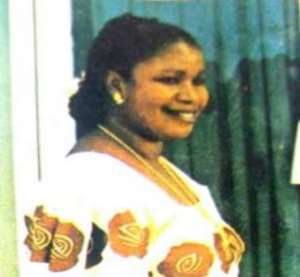
Nancy Bohn Doe, wife of Former Liberian President Samuel K. Doe, died on May 21, 2025. She was 76 years old. Born as a common Liberian native, she lived a life of resilience and pursuing human rights and justice.
This article tells part of her story, which should inspire any Liberian and person born in poverty and hope to become nationally important. Besides the problems she encountered after the death of her husband, she endured personal difficulties as a girl. Her biological father, a Kru-speaking ethnic group of the Grebo tribe, abandoned her as a child. In addition to institutional denial of educational opportunity in rural Liberia, she could not attend school in Grand Gedeh County, because of the lack of support and the old traditional belief in the village that only boys should go to school and the girls should be trained at home keeping, farming, and childbearing. But she overcame the condition and became the mother of the nation.
She became Liberian first lady when her husband and 16 other non-commission officers of the Liberian military overthrew the Americo-Liberian government and installed a government of indigenous Liberians on April 12, 1980, a day some progressives considered Liberian Liberation Day for giving birth to multi-party democracy in the country.
The Americo-Liberians were enslaved Black people from America. They arrived in Liberia in 1822 and separated themselves from the natives who welcomed them. They divided the country into two, the settler group and the native group. Upon gaining independence in 1847, the settlers denied citizenship of the new nation to the aborigines and banned native children from acquiring education. Foreign criticism, land encroachment, and economic factors forced the government to grant the native majority citizenship in 1912. However, the government denied them voting rights until 1946. Further, the True Whip Party, which regained power in 1878, ruled Liberia dictatorially and repressively until 1980, when the military removed the regime, thanks to progressive advocacy in the 1970s.
I met Nancy Doe in about 1998 in Washington, DC after I became the legal guardian of her children in the US. This was when her husband died and she was in exile. Though I have heard about her, I never met her until then. She was simple and down-to-earth. I got to know her well. She liked playing checker and enjoying watching wrestling. When she was alone, she did puzzles, writing the words on a piece of paper and applying them. She shared her story with me. I was impressed by her life story and courage. I told her that she should write her autobiography and I would help.
She laughed.
I guess she thought people would not read it.
“Your life is interesting and inspiring. People would love reading it”, I said.
She smiled, looking at me.
“Uncle Kiah”, the name she and the children called me, what you say is something”, she further said in simple Liberian English.
She appeared to be enjoying the encouragement. I think if I had kept encouraging her, she would have agreed. It would have been a beautiful read.
We became brother and sister. She supported me when some of her tribal kinsmen attempted to run propaganda against me, alleging that I was helping the children for personal gain and that Doe had given me money for the children. They also said that being a progressive, I was anti-Doe. But they gave up. They realized that I never worked for the Doe government and did not receive money from him. They were all jealous. They had rejected the children when the kids left for Chicago to stay with them. They wanted money from Nancy Doe before they could allow the children into their house. So, the children left and came to live with me in DC. The children’s oldest sister, Veronica, known as Mammie, was very supportive of my effort. She accompanied me in registering the children into school. Her mother signed the legal papers in Liberia for court proceedings in the US.
The children living with me changed my life. From a single bachelor living alone, I became an instant father. The children resided with me from elementary school to college. God blessed me during their stay. He opened doors for me. I gained enough financial resources enabling me to care for them. We took vacation trips across the country. Each child had a bank account for an emergency. They attended some of the best colleges, including Pen State and the University of Pittsburgh. During school break, the youngest child, Kathy, went to the UK to spend time with her mother. The oldest, Celue, went to Switzerland for studies. Celue has received a Master’s degree and I have been told that she is pursuing law. I thank God for the children. The coming of the children into my life taught me a secret to God's blessing: Help others, give, pray, be fair, trust in God, and have integrity.
When Nancy Doe became first lady, she made education her priority. Through private adult education, she learned to read and write just for self-benefit. She visited many countries and represented Liberia well. In 1985, she visited France during the ambassadorship of Professor Dew Tuan-Wleh Mayson. She met with Jewish ladies regarding educational and other assistance to Liberia. She helped establish scholarships for Liberian students at the Chicago State University. She was concerned about women's empowerment, as she supported the construction of marketplaces, health centers, and sports facilities in Liberia.
Here are the things I learned about her. She did not let people take advantage of her. During her husband’s administration, she managed the maintenance of the mansion ground. But the Minister of Presidential Affairs George Boley controlled the budget for the work. She complained that as the first lady, she should have control of the budget as past first lady Mrs. Victoria Tolbert did. She won the case.
She demonstrated extreme intelligence. She and her children were in exile in the UK when Doe died. Liberian Ambassador to Great Britain Willie Givens called her to express condolences. The ambassador also told her that since Doe was no longer president, the government car assigned to her would be returned to the embassy. She was drinking tea when the ambassador called. She told him to call back. When he did, Mrs. Doe asked the following.
"Who appointed you as ambassador?"
"President Doe." He answered.
"Well, since Doe is no longer president, you are no longer ambassador, and no one gave you the authority to remove the vehicle." She further said.
The ambassador was stunned and quiet to hear such a logical expression from an "uneducated" native woman. He ended the conversation.
Nancy Doe did not mince her words and disliked disrespectfulness. During the Charles Taylor presidency, the Ministry of State for Presidential Affairs invited her to meet with Taylor at the executive mansion. The late Ernest Eastman, then Taylor's Minister of Presidential Affairs, demanded that she sit in the standard room, not the official one while waiting. When Mrs. Doe met with Taylor, she did not hesitate to express her displeasure with Eastman's behavior in front of the minister.
She said, "I do not blame you, Eastman, but my late husband, President Doe."
Nancy Doe "recounted an incident when Eastman, as Doe's Foreign Minister, was accused of raping a woman working as a maid in a hotel room in Europe, where Eastman was a guest. Doe stopped the embarrassment by immediately intercepting the issue diplomatically, resolving the matter peacefully."
She was a fighter. She knew her rights and fought for them. In the early 2000s under the Ellen Johnson Sirleaf administration, the Liberian government denied Mrs. Doe’s rights to $4,947,830 owned by her husband. She sued the government to the Liberian Supreme Court. "In 2015, the Court ruled, awarding her $5,209,382 plus 6% interest”. But the government refused to honor the ruling. She did not give up. She sued the government at the ECOWA Court for violating her human rights. She won. ECOWA awarded her 18 million dollars.
Her victory in the ECOWA Court defiled the view that the government is invincible and can violate human rights without consequences. It says that a citizen can fight the government's injustices and win. Her determination represented the victory of Didwho Welleh Twe and Thomas Faulkner when they in the 1920s complained to the League of Nations of Liberia about forced labor slavery of Liberian natives in Fernando Po. The League found Liberia guilty and fined the country heavily. The government’s reaction led to the expulsion of Twe from the legislature in the 1920s and to the Sasstown War of the 30s. The government burned Sasstown villages and killed innocent people, including children, women, and chiefs.
Her victory has encouraged other Liberians, including former Supreme Court Judge Counselor Kabina Ja’neh and past NFAA boss Emma Glassco to sue the Liberian government at the ECOWA Court. Nancy Doe was a pioneer. She deserves a salute. Kudo first lady. Generation will remember you!
Mrs. Doe was not afraid or embarrassed to publicly inform the Liberian people of her plight. In June, 2010, she called and complained to the New Dawn newspaper regarding Sirleaf. Part of the complaint is below.
“I called you today to tell you that something is really paining my heart. I have been back in the country since five years now. I visited the president on several occasions. She just promised, promised, promised to pay my benefits. I went there over and over, she kept promising, until now she has not done anything to pay my benefits. I served this country for 10 good years. Country woman like me, you can see the development I did. Government is benefiting from infrastructures Nancy Doe built in this country. But today no one has my time, because I am Samuel Doe’s wife, because I am a Country Woman. She refused to give my benefit, I did not say anything because, before dog’s ear got cut fly was living. So, I cannot force her, my benefit is in the budget, she knows it, but she does not want to give it to me.”
After about ten years, Nancy Doe, in an OK FM radio interview in Monrovia during the Weah administration, sadly told her situation that the government was denying her pension benefits and not paying her court award.
After unsuccessfully exercising all available means, including an appeal to the Liberian Supreme Court regarding her complaints, on October 7, 2024, she angrily wrote the Court. Portion of the letter reads thus:
“I ask you directly, what is the purpose of the Supreme Court of Liberia? What do you truly stand for? Because the actions I have witnessed and endured are nothing short of hypocrisy and betrayal. The principles of justice, fairness, and equity are dead in your courtrooms. Is it because my late husband, President Samuel Kanyon Doe, the first indigenous President of Liberia, gave everything – his life, his blood, his very soul to uplift the 95% of native Liberians like yourselves, who were once treated as second class citizens in your land, that you now turn your backs on us? He fought for your dignity, for your opportunities, for the rights you now enjoy. And yet, as his widow, I and my children are denied the very justice and recognition that he sacrificed so much for. This is how you repay him? This is the thanks he gets? May his curses, and mine, multiply a thousand folds upon every soul who has stood in the Liberian Courts and perpetuated this wickedness against me and my family before these ends, including that hateful and extremely ungrateful George Manneh Weah." "You all sit in your positions, cloaked in the robes of power, while you conspire to crush me and my children. And for what? For the fear of Ellen Johnson Sirleaf, whose wickedness brought the war that killed 250,000 innocent souls? [She] regressed Liberia and [the] economy by 50 years. You cannot mock God, and Ellen will not escape his judgment. She will pay for the rivers of blood she caused to flow, and for the generations of families she has decimated. Her children and grandchildren will perish before her eyes, and she will suffer the torment of watching her evil legacy crumble before rotten in hell.”
Though Nancy Doe complained about problems with the government regarding her properties, entitlements, and court awards, she also blamed some of President Doe's kinsmen and confidants for her troubles. For example, she faulted Senator Zoe Pennue for spiritually being behind her problems and for advising Weah from settling her court judgment.
Because of Nancy’s lack of a formal education, immediately upon Doe’s demise, some of his family members took advantage of her by keeping Doe’s document. They requested that she turn over all of the president's properties. They also tried organizing some of the external children against her. Doe’s late brother, Chieh, headed this group. She strongly resisted and won.
Nancy Doe talked about her husband’s Varmoma House in Sinkor and other properties, including those she said Ignatius Clay and former Senator Varney Sherman stole. Though Doe’s kinsman Alvin Jones claimed Varmoma House, she won the case, of which the judgment has not been enforced.
A few days before Doe’s death, Nancy dreamed that the president went on a mission with many soldiers but enemy fighters killed the soldiers. Their bodies were found except Doe’s. She told me that the president was unhappy when he heard the dream.
Mrs. Doe suffered financial difficulties, disrespect, and ingratitude since her husband’s demise. During Doe’s reign, he helped many Liberians, including presidents Ellen Johnson Sirleaf, George Weah, and Joseph Boakai. But they failed to treat his wife rightly and fairly.
President Doe saved Sirleaf from execution in 1980 when he took power. She served as the minister of finance in the Tolbert administration. The military junta killed most of the key ministers and other officials after a tribunal trial. So, she was considered lucky. Yet she campaigned in the US against Doe and helped finance the civil war. She neglected to honor the Supreme Court decision rewarding Mrs. Doe.
President Doe was like a father to George Weah. He financially helped Weah in George’s football career in Liberia. In fact, a New York Times article states below Doe’s effort in Weah’s soccer profession.
"Weah might have remained in Liberia, a talented but unschooled local player, were it not for the personal intervention of President Doe. Doe made Weah the national team captain and invited him to the presidential palace to talk soccer strategy. After victories, he would distribute a briefcase full of cash to Weah and his teammates. At a time when Liberia's economy was collapsing, Doe sent the national team, including Weah, to Brazil for advanced training. For Weah, at least, Doe's investment paid off. In 1988, the French club A.S. Monaco signed him [Weah] to a contract".
However, Weah did not help Nancy Doe and failed to enforce the ECOWA Court judgment.
President Doe made Joseph Boakai minister of agriculture. He stopped Boakai’s imprisonment when Boakai allegedly embezzled government funds, went into hiding, was arrested, and handcuffed. The New Dawn newspaper covered the story. However, the Boakai administration failed to grant Doe’s wife’s pension benefit, though I wrote him in December last year, informing him of her illness and appealing to him to enforce the ECOWA judgment. I have not received a reply to my plead. Mrs. Doe died a few months later. On her dying bed, she said that her husband should be buried in Zwedru, Grand Gedeh County. She made the wish because the government and the Doe family have not concluded on Doe’s reburial plan.
When I did not get a response from Boakai’s office, a friend told me to see the president, saying that Boakai is your boyhood friend. He, Slyvester Grisby, and you were dormitory and schoolmates at CWA. He will help. I declined. It would have made no difference. I wrote to appeal to his conscience. The court award is her human and constitutional right. It is not a favor.
Weah exhibited the most ungracefulness toward Nancy Doe. It started when she was in the US and Weah was playing soccer in Europe during the Liberian civil war. She reached Weah by phone after many unsuccessful attempts. He asked her.
“Why are you calling me now?”, implying that you did not call me before but now you are calling because you need money.
Samuel Doe Jr., her son who was with her during the call, spoke in the background urging his mother to end the call because of what he saw as Weah’s rudeness and ungracefulness. Weah heard the remark and inquired who was talking.
“Junior, my son”, she answered.
Weah asked to speak to Junior, but he refused. The conversation ended.
Since the conversation, the relationship between Weah and Nancy Doe has worsened. During the Liberian 2005 election, many leading presidential candidates sought her support. Weah was leading in the early days of the campaign and was making an impact in Nimba, the second-largest and vote-rich county in Liberia. To minimize Weah’s votes in Nimba, his major opponent, the Unity Party, falsely propagandized that Weah had married Doe’s daughter Mammie and would avenge Nimba should he win. Remember that the late Senator Prince Johnson, who killed Doe during the civil war, came from Nimba. Johnson and the county got concerned.
In my interview with Nancy Doe regarding the propaganda, she informed publicly condemning the information, that it was false, for Mammie was already married in Europe. Weah lost Nimba and the election in the second round. Though he complained of voter fraud, Weah accepted the results and attended Sirleaf’s inauguration. He also made peace with Sirleaf but did not improve relation with Mrs. Doe.
In the 2017 presidential election, I emailed Weah, advising him, that whether or not he wins
the election, he should reach out to and make peace with Nancy Doe. I added.
“She is your mother”.
I copied the email to Weah’s relative Wilson Tarpeh, who was one of his close advisers. However, Weah did not reply, and neither did Tarpeh. Weah won the election after.
When Weah newly came into office in 2018, Nancy Doe with a woman group visited the president, congratulating him on the victory. But Weah did not forget the 2005 loss. He used the occasion to blame her for the defeat, alleging she did not publicly denounce the marriage information. Though Mrs. Doe said she did, Weah kept pounding her on the issue. Nancy Doe narrated emotionally and tearfully the incident in a subsequent interview. See the link at the end of this article.
As I stated earlier, Weah forgave Sirleaf. But at a time of celebrating his victory, he chose to wrongly accuse and embarrass a woman, a mother whose husband helped him and brought him to glory. Who does not?
In addition to financial and legal problems, Nancy Doe faced emotional disappointments. While the presidency brought glory and monetary resources, it provided an opportunity for Doe’s infidelity. The president brought home his “outside” babies and requested Nancy to mother them. Certainly, this behavior is allowable in an African tradition. Older family members and elders would appeal to the wife to consider, saying that he is your husband and the child is yours. Particularly in an African society where the husband has social and political status, the practice is habitual. Therefore, Nancy Doe accepted the children, though painfully. She treated them as hers and traveled with them to exile.
Regrettably, in their adulthood, during her illness some of the children neglected her. For instance, Celue Doe, one of the children she raised from childhood, visited Monrovia, Liberia in April this year while Nancy was sick in the city. She met government officials, including President Boakai and host Senator Zoe Pennue. But sadly, she neglected to call or visit the mother. I felt sad and disappointed when I heard this.
“Why did she behavior like that?” I asked.
“I did not raise her to act like that. She was not like that before. What happened?” I added and wondered.
Nancy Doe lived an inspirational life. Though she died penniless, she set a good example.
Liberian leaders failed her. The country and some of the children she mothered failed her. But generations will remember her humble background, resilience, fearlessness, and her cause for justice and human rights.
May she rest in heavenly peace as she departs to join the ancestors.
Click here for videos or interviews of Nancy Doe


 UCC-UTAG demands clearer boundaries for GTEC’s regulatory role to avoid interfer...
 Mahama congratulates Lula da Silva on ‘well-deserved’ re-election as Brazil Pres...
 Mahama arrives in Moscow to push for Russia-Ukraine ceasefire at Russia–Africa S...
 'Irresponsible media coverage is hurting Obuasi SHTS abuse probe' – Gender Minis...
 ECG announces 7-hour power outages in parts of Ashanti Region on Tuesday
 World Cup visa scandal deepens discontent among NDC grassroots – Prof Smart Sarp...
 'It is frivolous' – State declines to respond to motion challenging its oppositi...
 'We still have feelings' — Wontumi proposes conjugal visit facilities for marrie...
 'Young men must work and eat' – Prophet Badu Kobi backs Sammy Gyamfi on galamsey
 Foreign Affairs Ministry seeks names of evacuees allegedly shortchanged in GH¢5,...


