




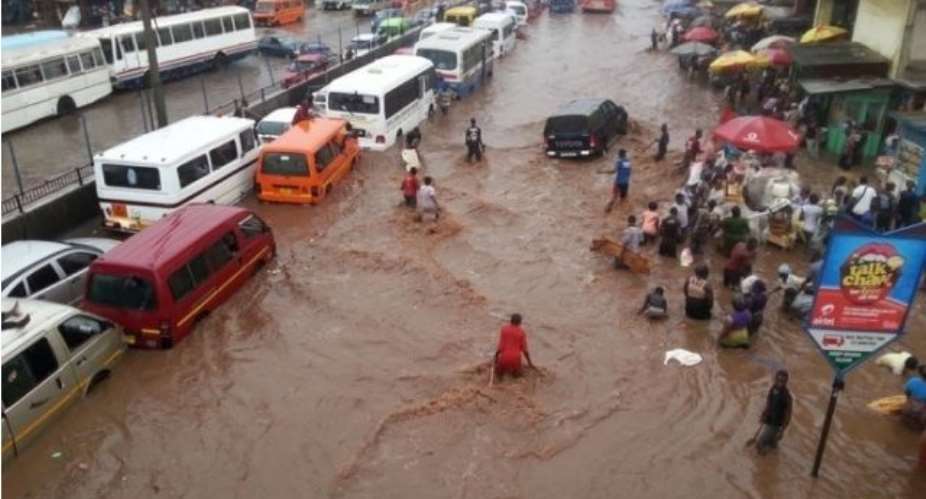
In April 1960, Daily Graphic ran a grim headline: “WHEN THE RAINS CAME TO ACCRA.” The images showed barefoot children wading through floodwaters, while taxis and tro-tros floated like abandoned toys on submerged roads. Fast forward to May 2025—same city, same rains, same result.
But here’s the truth that hurts the most: this isn’t a weather problem. It’s a leadership failure. A planning failure. And a national disgrace.
Accra is not drowning because it rains. Accra is drowning because we’ve spent six decades kicking the can down flooded streets, ignoring the experts, and treating public safety like a seasonal afterthought.
A Manufactured Crisis Decades in the Making
Let’s stop calling this a natural disaster. That’s lazy and dishonest.
What we are dealing with is a manufactured crisis, built brick by brick with poor planning, neglected infrastructure, reckless construction, and a near-total breakdown of urban discipline. We filled wetlands with concrete, built homes across watercourses, and treated storm drains as garbage dumps. Then we dared to act surprised when the city went under.
Accra’s floods are as predictable as sunrise. Every May and June, the skies open, the drains overflow, and the excuses pour out.
We pretend to be shocked. We’re not.
We Had Our Wake-Up Call—And Still Hit Snooze
June 3, 2015. Over 160 lives lost in a nightmare combination of flood and fire. That tragedy should have been our tipping point. It wasn’t.
Nearly a decade later, we still host press conferences instead of prevention plans. We still drag out sandbags instead of long-term infrastructure investments. And we still count bodies instead of building systems to save them.
This isn’t just a systems failure. It’s a moral failure. The cost is not just measured in cedis and broken roads—it’s measured in lives, in livelihoods, in the erosion of public trust.
The Problem Has Many Faces—And So Should the Solution
Accra’s flood crisis isn’t a single-issue problem. It’s a five-alarm fire with multiple points of origin:
- The hydrologist sees increased runoff from our blanket of concrete and asphalt.
- The urban planner points to homes and shops where water should flow.
- The environmental scientist mourns wetlands that once served as natural buffers, now obliterated for profit.
- The waste manager sees drains clogged with plastic, refuse, and carelessness.
- The governance analyst sees paralysis: overlapping agencies with unclear mandates, playing hot potato when the water rises.
They’re all right.
And yet, each time the crisis rears its head, we throw the same tired solutions at it: dredging the Odaw River, clearing drains, and making public service announcements about not littering.
That’s not a plan. That’s a routine.
What We Need Is a Wartime Mentality
This is not the time for another committee. This is not the time for symbolic clean-ups with TV cameras in tow. What we need is a wartime footing—a full-frontal, inter-agency assault on the rot.
We need an empowered authority with teeth—legal mandate, operational muscle, and political backing—to bulldoze through red tape and coordinate a coherent response.
We need to enforce building codes without blinking—yes, even if it means demolishing high-profile properties.
We need to restore our wetlands and respect nature's boundaries, not just exploit them.
And we need public accountability—mayors, ministers, MCEs—whose heads should roll if lives are lost again because of inaction.
Here’s What a Serious Plan Looks Like
We don’t need to reinvent the wheel. We know what works. The question is whether we have the guts to do it.
Short-Term (0–6 months)
- Launch a full-scale, military-supported drain clearing and desilting campaign across the city.
- Ban dumping of solid waste near drains with enforced surveillance and community policing.
- Roll out public education campaigns in schools, churches, mosques, and lorry parks—make flood literacy a civic duty.
- Equip NADMO and city authorities with localized, community-based early warning systems.
Mid-Term (6–24 months)
- Redesign drainage infrastructure based on modern hydrological modeling and climate projections.
- Create buffer zones and green belts where wetlands once stood.
- Introduce mandatory rainwater harvesting systems in all new developments.
- Integrate sanitation and drainage planning under one streamlined municipal agency.
Long-Term (2–10 years)
- Implement a watershed-scale drainage master plan that treats Accra as a unified hydrological system.
- Decentralize flood response planning—give local assemblies more resources and more responsibility.
- Introduce a standing emergency infrastructure fund, insulated from political cycles.
- Establish an Accra Resilience Authority, with the autonomy and budget to lead coordinated action.
We Must Choose: Courage or Complacency
The year is 2025. We have the data. We have the diagnostics. We even have the funds—when the political will is there.
So why are we still drowning?
Because we lack the one ingredient that no budget can buy: courage.
Courage to say "no" to short-term political gain. Courage to make tough calls. Courage to break with the past and face the water with backbone, not boots.
The Rain Is Coming Again
Let’s not pretend this is the last time we’ll be having this conversation. The skies will open again. The water will rise again.
But if we allow history to keep repeating, then the real disaster is not the rain.
It’s us.
Richard DABLAH
EnviroPreneur
Email:[email protected]


 'Ghana Jollof' case is a foolish case – Martin Kpebu tells Police CID
 'I don’t know Kevin Taylor, I will speak to his father to stop him from insultin...
 CPP appeals to Mahama for return of confiscated party property after overthrow o...
 Drug bust: 'Ghana’s reputation is not one party’s reputation’ – Dr. Adomako Kiss...
 ‘What is happening in the media space is horrifying’ – Kwesi Pratt condemns ‘irr...
 Mahama asks MFWA, GJA to lead national dialogue on hate speech
 Teenage pregnancy: Parents ‘too busy’ to notice warning signs – Protect Our Futu...
 NPP intelligence points to cocaine manufacturing in Ghana – Baffour Awuah
 NPP's Obiri Boahen sues two Tiktokers over alleged defamation
 Ghanaian Pastor Rev Emmanuel Boakye-Danquah on the run over alleged counterfeit ...



Comments
Small boys are young. Accra has been flood prone for over 64 years. The topology of Accra makes it so so reducing the challenge to leadership is overly simplistic. We, the people are equally flammable. Accra's population in 1960 was 491,000. In 2024 the population was 2.7 million. So you can imagine the impact of population growth on land use. To that extent, yes, you're right to blame leadership for letting the problem get out of control, but to extent have we the people too, let ourselves down...