




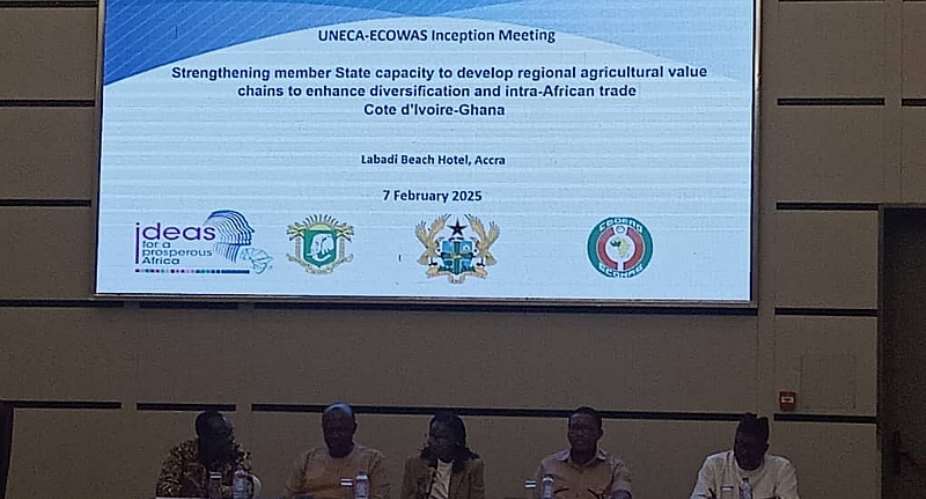
An inception workshop to develop regional agricultural value-chains to enhance diversification and stimulate intra-African trade between Ghana and Cote D’Ivoire has concluded in Accra, Ghana, with the identification of some commodities.
The expert meeting was to identify one commodity in addition to Cocoa, which resulted in the ranking of Cassava as the most popular commodity followed by coconut, yam, poultry and rice.
The justification criteria for the commodities include trade balance improvement, job creation, poverty reduction, food security, country’s comparative strength, commonality with Cote D’Ivoire and domestic use plus export potential.
The rationale for cassava attaining the highest ranking stemmed from being a low hanging in nature, extensive research available, available planting material, climate resilient, large number of derivatives, chips including animal feed, other products, ethanol (base products for other products and fructose), processing throughout West Africa and a market value estimation of USD$50 Billion and expected to rise.
Coconut on the other hand was ranked for its market value of USD$20 Billion now and expected to rise to about USD$38.5 Billion is produced in 11 out of 16 regions, derivatives is zero from tree to root, generates employment opportunity with Ghana leading the park in the production of the commodity and at number 12, globally.
Professor Ferdinand Ahiakpor, Lead Consultant of experts from Ghana and his counterpart from Cote D’Ivoire, Dr Aminou Arouma and the team would now assess the econometric value of the commodities between the two countries in addition to cocoa.
ECA, in collaboration with the African Union Commission (AUC) and development partners, has developed the AU-Guidelines for the Development of Regional Agricultural Value Chains in Africa, which was endorsed at the Third Ordinary Session of African Union Specialized Technical Committee (STC) on Agriculture, Rural Development, Water and Environment STC, in October 2019.
The Guidelines serve as a framework that provides policy makers in the Member States, as well as Regional Economic Communities (RECs), principles and tools to inform and guide during the formulation of policies intended to promote a viable and sustainable agricultural development process in Africa through the fostering of regional agricultural value chains.
The project on Strengthening Member State capacity to develop regional Agricultural Value Chains implemented by ECA, in close collaboration with ECOWAS Secretariat, with a view to promote the application of the AU Guidelines for the Development of Regional Agricultural Value Chains in Africa for improved intra-regional trade in agricultural goods in the ECOWAS region, particularly in Cote d’Ivoire and Ghana.
The project will be implemented within the context of the Common African Agro-Parks (CAAPs) programme, which was adopted by the African Union as a programme associated with the African Continental Free Trade Area in October 2019.
The Common African Agro-Parks (CAAPs) initiative is part of a larger strategy to create regional agro-industrial hubs, aimed at increasing the supply of domestically produced and locally processed foods and goods.
Toward developing Africa’s second common agro-park, and based on the experience in supporting the development of Africa’s first envisaged common agro-industrial park (CAIP) between Zambia and Zimbabwe, ECA, is intended to develop a fully-fledged capacity building project, within the context of the CAAPs programme, to support Cote d’Ivoire and Ghana in developing a common agro-industrial park with the aim of contributing to building a case for the development of a common agro-poles as a transformational development mean for the 2 countries, as well as to fostering related institutional and policy innovation at the national regional level.
This phase of the project includes assessing cross-border value chains for two strategic commodities, including cocoa; and examining relevant policy, regulatory, and institutional frameworks in support of promoting cross-border value chains of identified commodities.
The forum was organised by the United Nations Economic Commission for Africa (ECA), ECOWAS Commission, and other UN Agencies and supervised by the National Development Planning Commission (NDPC).
Participants and institutions include Ghana COCOBOD, Ghana Coffee Board, Ministry Food and Agriculture, Ministry of Trade, Agribusiness and Industry, National Development Planning Commission (NDPC), Universities, Private Sector, NGOs, CSO’s, international organizations and development partners.

 Ms. Emelia Affi Agbenyo must honourably resign as new EC Deputy Chairperson to p...
 Why have US-Ukraine relations soured ahead of the midterms?
 Govt to meet Free Zones Authority, Trade Ministry over Customs Act concerns
 Kojo Bamba was never my driver or bodyguard — Nana B
 Ekow Assafuah petitions OSP to probe alleged World Cup visa facilitation irregul...
 Africa attracting wrong waste management solutions – GAIA report
 Summon Kofi Adams, GTA boss over 2026 World Cup visa scandal — NPP tells Parliam...
 Obuasi SHS headmaster accused of sexual abuse is NDC constituency secretary – Ma...
 Family demands answers over death of 14-year-old student at Abomosu STEM SHS
 Osahen Afenyo-Markin reflects on loneliness of public service, says survival is ...


