




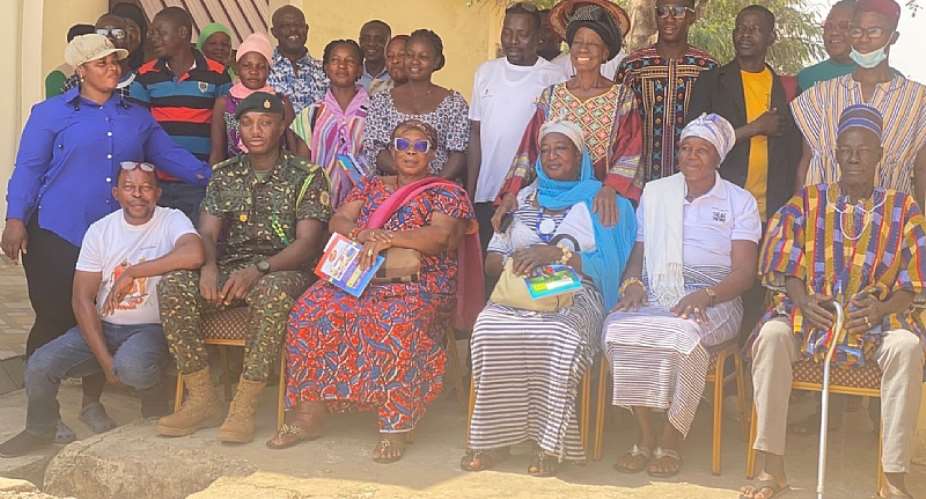
The Community Development and Advocacy Centre (CODAC), a Non-Governmental Organisation (NGO), is implementing a pilot project dubbed Women Against Violent Extremism (WAVE) in the Bawku West, Binduri, and Pusiga Districts of the Upper East Region.
These districts, which fall under the Kusuang Traditional Area, are located near the border town of Burkina Faso, where it is believed that jihadists are attempting to infiltrate local communities.
The project, sponsored by the Commonwealth Development Organisation under the British High Commission in Ghana, aims to enhance the capacities of at least 540 young men and women in 12 border communities to detect and respond to early warning indicators of violent extremism.
As part of the project’s implementation, community volunteers will be recruited and trained. These volunteers will be linked with WANEP-Ghana and security agencies to report incidents of violent extremism in their respective communities.
The project also seeks to strengthen collaboration among key stakeholders at the community and district levels to jointly prevent violent extremism.
Speaking at separate inception meetings in Bawku West, Binduri, and Pusiga Districts, CODAC Programme Manager Mr. Issahaku Bukari stated that high-level sources have confirmed that jihadists in Burkina Faso have been attempting to infiltrate Ghana’s Upper East border communities, particularly the Kusuang Traditional Area, where the ongoing "Bawku ethno-chieftaincy conflict" has heightened vulnerabilities.
“High-level sources have confirmed the presence of jihadist cells and hideouts in these areas. The Kusuang Traditional Area is considered the most vulnerable nationwide to social conflict and violent extremism, according to the National Early Warning System of the West Africa Network for Peacebuilding in Ghana (WANEP-Ghana),” he stated.
He added that since 2019, cross-border incidents have confirmed attempts by violent extremist organizations to infiltrate Ghana, particularly from the Central Region of Burkina Faso, which shares borders with Ghana’s Upper East Region.
“Extremist activities in Ghana's Bawku, Widnaba, and the Nazinga forest have been confirmed, with Burkinabe fighters from Boulgou province in Burkina Faso involved in the conflict. Arms are allegedly being smuggled from Burkina Faso into Ghana, but no links to terrorist cells have been proven yet,” he stressed.
Mr. Bukari highlighted the gender dimensions of violent extremism, emphasizing the importance of gender-focused initiatives in preventing and countering its spread. He explained that the WAVE project specifically focuses on women due to their increased vulnerability to recruitment by violent extremist organizations (VEOs).
Despite the presence of numerous local and national counter-extremism programs in Ghana, he noted that there is no dedicated initiative aimed at raising awareness among women and girls about violent extremism threats, vulnerabilities, and protective measures.
“Women and girls in the Kusuang Traditional Area, as well as those in Burkina Faso and Togo, are more likely to fall into the hands of violent extremist organizations than to embark on hazardous migration journeys abroad due to uncertain financial and economic prospects. Their strong cross-border social bonds can be exploited by extremist groups to recruit more women and girls in Ghana into VEOs,” he stated.
The WAVE in Border Communities Project aims to address gender-specific security gaps by raising awareness of how extremist groups manipulate women and girls, identifying gender-specific radicalization processes, and countering recruitment strategies.
The inception meeting brought together key stakeholders, including queen mothers, representatives of women's groups, youth groups, the Ghana Immigration Service, Customs, Excise and Preventive Service (CEPS), the Police, and opinion leaders. These stakeholders are expected to collaborate to help combat violent extremism in the region.
Security agency representatives lauded the project, emphasizing the need for an extended implementation period to ensure greater impact and sustainability.

 'Climate action is alive': Triumphant Democrats attend COP31 summit shunned by T...
 South Africa's Ramaphosa heads to US for AI visit
 China to host first-ever trilateral meeting between Trump, Xi and Putin next wee...
 Delegates to elect NDC Volta regional executives today
 NDC regional elections begin today
 IMF says Ghana's economic stability is taking root, shifts focus to long-term re...
 GRA arrests China Mall officials over alleged E-VAT violations
 Customs seizes 97 bales of imitation wax prints and 10 motorbikes in Techiman
 Minority demands Bank of Ghana Governor appear before Parliament over new cedi n...
 Dangote Seeks Deal to Process 500,000 Tonnes of Ghana Cocoa Locally


