




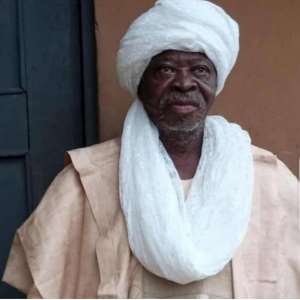
If the words of Ibn Khaldun in his Muqaddimmah on the importance of historical knowledge as “a noble discipline” is anything to go by, then the men and women who make efforts to preserve different aspects of our history, despite the inconveniences of such adventures are noble personalities whose stories of toils and sweats must be retold for all. Not only have they preserved history by recording events that would have been unknown to later generations, but they have also made history themselves because not everyone has the means and the expertise for such noble tasks. As such, biographies, whether succinctly short or exhaustively long, are a way to appreciate the efforts of important persons and to give the coming generations a chance to emulate them. In this regard, it would be worth all the sacrifices to bring to light the remarkable exploits of the Yoruba African scholar and historian from Ibadan - Sheikh Murtaḍa Abubakar Gatta-Agbọtọmọkekere Oke-Koto who illuminated our otherwise ‘historically’ dark paths with the bright ink of his pen.
Who Is Sheikh Murtaḍa Abubakar Gatta-Agbọtọmọkekere Oke-Koto?
Sheikh Murtaḍa Abubakar Gatta also known as the son of the teacher of Oke-koto or ibnul mua’lim fauqal-garr was a prolific author and an accomplished African scholar. His full name is Murtaḍa (Alamu) bn Abībakr bn Muhammad bn Hassan Gatta bn Ismaai’l. He was a historiographer, historian, jurist, author, and teacher. He was born incolonial Nigeria in the city ofIbadan, present dayOyo state. He is considered as one of the foremost authors on the history of Islam in Yoruba land with a large focus on Ibadan and its environs. His principal academic works capture different intellectual discourses such as history, sociology, literature, Islamic studies, and philosophy. He famously referred to the significance of a historiographical compilation of the activities and contributions of early indigenous West African Muslim scholars as an adventure that must neither be forgotten nor undermined by the switching of time or the passing of generations. In the introductory part of his book,Diya bn Muhammad, he famously and poetically wrote:
“These (early) scholars are the ones who, with their flowing pens, adorned the pages of papers with (intellectual) information in Arabic language… it is unbefitting that we forget or deny their virtues and exploits over the (passing of) times and ages” (Sheikh Murtadha, Diya bn Muhammad).
Early Life and Family
He was born inÌbàdàn during the colonial era to a religious household, known for centuries of Islamic scholarship, literacy, and leadership spanning well over 200 years across different spatial and temporal clusters. His grand-father, Sheikh Muḥammad of Bida, who passed away in the year 1846 CE (1262 AH) was known as one of the early Muslim scholars who lived in pre-colonial Ìbàdàn empire. His father, Sheikh Abūbakr Gatta Agbọtọmọkekere (d. 1954CE / 1373 AH) was a former mufti of the Māliki school of jurisprudence in Ìbàdàn. His uncle, Sheikh Abdul Salām Oke-Koto was an accomplished author and jurist who was referred to as “the renowned scholar” by the German researcher Stefan Reichmuth and his Nigerian counterpart Isaac Ogunbiyi in their well-known publication, ‘Arabic Papers from the Olubadan Chancery II: Toying with the Caliphate’. His brother, As-sheikhA’bdul-Ġaniyy bn Abībakr Gatta Agbọtọmọkekere became the 17th Grand Imam of Ìbàdàn on 15 May 2015 after first serving as the city's chief-Mufassir.
Career
Sheikh Murtaḍa Abubakar Gatta worked as a teacher atKharashi high school (established in 1945 CE / 1364 AH) for some period where he taught different subjects that relate to Islamic jurisprudence and Arabic language. After moving on from his teaching position at the school, he continued to teach using his private space, courtyard, and home mosque as places where students could learn Islamic and Arabic studies. Versed in the Islamic jurisprudence of the Māliki school, he collated and edited the scholarly works and manuscripts of his uncle, Abdul Salām bn Muḥammad bn Hassan Gatta (also known as the teacher of Okeekoto) - one of the foremost Māliki scholars of his period who passed away circa 1920 CE (1338 AH).
Recovery and Modernisation of Family Manuscripts
As a testament to his love for preserving intellectual legacies of early indigenous scholars and his focus on sustaining the intellectual contributions of his family, Sheikh Murtaḍa Abubakar Gatta modernized and re-published old family manuscripts that belonged to the successive scholars of his family. This can be seen as one of his several contributions to maintaining the legacies of West African Islamic scholars to the larger Islamic world and beyond. Some of the re-published manuscripts, originally authored by his uncle, Sheikh A’bdu-s-Salam bn Muhammad include:
1. Ṭarīqul Jannah – The Path to Paradise
2. Tuhfatul Muhaditheen wal Ghafilin – The Masterpiece of the Instructor and the Forgetful
3. Sirājul Wāiżīn – The Admonishers’ Lamp
4. Tuhfatul Wā-iżīn – The Masterpiece of the Admonishers
Intellectual Contributions
Apart from preserving and modernising old manuscripts that would have been entirely lost, he extensively published his own works on different aspects of islamic jurisprudence, behavioural science, sociology, and history. Sheikh Murtaḍa Abūbakr Gatta stressed that in the area known today as Nigeria and the wider ‘Sudan’ (or the Sub Sahara), indigenous Muslim “scholars have written useful intellectual works in Arabic language as early as the 10th century of the Hijrah” to debunk a series of afro-pessimist views that argue otherwise.
Some of his Known Publications:
1. Miraatu Nadhireen fii ta'riifil Aasaal minal ulamai fi baladi Ibadan.(Observer’s Mirror in Defining the Foundational Scholars of Ibadan)
On the activities of early Muslim scholars of Ibadan and their struggles to establish a safe space for Muslims in the city.
2. Diyāʾ bn Muḥammad (Illumination of the Son of Muhammad)
An expanded work on the history of Islam in Ibadan and its environs. The book also includes examples of literary contributions of indigenous scholars to Arabic and Islamic studies.
3. Sirājul Mašāyiẖ (The Lamp of the Scholars)
A sociological observation of the social and cultural life of Muslim scholars in Yoruba land. The book contains observations on the state of the Muslim ummah with a focus on the scholars and some of their excesses.
4. Aysarul Janāiz (Simplified Funerals)
On the rituals of Janāza with inputs from the different principal schools of thought. The book also contains reflections on some cultural activities among Yoruba Muslims on funeral services and the position of sharia on such activities.
5. Nuzḥatul Ahbāb (Outing with Beloveds)
The book is a compilation of the scholarly works and the traditions of scholars from his family of Agbotomokekere-Gatta.
Apart from the published works, he was also working on different manuscripts that were yet to be published until his demise on the 13th of February 2024 CE (3-Shaban-1445 AH). He passed away a day after returning from Ummrah with his last words being “laa illaaha illa Allah Muhammadu Rasuulullah Salla Allahu alaehi wa salam”.

 Ukraine launches fresh drone attack on St. Petersburg region on final day of ‘Ru...
 US Ebola facility in Kenya fuels anger in a country with no cases
 Ghana considering legal action against South Africa over xenophobic attacks — Ab...
 There's no acrimony between Agric and Finance Ministers — Dafeamekpor
 Finance and Agric Ministries clash could create COVID-like effect — Bryan Acheam...
 Allow people to do their things in their rooms — Senyo Hosi on anti-LGBTQ bill
 Disregard news of ministerial reshuffle — NDC urges Ghanaians
 Awutu Senya East NDC Branch elections face uncertainty amid register controversy
 Flooding is now a festival in Ghana, we have it every year – Kamal-Deen Abdulai
 Mother, son arrested over alleged murder of husband at Nsawam-Adoagyiri


