




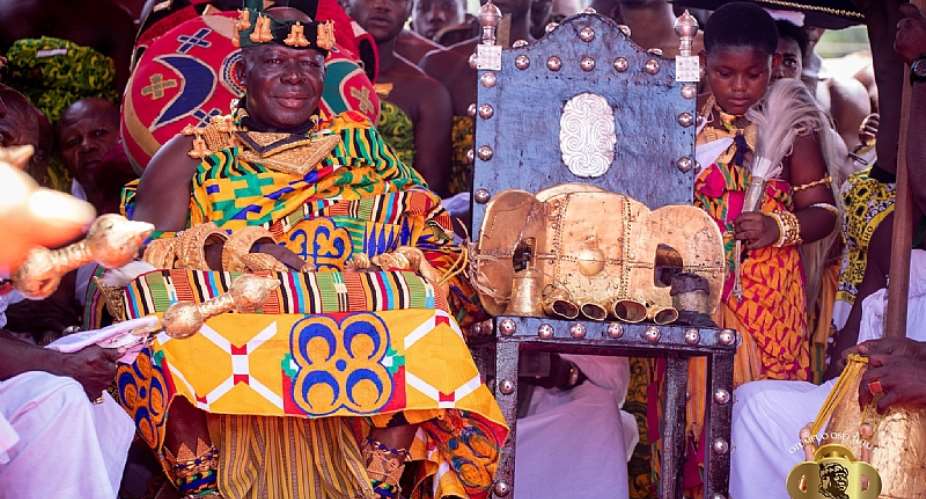
The chieftaincy system in Ghana plays a significant role in the nation's cultural and political spheres. While traditional leadership is widespread across the country, it is not uniform in structure and hierarchy. The Asante Kingdom, in particular, stands out for its centralized governance and the authority of the Asantehene, who his people regard as a king despite the absence of formal legal recognition of kingship in Ghana.
The lack of official acknowledgment has led some to equate the Asantehene to a typical paramount chief erroneously. However, such comparisons overlook the complexity, historical significance, simple arithmetic, and cultural importance of the Asantehene's position. This article explores why the Asantehene's status is far beyond that of a paramount chief and why attempts to equate the two reflect a misunderstanding of Ghana's diverse traditional systems.
The absence of a legally recognized national king in Ghana reflects modern republican governance, which places sovereignty in the hands of the people and their elected representatives. The Chieftaincy Act, which governs the role of traditional leaders, does not recognize any figure above the paramount chief. This decision dates back to the colonial period and has continued into post-independence governance. It aimed to prevent traditional rulers from wielding sufficient power to challenge the central government.
However, this legal framework does not encapsulate the full extent of Ghana's rich cultural diversity. Different regions and ethnic groups maintain varied systems of leadership, some of which are highly centralized. The Asante Kingdom is distinctive due to its historical and cultural influence. Although the Asantehene is not officially recognized as a king by the state, he continues to be regarded as the de facto monarch of the Asante people.
The Asante Kingdom has long been a centralized state with a sophisticated hierarchy that reflects its political and cultural complexity. At the base level, families are governed by the Abusua Panyin, followed by villages led by the Odikro, and then divisions ruled by divisional chiefs or Ohene. Paramount chiefs, or Omanhene, preside over entire states, which are collections of these divisions. The Asantehene, at the apex of this structure, governs the Asante Kingdom as a whole.
Historically, the Asantehene was not just a ceremonial leader but a ruler whose authority extended across multiple states within the kingdom. Unlike the decentralized systems in other regions of Ghana, this structure positioned the Asantehene as a unifying figure, holding sway over 60 paramount chiefs who swore allegiance to him. To equate the Asantehene with a single paramount chief from another region is to disregard the scope and reach of his influence. Mathematically, the Asantehene's authority is different from that of a typical paramount chief, just as the leader of a federal system cannot be equated with a state governor.
The Asantehene's role is not merely political but also deeply symbolic. He represents the unity, identity, and spirituality of the Asante people. His leadership has continued for centuries, and his position embodies the cultural heritage of one of Ghana's most prominent ethnic groups. Reducing his status to that of a paramount chief ignores the rich tapestry of Asante tradition, which positions the Asantehene as both a political leader and a cultural symbol.
This misunderstanding of cultural diversity is not just a misrepresentation of the Asantehene's position but a broader reflection of the challenges faced when applying a uniform legal framework to a country with varied traditional systems. The Asante Kingdom's centralized structure is deeply rooted in its history and has functioned effectively for centuries. Imposing a decentralized model on it would be illogical and disrespectful of the historical context that shaped the Asante political system.
Even during the colonial period, the British recognized the unique status of the Asantehene. Although they sought to prevent traditional leaders from becoming powerful enough to challenge their authority, they acknowledged the Asantehene's role as "primus inter pares"—first among equals. The British conducted diplomacy with the Asantehene as they would with any sovereign ruler, a recognition that extended beyond Ghana's borders.
In post-colonial Ghana, leaders like Kwame Nkrumah acknowledged the Asantehene's cultural authority while ensuring that political power remained centralized. This delicate balance allowed the Asantehene to maintain his symbolic and cultural leadership without threatening the modern state. Even today, the Asantehene occupies a special place in Ghanaian society as a figure of historical, cultural, and symbolic importance.
Those who attempt to equate the Asantehene with a paramount chief based solely on the constitutional framework must include a crucial point: Leadership is not determined solely by title but by the scope of influence and the number of people governed. The Asantehene, who presides over 60 paramount chiefs, commands far more authority than any paramount chief.
His leadership extends across an entire kingdom, encompassing millions of people and carrying immense cultural weight. While the Ghanaian Constitution may not formally recognize the Asantehene as king, his position in the Asante cultural and political structure far exceeds that of a typical paramount chief. His large following and the historical significance of his leadership place him in a league of his own.
To ask the Asantes to equate the man who sits on the Sika Dwa Kofi—the Golden Stool, the symbol of the Asante Kingdom’s soul and unity—with a paramount chief is culturally insensitive and spiritually unfathomable. The Asantehene occupies a revered position transcending mere political leadership; he embodies centuries of history, heritage, and collective identity for the Asante people. The Golden Stool, upon which the Asantehene’s authority rests, is considered the essence of the Asante nation, believed to house the spirit of the Asante people, both living and dead. Therefore, any attempt to reduce the Asantehene's role to that of a typical chief reflects a profound misunderstanding of the spiritual and cultural dynamics of the Asante people.
To impose such a comparison is not just impractical but also culturally disrespectful, as it disregards the spiritual significance of the Golden Stool and the Asantehene’s role in safeguarding the traditions and spiritual well-being of his people. The Asantehene’s authority and stature, deeply rooted in history and spirituality, place him far beyond the realm of an ordinary paramount chief. Therefore, any call to view him as such is not only illogical but also a violation of the deep spiritual and cultural values that define the Asante people.


 'Stop unlawful detention, searches, debt-related arrest, torture during criminal...
 Ato Forson’s suspension of board sitting allowances very serious matter, must be...
 UG seeks legal clarity on Rent Control’s authority over its hostels due to natur...
 UAE imported $56.7bn worth of undeclared African gold in 2024 – Swissaid report
 Man arrested in Dublin over fatal stabbing of 21-year-old Ghanaian Thomas Oduro ...
 Speaker Bagbin proposes independent account audits, spending limits to regulate ...
 You promised Nkoko Nkitinkiti and within two years you have not deliver even 2% ...



Comments
please can you show us a picture where Asantehene is sitting on Golden Stool?