




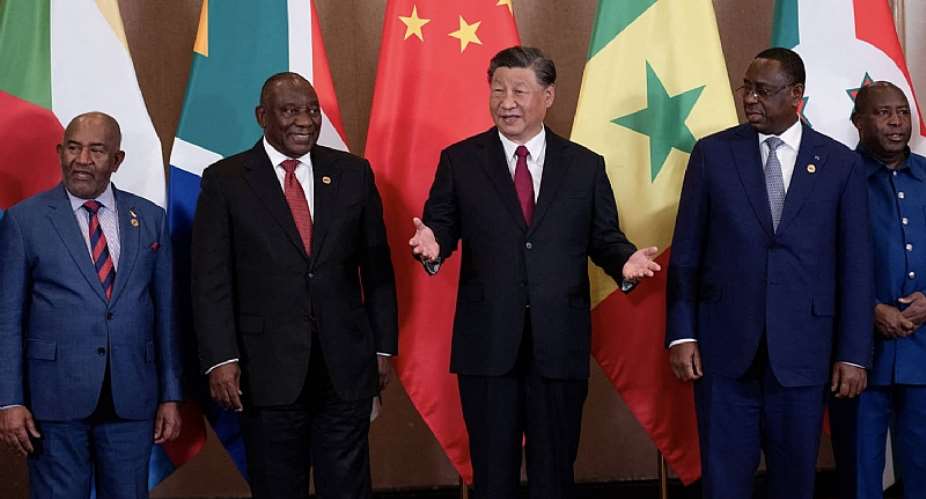
The Ninth Ministerial Conference of FOCAC took place in Beijing from September 4 to 6, 2024, under the theme “Joining Hands to Advance Modernisation and Build a High-Level China-Africa Community with a Shared Future.” Leaders from 53 African nations, along with the Chairperson of the African Union Commission and the UN Secretary-General as a special guest, attended the Summit, marking a significant gathering that underscores China’s focus on Africa.
2024’s Forum on China-Africa Cooperation (FOCAC) takes place against the backdrop of two significant trends. First, the role of the Global South and the debate over whether China should be considered a part of it has become a more prominent question amidst escalating U.S.-China tensions and an increasingly pronounced North-South split around issues like the conflict in Gaza. Since its inception in 2000, many nations—including the US, Russia, India, and even smaller participants like Italy—have taken the initiative and hosted large gatherings of African leaders as part of their own "plus one" summits. Nonetheless, FOCAC is still regarded as the most significant meeting for Africa.
One of the reasons FOCAC has become so influential is that it plays this game of optics better than most. While it replicates the inherent inequality of the 54 countries versus one country structure, this happens within the context of China’s assiduous small-country diplomacy. Unlike in the United States (or even Italy), leaders from African countries frequently receive the full red-carpet treatment, including meetings with Chinese President Xi Jinping during bilateral visits to China. This softens the imperial logic that underlies the Africa Plus One summit structure of FOCAC. Once they show up at FOCAC, many of these leaders have already met Xi and done the “grand tour” of Beijing, Shanghai, Shenzhen, and Guangzhou, which now characterises official bilateral visits.
Deciphering FOCAC 2024
At the outset of the Summit, delegates adopted the Beijing Declaration, which emphasizes building “a shared future in the new era,” alongside the Beijing Action Plan for 2025-2027. These initiatives align with the white paper released by China in September 2023, titled “A Global Community of Shared Future: China’s Proposals and Actions.”
By the end of the Summit, a comprehensive 30-paragraph Beijing Declaration was approved, highlighting key Chinese initiatives such as the Global Development Initiative (GDI), Global Security Initiative (GSI), and Global Civilization Initiative (GCI). The declaration also noted Africa’s appreciation for China’s support of the African Union’s inclusion in the G20, subtly countering India’s efforts to advocate for Africa’s permanent membership.
China pledged zero-tariff treatment for 100% of tariff lines to all 33 least developed African countries. In contrast to its previous commitment of at least $10 billion in investment and an equal amount in credit lines during the 2021 Dakar summit, this time China announced a total of 360 billion yuan (approximately $50.70 billion) in financial assistance over three years, specifying that 210 billion would come through credit lines and at least 70 billion in new investments from Chinese companies.
However, while the $51 billion figure may seem impressive, it is somewhat misleading. Of this amount, around $29 billion is allocated for “credit lines,” which are likely to benefit Chinese firms more than African stakeholders. Additionally, the $10 billion labeled as “investment” is vague, as much of it will come from Chinese private enterprises, particularly in the mining sector. The remaining $11 billion is categorized as “assistance,” mostly in the form of foreign aid, spread over three years—an amount that pales in comparison to the $8 billion in annual humanitarian assistance the US provides to Africa.
The COVID-19 pandemic exacerbated Africa's debt crisis, with about 40% of African countries at high risk of debt distress, and 18% experiencing a debt crisis in 2021. Many of the 30 African nations participating in the G20 Debt Service Suspension Initiative (DSSI) sought relief, with countries like Zambia, Ethiopia, and Ghana applying for debt relief. China has been compelled to erase 23 debts for 17 African nations and provide various debt deferrals and refinancing options.
Despite this, Chinese lending to Africa continues to rise, albeit still below the peak of $28 billion in 2016. In 2023, China granted $4.61 billion in loans to African governments. While China holds about 60% of Africa’s bilateral debt, its share of total sovereign debt in sub-Saharan Africa remains relatively modest at around 6%. The majority of African debt consists of domestic (60.9%), commercial (16.4%), and multilateral (13.7%) debt.
Notably, for the first time, China announced its support grants and loans in Yuan, with international payments in RMB now making up 6% of all currency transactions—surpassing the Euro's share of 5.3%. This marks a significant move toward de-dollarization and the promotion of the Chinese Yuan.
Conclusion
FOCAC 2024 received significantly less media attention in Africa compared to the previous summits, raising concerns about the Summit's waning significance. Initially conceived under the Chinese principle reflected in the proverb, “If you want to get rich, build roads first,” FOCAC now faces a world marked by considerable turbulence and rapid change. Consequently, China's approach to Africa is evolving in response to these dynamics.
China's financial commitments to Africa now seem more cautious compared to the dynamic strategies of the mid-2010s, characterized by extensive resource agreements and significant loans. In its engagement with Africa, China has now adopted the phrase “xiao er mei,” meaning “small and beautiful,” suggesting that lenders should support both modest and impactful projects. This shift emphasizes a focus on financial and environmental sustainability. Looking ahead, a crucial question remains: whether African nations move past the formalities of these summits to negotiate effectively, set their terms, and assert their priorities.

 1,568 new lawyers must use law to advance justice — Chief Justice
 GH¢800,000 worth of goods lost in Kia Rhino truck fire at Amanfrom
 I never said Ghana has more nurses than it needs — Akandoh
 I have tried reaching Boakye Agyarko after NPP chairmanship race, but to no avai...
 Ghana’s Corporate Illusion: Why We Celebrate Professional Titles More Than Natio...
 Sam George, Armah-Kofi Buah, Phyllis Naa Koryoo and OPK among 1,568 lawyers call...
 Visa scandal: 'Ampofo Ankrah’s suspension not enough; Kofi Adams must also step ...
 'Let integrity, discipline guide your conduct' — Samson Lardi tells new lawyers
 Labour Minister optimistic teachers will suspend strike by close of day
 Dr Ato Forson urges MMDCEs to eliminate waste in public spending


