




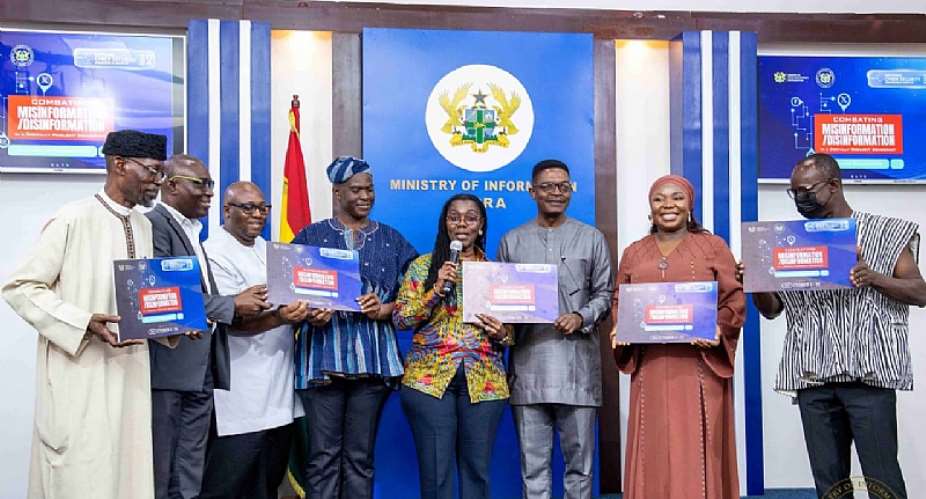
The Cyber Security Authority (CSA) has called on the Electoral Commission (EC) to be proactive in addressing issues of misinformation and disinformation ahead of Ghana's 2024 general elections.
The call was made by Dr Albert Antwi-Boasiako, the Director-General of the CSA, during the media launch of the National Cyber Security Awareness Month (NCSAM) 2024 held at the Ministry of Information Press Centre in Accra on Sunday.
"We therefore call on the Electoral Commission and other organisations to be prompt in addressing issues of misinformation or disinformation," he said, emphasising the need for a coordinated effort to combat this growing challenge.
Dr Antwi-Boasiako noted that the spread of misinformation and disinformation poses a threat to democratic processes and stability in Ghana.
He cited statistics from a study conducted by the International Institute for Democracy and Electoral Assistance (IDEA), which found that 94% of Elections Management Bodies (EMBs) were targeted with disinformation and attacks during the 101 national electoral events which are analysed in 53 countries between 2016 and 2021.
The study also revealed that disinformation targeting electoral campaigns was the highest at 33%, followed by voting operations and election day at 24%, the planning and implementation phase at 19%, and the post-voting period at 17%.
Dr Antwi-Boasiako emphasised the urgency of the situation, noting that as Ghana approaches the Presidential and Parliamentary elections in December 2024, the theme for this year's NCSAM, "Combating Misinformation/Disinformation in a Digitally Resilient Democracy; Our Collective Responsibility," could not be timelier.
He also stated the consequences of misinformation, citing examples from the UK and Rwanda, and a study by the University of Oxford (2024) that revealed social media platforms were used to spread misinformation and disinformation in 81 countries, with 70% of online misinformation being spread through just 10% of social media accounts.
Dr Antwi-Boasiako stated the need for increased public education and stakeholder collaboration to develop and implement strategies to counter the spread of false information.
He also stressed the legal implications of disseminating misinformation, citing relevant sections of the Criminal Code and the Communications Act.
"It is important to intensify the education of stakeholders including the public and the media and communications fraternity on how to detect and report misinformation," he noted.
 S.african Police Probe Killing Of Foreigner In Xenophobic Unrest
 Tension at Bantama NPP office as chairman accuses Asenso Boakye of political mac...
 Korle Bu succesfully performs first two off-pump heart bypass surgeries
 Disability Act lacks teeth, must be strengthened — Annoh-Dompreh
 Mental health, drug tests now mandatory for firearm licences — Interior Minister
 GoldBod directs licensed buyers to report gold purchases within five minutes
 Action will be taken on viral video showing SHS student assaulting a junior — Dr...
 NDC promised to ease cost of living yet increasing utility tariff — Kofi Tonto
 NDC is a useless govt – Miracles Aboagye fumes
 Govt eyes 1,012km rail corridor to boost trade, transform cargo transport from T...


