





Niger’s relations with its neighbour Benin have been strained since the July 2023 coup in Niger, followed by the border closure. Despite incurring huge losses, landlocked Niger was reluctant to open its border with Benin citing security reasons. Last month, China sent its Foreign Ministry and Energy Ministry officials, along with CNPC executives, to resolve the dispute between the two nations. After China’s successful mediation, Niger has agreed to restore its diplomatic relations with Benin, and open up the border. Consequently, Benin also agreed to allow Niger dispatch oil shipment using Benin’s port. While China is set to economically benefit from the deal, China’s successful mediation also marks its emergence as a peacemaker in Africa.
Niger-Benin Oil Pipeline Row
In March 2024, the Chinese state-owned company China National Petroleum Corporation (CNPC) completed an almost 2,000-kilometer pipeline from Agadem in eastern Niger to Seme-Kpodj of Benin, close to Cotonou port on the Atlantic coast.
Started in September 2019, the project was expected to be operational by 2021. However, the project got delayed due to the pandemic and other instabilities in the region. The July coup in Niger and consequent sanctions over Niger, imposed by the ECOWAS (Economic Community of West African States), further complicated the situation and project costs soared well above estimated $5 billion. ECOWAS sanction prompted Niger to leave ECOWAS and join Mali and Burkina Faso to form the Alliance of Sahel States (AES), another regional grouping of three junta-ruled countries of West Africa.
In December 2023, Benin unilaterally opened its border for Niger on humanitarian grounds. This was followed by the partial removal of sanctions by ECOWAS in February 2024 on the same ground. However, Niger decided not to open its border, despite Benin doing so, preventing Beninese goods and people from entering Niger. Although Niger cited security concerns, it was principally because of the Benin government’s open condemnation and public protests against the coup. The junta of Niger was probably scared that France or ECOWAS would use the Benin border and attempt to reinstall the earlier government.
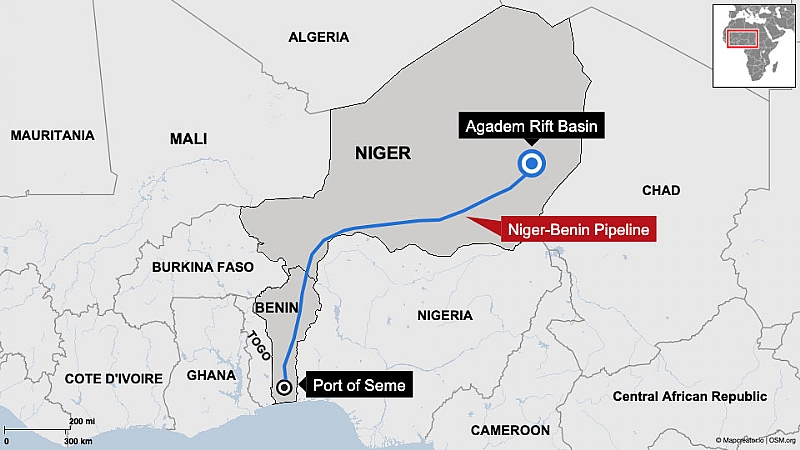
Source: https://chinaglobalsouth.com/2024/05/16/benin-allows-niger-to-export-crude-overcoming-a-dispute/
Ironically, the survival of the junta government depends on its relationship with Benin. Before the coup, the Benin corridor, which connected the capital of Niger Niamey, with the Cotonou port, handled 80 per cent of Niger’s freight. As a matter of fact, both the IMF (International Monetary Fund) and the African Development Bank (AfDB) have predicted an 11 per cent or more growth rate for Niger in 2024, based on its oil export. However, to export, Niger was required to make peace with Benin.
Deconstructing Chinese interest in the deal
While China’s intervention in this standoff is primarily driven by its economic interests, it also has vital political motivations in Niger and the broader Sahel region. Besides, China also aims to build a positive international image as a successful mediator. This is reflected well in its mediation efforts in the Niger-Benin standoff.
Economic interests
CNPC alone has invested more than $4.6 billion in Niger’s petroleum industry. With an investment of over $5 million, this pipeline project was the biggest investment CNPC has made in a cross-border crude oil pipeline. Currently, NIger produces 20,000 barrels per day (bpd). However, the pipeline can transport 90,000 bpd immediately, and China wants to export all of it. With the potential of carrying 110,000 bpd, the pipeline would transform the economy of Niger.
In addition to crude oil, Niger also boosts of Africa’s highest-grade uranium ore and accounting for about five per cent of the global production. In 2007, the state-owned China National Nuclear Corporation (CNNC) entered a joint venture with the Nigerien government to develop the Azelik uranium mine. However, the project was closed in 2015 due to financial difficulties. In July 2023, China Nuclear International Uranium Corporation, known as SinoU, agreed to restart the project. With an estimated 15,600 tons of Uranium resources, the mine is expected to produce 700 tons annually, benefiting China’s nuclear industry.
China also gave the junta government of Niger a loan of $400 million to help the country pay off its mounting debt, accumulated since the military takeover. The interest rate of the loan is seven per cent, which Niger agreed to pay back with the export of an equivalent amount of oil within a year. China also conducts significant trade with Benin, more than hundreds of millions of dollars annually, and, consequently, is keen to resolve the standoff. This successful mediation was pivotal for China to protect its economic and resource interests in the region.
Political interest
Niger is also important for China to increase its political clout. Six years ago, the US invested around $110 million in constructing two drone sites in Niger: Niamey and Agadez. The US spends another $30 million annually to maintain these two sites. Yet, the junta government that came into power in July 2023 asked the US to withdraw its troops and dismantle its bases. Earlier in December 2023, France was forced to remove its 1,500 military personnel from Niger. Although Russian military personnel have started to arrive in Niger, China senses a void and may want to carve out some diplomatic space necessary to protect its commercial interests.
Reputational interest
Finally, when traditional partners failed to provide security in Niger, the success of China’s mediation efforts would undoubtedly increase the country’s international profile and reputation as a sincere security partner, at least in Africa. Using expressions such as “community with a shared future” in its relations with African countries would establish China’s claim to normative commitment and to values of stability, peace, and prosperity.
Conclusion
With China’s diplomatic stance and economic leverage over both sides, the Niger-Benin rapprochement was crucial for China to safeguard its economic interests. However, this successful mediation has also raised Beijing’s diplomatic profile in Africa. In this regard, China’s lack of historical baggage in Africa has helped it earn an image of being a neutral mediator. Following the agreement, Benin agreed to allow Niger to export crude oil using its port. Undoubtedly, this successful mediation has strengthened China’s role as a peacemaker, and it will improve China’s image among Africans. However, most importantly, it signals a significant departure from Beijing’s usual politics of avoiding conflicts or conflict mediation.
The analysis in this article points out that Beijing’s motivations concerning the conflict resolution in Niger were a mix of economic, political and reputational drivers. Going forward, Beijing will remain invested in Africa’s security framework due to its BRI ventures, energy dependency, and trade relationships. However, China’s engagement in dispute resolution also clearly reflects its aspiration to be a global security provider. Therefore, this deal provides some crucial insights concerning its motivation and will be helpful in predicting China’s future course of action in other countries where it has similar interests.
Samir Bhattacharya is Associate Fellow at Observer Research Foundation


 1,568 new lawyers must use law to advance justice — Chief Justice
 GH¢800,000 worth of goods lost in Kia Rhino truck fire at Amanfrom
 I never said Ghana has more nurses than it needs — Akandoh
 I have tried reaching Boakye Agyarko after NPP chairmanship race, but to no avai...
 Ghana’s Corporate Illusion: Why We Celebrate Professional Titles More Than Natio...
 Sam George, Armah-Kofi Buah, Phyllis Naa Koryoo and OPK among 1,568 lawyers call...
 Visa scandal: 'Ampofo Ankrah’s suspension not enough; Kofi Adams must also step ...
 'Let integrity, discipline guide your conduct' — Samson Lardi tells new lawyers
 Labour Minister optimistic teachers will suspend strike by close of day
 Dr Ato Forson urges MMDCEs to eliminate waste in public spending


