




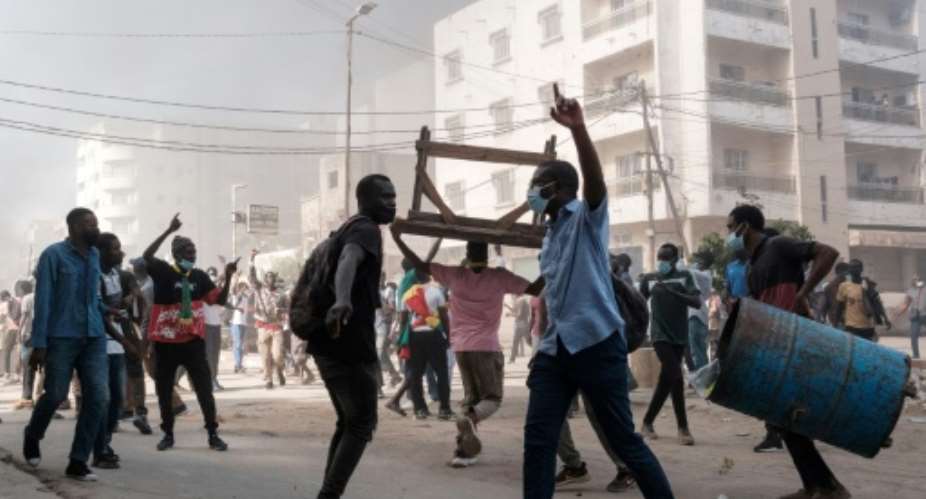
Senegalese civil society and opposition kept up the pressure on President Macky Sall on Monday, the eve of a planned march against the delay to this month's presidential election which has already unleashed deadly unrest across the country.
Sall's decision to push back the February 25 vote plunged traditionally stable Senegal into one of its worst crises since independence from France in 1960, with violent protests leaving three dead.
Campaigners from the Aar Sunu Election (Let's protect our election) collective, which includes some 40 civil, religious and professional groups, have called for a fresh march in the capital Dakar on Tuesday afternoon.
"We call on all Senegalese to mobilise, we call on all Senegalese to come and take part peacefully in this silent march to say no to the postponement of the elections, to say no to the extension of President Macky Sall's term of office," Abdou Khafor Kandji told journalists on behalf of one of the groups in the collective.
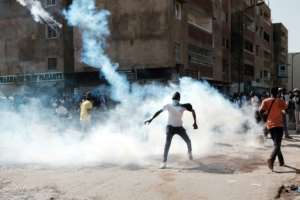 Security forces fiercely repressed demonstrations which took place on Friday. By GUY PETERSON (AFP)
Protests pitting youths against the security forces have turned increasingly violent in a country long seen as a haven of stability and democracy in West Africa, a region roiled by coups and unrest.
Security forces fiercely repressed demonstrations which took place on Friday.
The organisers of Tuesday's march said they had received no information from the authorities as to whether it would be banned.
Possible amnesty
President Sall is now seeking a way out of the turmoil.
Local media have reported the potential for a renewed dialogue with the opposition, including anti-establishment firebrand Ousmane Sonko, who fought the state for more than two years before being imprisoned last year.
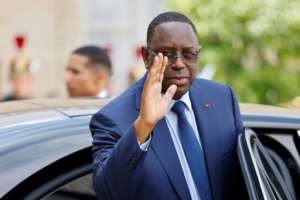 Senegal has been grappling with widespread protests since Sall announced the postponement of the presidential election. By Ludovic MARIN (AFP)
Some have even suggested the possibility of an amnesty for Sonko, his imprisoned second-in-command Bassirou Diomaye Faye and for those detained during the violent unrest of 2021 and 2023.
Neither the presidency nor the government have responded to AFP's requests for comment.
Senegal has been grappling with widespread protests since President Sall announced the postponement of the presidential election three weeks before the ballot.
Members of Sall's parliamentary camp, and those of one would-be candidate banned from standing, then voted in favour of the delay until December 15.
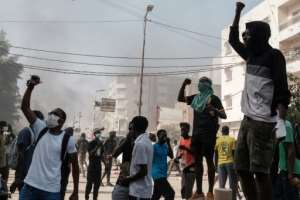 Senegal's eight public universities began a two-day strike on Monday over the death of a student during protests. By GUY PETERSON (AFP)
The contentious vote paved the way for President Sall -- whose second term was due to expire in early April -- to remain in office until his successor is installed, probably in 2025.
Senegal's opposition has decried the last-minute move as a "constitutional coup" and suspects it is part of a plan by the presidential camp to avoid defeat, or even extend Sall's term in office, despite him reiterating that he would not stand again.
Mistrust
Senegal's eight public universities began a two-day strike on Monday in protest over the death of a student during Friday's unrest in the northern city of Saint-Louis, the main higher education union said.
Academics posted a video on social networks demanding "the immediate restoration of the electoral timetable" and respect for human rights.
Sall said he postponed the election because of a dispute between parliament and the Constitutional Council over potential candidates barred from running, and over fears of a return to the violent unrest seen in 2021 and 2023.
He has also said he wants to begin a process of "appeasement and reconciliation".
But the rhetorical olive branch raises a host of questions, including whether it will be accepted by the likes of opposition figures Ousmane Sonko and Bassirou Diomaye Faye -- and what it means for their fate.
Various experts say that an easing of the tension is almost impossible unless the pair are released from prison and Sonko is allowed to run in the election.
But their party has so far rejected the offer of dialogue.
Faye's representative, Amadou Ba, took to social media to express his mistrust of a possible amnesty law -- which some media have said could be discussed on Wednesday by the Council of Ministers.
"An amnesty law is simply an ordinary law (which) can easily be renounced by a new National Assembly", he said.


 Israel election: Record turnout as Netanyahu and Eisenkot remain deadlocked
 'Ghana Airways will be back in the air before I leave office' — Ghana's Presiden...
 'You can’t make money in journalism' — Speaker Bagbin
 GES sets November 16 date for payment of 2025 promotion arrears
 Wontumi’s lawyers seek recall of prosecution witness in illegal mining case
 Minority urges independent audit of GHS49.7m South Africa evacuation
 Some prison inmates attempted to poison Wontumi – Palgrave
 NACOC Boss reveals how 'smart' suspected drug traffickers are diverting proceeds...
 Minerals Commission defends termination of Northern Ashanti Mines lease over US$...
 Ablakwa will be prosecuted in 2029 under Bawumia – Kwadwo Poku warns


