




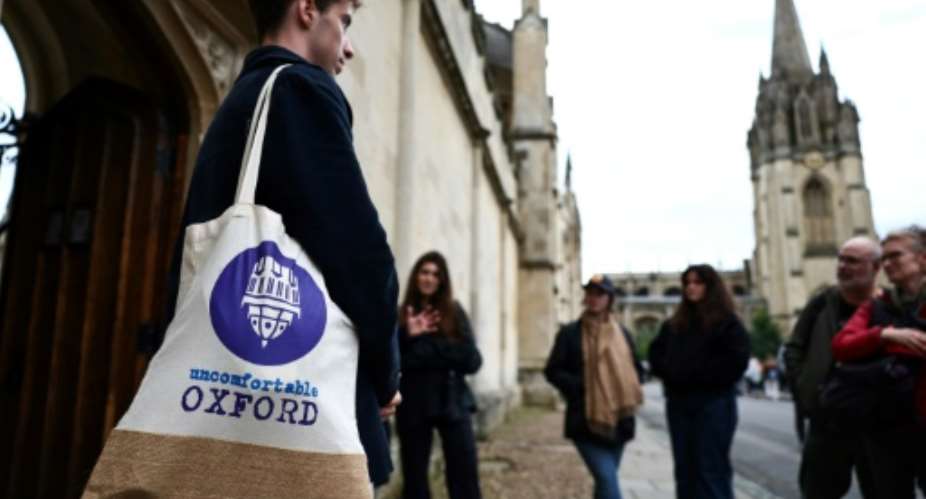
British universities Oxford and Cambridge are constantly ranked among the best in the world and celebrated for their academic excellence.
But their murkier history is being brought to life for tourists, as the country increasingly grapples with its colonial past.
"This is not the standard walking tour," warned guide and student Claire McCann, before leading her group onto the cobbled streets of Oxford, which attract some seven million visitors every year.
Majestic buildings, many dating back to the Middle Ages, bear witness to the rich history of the university city, some 50 miles (80 kilometres) northwest of London.
Most British prime ministers, including current UK leader Rishi Sunak, and the Labour main opposition leader Keir Starmer, have studied behind the high walls of Oxford's various colleges.
But their university years are not the subject of the tour, which instead focuses on "difficult legacies" -- a burning issue brought to the fore in the UK since Black Lives Matter anti-racism protests.
First stop on the tour is Oriel College, outside of which sits a statue of alumnus Cecil Rhodes (1853-1902), a coloniser who dreamed of a British Africa from Cape Town to Cairo.
McCann, originally from South Africa, read a quote of Rhodes in which he described Africans as the "most despicable specimens of human beings".
She highlighted his role in the Second Boer War (1899-1902) and that he founded De Beers, which is still the world's number one diamond company.
As part of the tour, she talked about the "exploitation" in the mines, which made Rhodes a fortune and also allowed him to set up one of the most prestigious academic awards in the world.
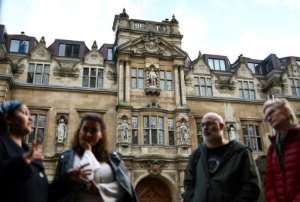 In Oxford, tourists are shown the statue of British coloniser Cecil Rhodes. By HENRY NICHOLLS (AFP)
Notable Rhodes scholars include former US president Bill Clinton.
"What should happen with the statue?" asked McCann.
Slavery
The "Rhodes Must Fall" campaign launched by students called for the statue's removal. But Oxford decided in 2021 that the statue would remain in place.
A short walk away across the High Street is All Souls College, which McCann described as "the most exclusive college in Oxford".
Dating back to the 1430s, it is one of the richest and only accepts two or three new research students per year.
"All Souls demonstrates for us how networks of prestige have historically been supported by economic exploitation and slavery," said McCann.
Following the Black Lives Matter protests of 2020, All Souls announced that it would no longer call its library after Christopher Codrington, a former student.
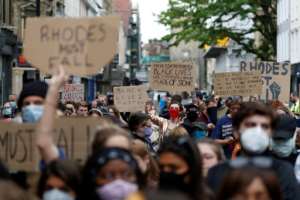 Protests have called for the statue to be torn down. By Adrian DENNIS (AFP)
When Codrington died in 1710, he left part of his fortune to the university, which according to All Souls' website came "largely" from his family's plantations in the West Indies that were "worked by enslaved people of African descent".
More than 20,000 people have participated in the walks, called Uncomfortable tours, since they started in 2018.
They also exist in Cambridge and the founders hope to extend them to London and even Paris.
"Did you know that Oxford and Cambridge combined own more land than the Church of England?" asked guide Ashley Lance as she walked along the tranquil River Cam, opposite Cambridge University's sumptuous King's College Chapel.
"According to a study published in 2018, Cambridge is the most unequal city in Britain," she added.
'Shocking'
Lance, 27, explained that two worlds exist in the city: one comprised of the university, with its students, professors and laboratories and the other made up of the rest of the population.
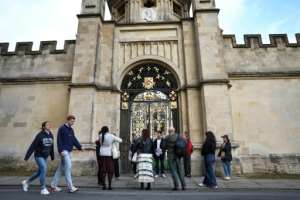 Also on the tour is All Souls College, which has received legacies from former students linked to slavery. By HENRY NICHOLLS (AFP)
Despite their rivalries -- Oxford is referred to as "the other place" in Cambridge -- the two universities have had much in common.
Women were able to study at Oxford from 1870, but had to wait until 1920 to qualify for a degree.
They were banned from libraries for a long time, for fear they would be "far too distracting" to men, explained McCann.
Oriel, founded in 1326, was the last Oxford college to open its doors to women, in 1985.
In Cambridge, St John's College, founded in 1511, accepted women from 1980. But on the day the first female students arrived, a faculty official lowered a flag to half-mast and wore a black armband.
"It's so shocking," said one exasperated Londoner on the tour, visiting with her daughter.
Michelle Miller, an American who has just moved to Oxford with her husband, said she was interested in the lesser-known aspects of popular tourist destinations.
"We didn't know there were so many controversies," the 52-year-old told AFP.


 Attorney-General appeals ruling halting trial of former Buffer Stock CEO, wife
 NAIMOS destroys 1,970 changfans, 863 Illegal mining structures in three months —...
 Let's see how Asiedu Nketia becomes NDC flagbearer with same people he conspired...
 Asiedu Nketiah opts out of NDC chairmanship race amid flagbearership speculation
 NDC insists Nkwanta North elections will proceed despite court injunction
 'My side of the story will shock you; I'm waiting for court days' – Obuasi SHTS ...
 Obuasi SHTS sexual abuse: 'GES must distant itself, allow the law to work' — For...
 Upper East: Fear grips nine Kusaug communities over mysterious fish deaths in da...
 NDC suspends Amasaman Communications Officer over 'irresponsible' remarks on Obu...
 Parliament secures religious leaders’ support to end witchcraft accusations


