




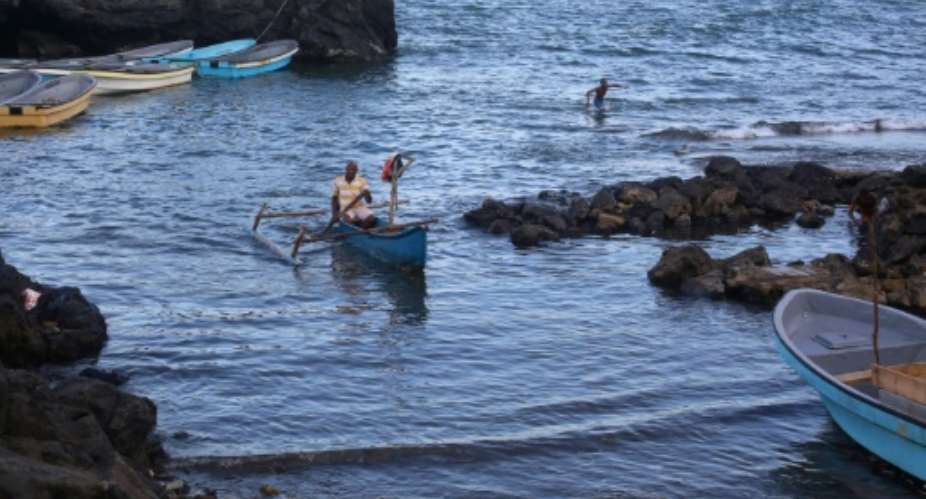
In Anjouan, part of the Comoros archipelago in the southern Indian Ocean, the distant French island of Mayotte casts a dangerous charm.
Boasting schools, hospitals, roads and a social safety net, Mayotte is an eldorado that every year thousands of impoverished Comorans risk their lives trying to reach.
Domoni, the second largest town in Anjouan, is a common departure point for migrants desperate for a better life.
Many of its 17,000 residents live off small-scale fishing -- but some also earn cash on the side through the lucrative business of human smuggling.
Sitting under the shade of almond trees, men banter while playing bao, a traditional board game.
Near the beach, the air reeks of resin, used to build and maintain timber boats called kwassa kwassa.
Almost half of Comoros's 900,000 inhabitants live below the poverty line, with average monthly incomes barely exceeding the equivalent of $110. Many have no access to health care.
Those trying to get to Mayotte -- 70 kilometres (45 miles) away at the closest point -- have to brave uncertain waters, packed in rickety, crowded boats.
How many have perished over the years is unknown, and for those who succeed in landing on Mayotte, the welcome is increasingly hostile.
France has stepped up its fight against illegal immigration, which is blamed in Mayotte for proliferating slums and worsening security.
A controversial operation, called "Wuambushu" (take back, in a local language) is underway to kick out undocumented migrants, most of whom are Comorans.
The operation faces resistance from the Comoros authorities who are refusing to accept deportees from Mayotte, saying it cannot cope with the influx.
'Fisherman-smuggler'
Sitting on a beach littered with rubbish, a 27-year-old man who asked to be called Abdou Ahmadi, admitted that he was a "fisherman-smuggler," who made a living both from his nets and from taking people to Mayotte.
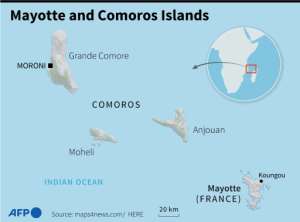 The four islands of the Comoros archipelago used to be a French territory. After a referendum in 1974, three became the Union of the Comoros while Mayotte stayed with France, becoming its 101st department. By Sophie RAMIS (AFP)
"I transport up to eight people in a month, but only sick people... I do it for God," he told AFP.
He said he charged the equivalent of 100 euros ($110) for a one-way trip.
"When I don't have a patient, I'm busy with my fishing. But fishing (alone) is not enough to live off," he admitted.
Ahmadi scorned the idea of leaving Domoni and living as "an undocumented migrant."
"I prefer to stay here," he said. "The situation in Mayotte is terrible, crime is very high. I'm not tempted".
A former smuggler who gave his name as Soula said he gave up the business after being handed a three-year jail term, and now worked as a taxi driver.
"I knew the sea like the back of my hand. But fishing was not very profitable. So I became a smuggler," he said. Some of the people he helped cross came from Madagascar.
"I have never lost anyone at sea. But I was arrested," he said, sitting on the red hull of a boat.
'So many deaths'
Rafouzoiti Dhoimir, 52, said she had tried three times to enter Mayotte but each time had been sent back.
Her three children live there, and she has not seen them in 15 years.
"I pray to God that (Wuambushu) is stopped," she said, thinking about her children living in shacks.
Wearing a navy and orange dress, she sat on an armchair in her small house opposite the beach, nervously wringing her fingers.
"I don't sleep anymore, I'm scared," she said.
She was too afraid to try another crossing.
"There have been so many deaths," she said. Her wish was that "one day they won't expel anyone, and we stop going there."

 Ukraine launches fresh drone attack on St. Petersburg region on final day of ‘Ru...
 US Ebola facility in Kenya fuels anger in a country with no cases
 Ghana considering legal action against South Africa over xenophobic attacks — Ab...
 There's no acrimony between Agric and Finance Ministers — Dafeamekpor
 Finance and Agric Ministries clash could create COVID-like effect — Bryan Acheam...
 Allow people to do their things in their rooms — Senyo Hosi on anti-LGBTQ bill
 Disregard news of ministerial reshuffle — NDC urges Ghanaians
 Awutu Senya East NDC Branch elections face uncertainty amid register controversy
 Flooding is now a festival in Ghana, we have it every year – Kamal-Deen Abdulai
 Mother, son arrested over alleged murder of husband at Nsawam-Adoagyiri


