




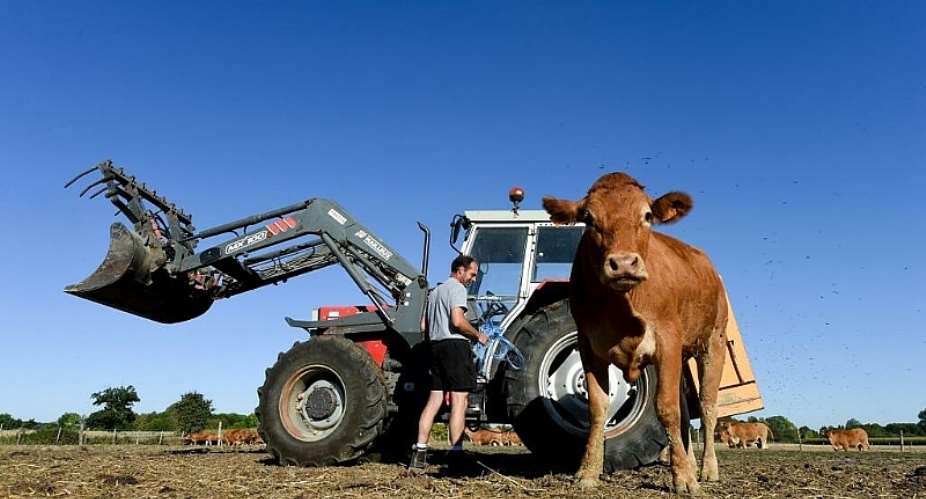
One hundred thousand farms have disappeared in France over the last 10 years, according to the latest Ministry of Agriculture data – which showed a profound shift, but not decline, in the farming sector.
The ministry's once-in-a-decade agricultural census, released on Friday, showed that France now has 389,000 farms, down from 490,000 in 2010, confirming a trend that began in the 1970s.
But the overall amount of farmland remained constant at 26.7 million hectares, equivalent to half the country's mainland territory.
The census showed French farms had gotten bigger on average, rising to 69 hectares in 2020 from 55 hectares in 2010 as land from the closed farms was folded into rival businesses.
Debate has mounted in recent years over the pros and cons of industrial-scale farming in France – the European Union's largest agricultural producer with a turnover of 74.6 billion euros in 2020.
Bigger and better?
There are growing concerns over animal welfare and the impact that ever-bigger cattle farms can have on the environment.
But your average French farm is still far smaller than agricultural businesses in major rivals such as Canada and the US, the farm ministry said.
"The size is human scale and very, very, very far from what some people want to make us believe about a galloping industrialisation of our agriculture," France's Agriculture Minister Julien Denormandie told reporters at a presentation of the census results.
The minister said French farms were now on a par in size with Germany but that North American farms were still far bigger. Canadian farms were 332 hectares on average in 2016 – five times the size of French farms – while US farms averaged 178 hectares.
Increasingly qualified farmers
Among the other changes in modern farming, the census found that organic farming had grown threefold with 12 percent of land now devoted to organic, compared to 4 percent in 2010.
The agriculture sector is also becoming less of a family affair with fewer family employees working permanently on farms (8 percent in 2020, compared to 12 percent in 2010).
Seasonal labour remains stable, accounting for 10 percent of the total workforce.
The census confirmed that the average age of farmers is increasing, with six out of 10 over the age of 50. Seven thousand new farmers are needed each year to replace those going into retirement.
The future is not bleak, however, and young, increasingly qualified, people continue to join the industry.
2020 was the first year which saw an increase in the number of students enrolling in agricultural schools.
Read also:


 Mahama urges regulators to simplify business permit processes
 President Mahama urges ECOWAS to stop the rhetorics, remove trade barriers
 Ghana's democracy is for sale as money floods party elections — Ho West MP
 Meet Diamond Lucas, 12-year-old UCC undergraduate student pursuing BSc degree in...
 GRA uncovers widespread tax non-compliance at West Hills Mall, 16 businesses inv...
 Education Minister directs GTEC, Rent Control to address rising tertiary hostel ...
 Over 1,200 bags of suspected smuggled rice, sugar intercepted in Tatale
 All qualified doctors employed – Majority
 BoG's MPR adjustment from 14% to 11% was a realignment, not a cut — Dr. Gideon B...
 VAT breaches uncovered in nearly every shop GRA checked at Achimota Retail Centr...


