




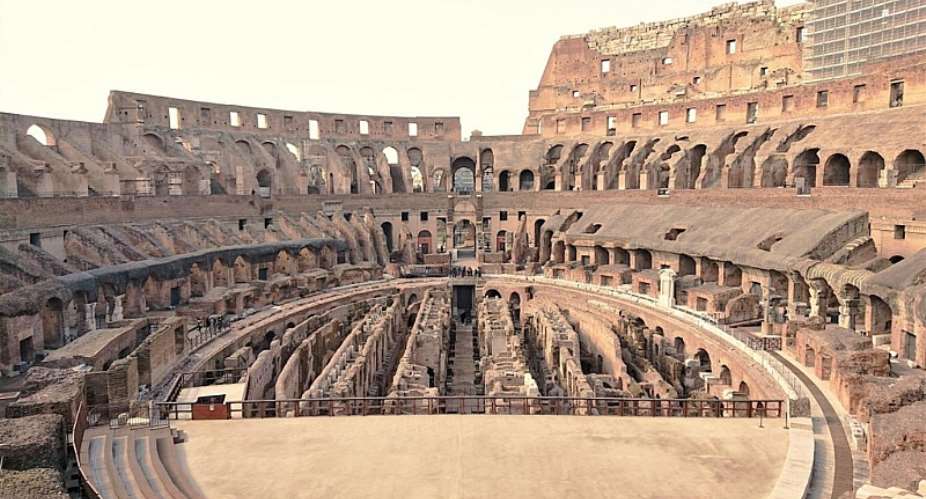
For the first time, visitors to the most popular tourist site in Rome, the Colosseum, are being given access to the freshly restored underground area below the arena where in times past chariot races took place and gladiators fought violent battles.
Below the ancient Roman amphitheatre, a 15,000 square-metre area existed with arched passageways and chambers for wild animals and performers. There were mobile platforms and wooden elevators to let the animals out so that they could join the combat action in the arena.
A special water system also allowed the arena to be filled with water for naval battles.
A new 160 metre wooden walkway for visitors has now been constructed in this area, known as the hypogeum, which provides access to parts of the monument which were not previously visible.
It took a multi-tasked team of 80 experts including archaeologists, architects, engineers, restorers, geologists, and other workers two years to complete the works, which were funded by Diego Della Valle's Tod's fashion group.
Alfonsina Russo, director of the archaeological park of the Colosseum, said the team worked for 7000 days inside the heart of monument in what was the second phase of a major restoration project of the iconic landmark that was launched in September 2013.
'A monument within a monument'
Russo said the restoration of the hypogeum was a very complex endeavour and the results are still under study adding that “each stone here is a witness of everything that occurred under the great arena of the Colosseum from its inauguration in AD 80 to its final performance in AD 523”.
“This was the backstage of the Colosseum, a monument within a monument which has now been fully restored and reopened”, she said.
The first phase of the works on the Colosseum involved the cleaning of the northern and southern facades, replacing damaged mortar in arches and fitting new gates while a third phase will involve the restoring of galleries, the creation of a completely new visitors' centre and a new lighting system.
Before the start of the works on the amphitheatre, Della Valle pledged 25 million euro to this arduous and expensive feat. At the presentation of the end of phase two, he expressed satisfaction at what has been achieved so far on a monument that “the whole world loves” also thanks to a decision that allowed the public and private sectors to come together “for a good cause”.
Other fashion groups have since followed the Tod's group example in sponsoring the restoration of other important monuments in Italy. Bulgari funded the restoration of the Spanish steps and Fendi the clean-up of the Trevi fountain and others.
In a separate project for the Colosseum, a new high-tech retractable stage will be built and is likely to bring back cultural events and performances just like in ancient times. It is expected to be operational in 2023.


 'Ghana Airways will be back in the air before I leave office' — Ghana's Presiden...
 'You can’t make money in journalism' — Speaker Bagbin
 GES sets November 16 date for payment of 2025 promotion arrears
 Wontumi’s lawyers seek recall of prosecution witness in illegal mining case
 Minority urges independent audit of GHS49.7m South Africa evacuation
 Some prison inmates attempted to poison Wontumi – Palgrave
 NACOC Boss reveals how 'smart' suspected drug traffickers are diverting proceeds...
 Minerals Commission defends termination of Northern Ashanti Mines lease over US$...
 Northern Ashanti Mines says moves to reassign disputed concession began before l...
 Ablakwa will be prosecuted in 2029 under Bawumia – Kwadwo Poku warns


