




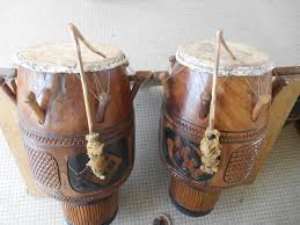
In my last write up on drums which form part of my heritage month series, I focused on the 'Asafo Kyen' or Warrior Drum and its importance within the Akan society of Ghana.
Today in continuation of where I stopped the last time, I'm going to take readers through the second type of Talking Drum which is called the 'Etumpan' and one of the three Talking Drums used among the Akans.
The 'Etumpan' is the main talking drum of the Akan people. It is the most favoured instrument to play the bass part to accompany dancing. The 'Etumpan' is an open goblet drum on a base or stand. It is played in pairs, usually by a master drummer or divine master drummer using two angular or seven shaped sticks.
To appreciate this type of Talking Drum and how it functions among the Akans, again, I visited Master Divine Drummer, Ɔdomankoma-Kyerema Kwamena Pra at his base within the Cape Coast Castle for him to share his knowledge on the 'Etumpan'.
'Etumpan,' according to him are twin talking drums which are normally found in a Chief's palace for the purposes of communication and honouring the Chief through appellation.
It is this same 'Etumpan' that is played to demand the attention of all the Chiefs subjects within the community and it is also used to notify the community of the passing of a son or daughter of the land.
The 'Etumpan' plays a key role in the celebration of festivals, durbars of Chiefs and all other social gatherings where the chief is present.
Normally, at social gatherings, when the chief speaks the 'Etumpan' is played to support and affirm the words of the Chief. This is done after every sentence from the chief at any official function.
One cardinal difference between the Asafo Kyen or Warrior Drum and the 'Etumpan' is that, the 'Etumpan' is oftentimes a static drum always found at the Chief Palace or stationed at a gathering where the chief is present.
This drum can also be used to assemble a gathering for any community engagement but while the Asafo Kyen accompanies the gathering to the venue where the supposed activity must take place the 'Etumpan' isn't carried along to the venue.
Apart from these, another important function of this drum, is when a chief dies, the 'Etumpan' is the drum used to spiritually invite all the ancestors who have occupied the stool and to inform them of what has happened to the current chief. This is critical to our tradition and an important activity performed with the 'Etumpan' when a Chief passes on to eternity.
But, Ɔdomankoma-Kyerema Pra was quick to add that, when all is said and done, the Master Drummer or Divine Master Drummer who invited all the ancestors must use the same 'Etumpan' to dismiss them after all the rituals performed have come to an end.
"When the Master Drummer fails to dismiss the ancestors after inviting them, it would bring about some negative repercussion on the drummer".
'Etumpan' is also played when someone dies and at funerals. This drum is played during funerals within the Akan Traditional setting.
But, after every funeral, the 'Etumpan' drums must be purified. The purification rite is normally performed by sprinkling a mixture of seawater and hop onto the drums after every funeral.
How the 'Etumpan' Are Made?
The manufacture of the 'Etumpan' follows the same pattern as that of Asafo Kyen and made from the same wood and procedure with some minor differences.
In the case of the 'etumpan', the two goblets like shape of the drum are carved from the same special wood used to manufacture the Asafo Kyen or Warrior Drum.
While the Asafo Kyen has seven sticks called ' 'Nsorowa' which are used in fastening the leather or membrane, the 'Etumpan', uses nine sticks instead. These are used to fasten the leather or membrane to complete the drum. These sticks are conical in shape and Nine in number. Lesser number of sticks are used but the number which ignites the most potent spiritual energy when the drum is played are the nine sticks.
According to Ɔdomankoma-Kyerema Pra, anything below the number would not make the drum to be able to attract the necessary spiritual vibrations needed when it is played.
In playing the Etumpan, the drummer must always use two sticks shaped in the form of seven. These sticks are cut from the 'Ogyama' or quava tree. The 'Etumpan' are not played with hands. It is taboo to use your hand to play this drum.
The leather that is used to make the 'Etumpan' come from a certain antelope called 'Dabɔ' in the Fante language as used for the Asafo Kyen but with slight difference again.
The difference is that, because the 'Etumpan' is a twin drum comprising male and female properties, one of the drum is covered with the skin of a male Dabɔ and the other with a female dabɔ skin.
When I put to him that why two separate antelope skins from the same animal are used for the 'Etumpan', Kwamena Pra said "Males have deeper voices while the females have higher voices. Spiritually, everything is male and female, so when the Etumpan is played, it is able to emit a harmonised sound that draws the necessary spiritual vibrations needed. That is why the male and female skins of the 'dabɔ' are used".
Further, the Master Divine Drummer said, the drum needs a welcome ceremony. All the Etumpan are welcomed home with special ritual before they are played for the first time.
Rituals are religious or solemn ceremonies consisting of a series of actions performed according to a prescribed order. These activities are part and parcel of the Akan Tradition and normally done to herald the beginning and the exit of things considered important within the Akan culture.
For the 'Etumpan' ritual to be successful, one must get seven local fowl eggs and the bark of a tree called 'Ɔkrɔw'. The tree bark must be dried, ground into powder before the seven eggs including the shells are added and mixed together.
Afterwards, the mixture is smeared around the drum. When it gets to the head of the drum, the mixture is used to draw a sign of the cross on the head of the drum.
The sign of cross made on the head of the Etumpan according to Ɔdomankoma-Kyerema Pra is to signify that, "The animal skin and the wood used to carve the drum are all from the Creator which have been assembled together to work for the Creator".
After all, these have been done, because they are new drums, libation has to be poured using either 'Ahei' (which is a local drink) or Palm wine to invoke the spirits within the drums and for the drum to respond.
"The drums shall respond by mentioning their names to the Traditional Priest and what is acceptable to them and what is a taboo as well".
After these rituals as narrated by Ɔdomankoma-Kyerema Pra, are part of making the 'Etumpan' what it ought to be.
After the libation, the drums are left at a place and within seven days, the Traditional Priests shall communicate what he has been told by the spirits concerning the foods and other things that one cannot eat or do before handling the drum.
It is after all these have been accomplished before the Etumpan drums are covered with either a white or red khalico before it is played for official purposes. He said, "White represents higher spirits and red represents lower spirits".
One can only know which colour of khalico to use after the libation ritual has been performed. "Because it is after that exercise that the spirits shall reveal to the Traditional Priest the colour that is supposed to be used to wrap the drums and he shall also notify the drummers accordingly".
In conclusion, Kwamena Pra said this is what goes into the making of an 'Etumpan'. As such if one visits any Chief's Palace and drums are being played, we should know that, Traditional drums have both cultural and spiritual significance and played for both purposes.
Next write up shall focus on the last of the three Akan Talking Drums. Thus the 'Akɔm Kyen' or Traditional Priest drum.


 Ms. Emelia Affi Agbenyo must honourably resign as new EC Deputy Chairperson to p...
 Why have US-Ukraine relations soured ahead of the midterms?
 Govt to meet Free Zones Authority, Trade Ministry over Customs Act concerns
 Kojo Bamba was never my driver or bodyguard — Nana B
 Ekow Assafuah petitions OSP to probe alleged World Cup visa facilitation irregul...
 Africa attracting wrong waste management solutions – GAIA report
 Summon Kofi Adams, GTA boss over 2026 World Cup visa scandal — NPP tells Parliam...
 Obuasi SHS headmaster accused of sexual abuse is NDC constituency secretary – Ma...
 Family demands answers over death of 14-year-old student at Abomosu STEM SHS
 Osahen Afenyo-Markin reflects on loneliness of public service, says survival is ...


