




4.8 million ounces in output and about US$700 million revenues in 2019, 5% of the country's GDP. The tremendous weight of the Ghanaian mining sector today is undeniable. As Africa's largest gold producer (7th in the world), the country will nevertheless have to overcome many challenges in 2021 to successfully preserve such economic achievements. In today’s context of difficult economic recovery resulting from the coronavirus crisis, combined with numerous political scandals that have affected the natural resources sector in 2020, these challenges awaiting Ghana will not be limited to the economic sphere alone, but rather encompass social and political variables as well. Here is a glimpse (not an exhaustive one) of the multiple and diverse challenges that Ghana will face in the year ahead.
Political machinations harmful to the country's notoriety among investors
2020 did not come without consequences for the reputation of the Ghanaian mining industry among foreign investors. Governance and corruption issues revealed by the press and social networks have undermined an economic sector that is often seen as almighty, because of its economic weight. From the resignation of the Special Prosecutor Martin Amidu as a result of the Agyapa Royalties Deal scandal to the dissolution three weeks ago of the Inter-Ministerial Committee on Illegal Mining (IMCIM) following Anas Aremeyaw Anas' investigation published on social media to reveal cases of bribery within the commission , it is now clear that this prolific industry is attracting greedy and ill-intentioned politicians. In addition to harming the country's economic development, the proliferation of such scandals is damaging Ghana's international image, despite the country's heavy dependence on foreign partners ( the country's mining exports account for nearly 10% of its GDP ).
A positive signal in this fight against corruption is the cabinet reshuffle carried out by President Nana Akufo Addo a few weeks ago, during which he removed his Minister for Lands and Natural Resources Kwaku Asomah-Cheremeh, who was implicated in many scandals. The media exposure and allegations of bribery of the latter led the president to seek a suitable replacement in the person of Samuel Abdulai Jinapor . Even though this ministerial reshuffle may seem futile to sceptical observers, the arrival of Samuel Abdulai Jinapor could help the country to find a second breath in the management of this key economic sector. Far from being a panacea for the structural problems in the management of the mining industry, this appointment perhaps marks a new beginning for the country and a willingness to change.
Many socio-economic issues at stake
Other important reforms await the country in the socio-economic field. Indeed, despite the considerable weight of the mining sector in the Ghanaian economy, the benefits are still limited for the local population. While the economic impacts of Covid-19 are affecting the Ghanaian society, with an estimated 42,000 people who lost their jobs in the first two months of the pandemic in Ghana , it is more urgent than ever for the government in office to take effective measures to better redistribute the wealth offered by the country's natural resources.
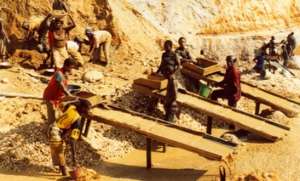
The formal mining sector currently accounts for only a small percentage of total employment in Ghana ( about 1% ), which pushes part of the population to engage in risky informal practices such as illegal gold panning, also known as "galamsey" in Ghana. Even though the Ghanaian state committed itself to fight against galamsey in 2016, willing to create a "regulated, secure, and lawful environment", the Ghanaian population - half of which is under 21 years old - is lacking professional prospects. The Ghanaian state must therefore work to ensure that the dynamism of the mining industry benefits the entire population: this includes job creation and the prevalence of public interests over private ones.
The mining industry, an extremely competitive environment in Africa
Besides the various challenges mentioned above, it is important to bear in mind that the mining sector is highly developed in Africa, and is facing increased competition between different states to attract international investors. The latter plays a key role in providing financing for the high cost of mineral exploration and extraction projects, and the infrastructure that this entails. Within the subregion, Ghana competes with its neighbouring producers such as Mali (71.1 T/year), Burkina Faso (62.0 T/year) and Ivory Coast (41.9 T/year) . This competitiveness is, moreover, intensified by the arrival of new players seeking to position themselves in this area, such as Madagascar or Ethiopia: international investors could thus be tempted to go elsewhere for more favourable conditions.
In this context, it is more than ever essential for Ghana not to tarnish its reputation among investors by repeated scandals, at the risk of losing its status as an African leader. The challenges facing the country for 2021 are therefore considerable, and every decision taken in the mining sector will have significant outcomes, both for public opinion and foreign investors.

 ‘If we all pay GH¢1,000 each, we should be able to construct National Cathedral’...
 Mahama inspects proposed site for Upper West Regional Airport
 Mahama reiterates government's commitment to end double-track SHS system
 Police interdict officer over death of 23-year-old Ivan Baidoo on Tema Motorway
 NDC gov't ‘scored own goals’ with new SHS placement policy — Dr. Bempah Tandoh
 Five-year presidency will give governments more time to deliver — Kofi Bentil
 Improved invigilation is exposing true performance of Ghanaian students — Mahama...
 There's no policy to introduce Arabic, Chinese in all public schools — Mahama
 Saudi Arabia closes East-West pipeline as Houthis tighten grip on Red Sea
 Uganda buries 'youngest' king amid succession row


