




During the “lockdown” implemented by the Government to try and limit the spread of Covid-19, our Government, out of humanitarian concern, tried to distribute free food to some of the inhabitants of the urban centres.
If the initial distribution went well (so it was hoped) the Government would distribute more to help those who were prevented by the “lockdown” from working and earning a decent living..
Well, very early on, those in charge of the exercise came face to face with “crowd psychology.” Even though it was clear that the Government was acting out of altruistic motives, some people thought they would be robbed of their share unless they forced their way to the front of the queues! Ghanaian style.
So bad was the situation that eventually, the food distribution scheme was scrapped. It may well have been the case that some of the people in the queues were not just ordinary people trying to get food for themselves and their families, but people with a political agenda.
For it was easy for some people to perceive the scheme as a means whereby the NPP Government wanted to win more votes by demonstrating that: “WE GAVE YOU FOOD WHEN YOU NEEDED IT MOST!”
This interpretation of events is supported by the fact that unlike what happened during the food distribution process, millions of people did wait patiently at registration centres when they were asked to do so in order to be registered as voters.
The reason, you see, is that “crowd psychology” needs to be stirred up before it can work well. It was realised that if the registration exercise were seriously undermined, all political parties would be the losers as their chances of victory would be adversely affected by the end-result of non-registration. The propagandists were realistic enough to perceive that they had to be careful not to wreck the whole train on which everyone would be travelling to election day!
But with food distribution, on the other hand, if an agent-provocateur was handed say, ten cedis, and to go and cause trouble at a distribution centre by creating a “difficult” or impossible situation, he or she could use the ten cedis to satisfy personal needs, while leaving the would-be beneficiaries of Government handouts to go hungry. Believe me, political parties have money for such purposes.
The reason why I am bringing the phenomenon of “crowd psychology” to readers is that I want to warn my fellow countrymen and women that if they continue to engage in galamsey, they will end up sleepwalking into a situation whereby they will actually destroy the very country in which they hope to enjoy the riches they get from galamsey.
Certainly, one can make a lot of money out of galamsey and thus be able to expend huge sums of money in campaigning to win power. But what happens if, whilst trying to use that power to govern, one is faced with “crowd psychology”?
“Don't mind him! He's galamsey man! He has destroyed our drinking water!”
The President, Nana Addo Dankwa Akufo-Addo, must have had envisioned such a scenario when he touched on the question of galamsey once again during his recent electioneering tour of Ghana's rural areas.
(Other politicians – both on the NPP side and the NDC side – have chosen to keep rather mute about galamsey/ Why? It's because there ARE people in politics who are making a very good living for themselves out of galamsey. These people ARE able to “win” voters and electioneering agents on to their campaign trains because they have enough money to make such a “trip” worthwhile.
But what they ignore, though, is this: What will be the point of it all if one uses galamsey money to win the election, but one then finds it necessary to lock oneself behind impregnable gates, because one's fellow countrymen and women want one's blood? What is every rich and powerful person comes under suspicion of having become rich through galamsey operations that are responsible for ruining the nation's water sources?
If you go to Nigeria, you will see some magnificent mansions with enormously strong security gates. The occupants don't go out often for fear of kidnappers. For the popular belief in the country is that you can't become filthily rich without being an “oil thief”! Do the Ghanaian ruling class desire to be similarly tagged en masse?
Do they want the people to believe that they deliberately caused a situation to arise in which the people neither have water to drink, nor to wash, or cook with?
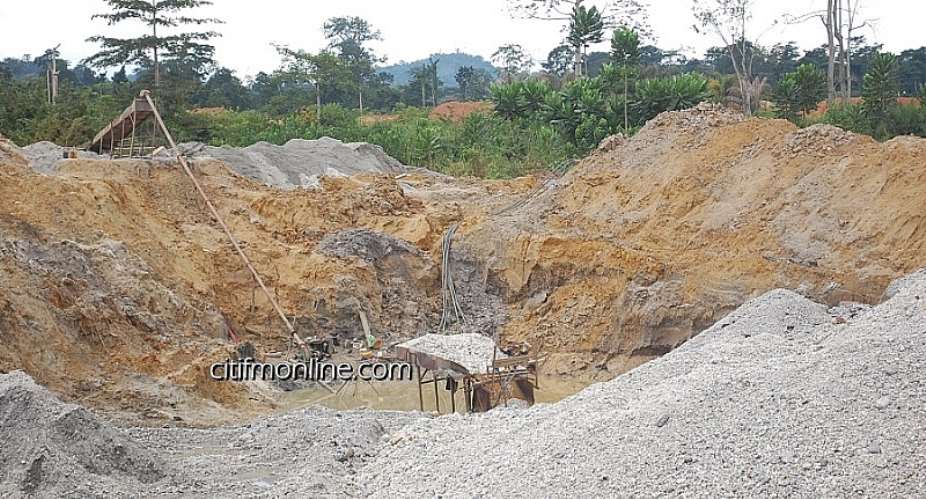
It does not require one to be a very deep thinker to understand that this would be a most worrying scenario. But it will come to pass if galamsey continues, for I tell you, if you are used to village life and you see a galamsey site for the first time you may weep, whether you like it or not.
You will find that excavators are used in such a brutally haphazard fashion on farmlands and riverbanks that it is impossible to even find a pathway into a farm in which one could once walk blindfolded! I don't exaggerate – the situation on the ground in many places calls for deep lamentation bordering on suicide.
I have written an article about the total disbelief with which I once observed the destruction on such a farm. (Please Google “Galamsey+blow+gut)
I tell you such a sight is capable of turning one into a near-misanthrope.
I was therefore extremely pleased when I heard that President Akufo-Addo had-- in spite of the election campaign in which he wants everyone's support – not refrained from pointing an accusing finger at “some DCEs, MCEs, politicians and chiefs” who, he said, “are involved in illegal galamsey activities.”
According to the President, the excuse given by these galamsey perpetrators is that “the activity gives employment to the youth”. However (he cautioned) it would be “prudent” for them to put an end to their galamsey operations. The President said:
"As for the galamsey, it is not only the youth who are doing it. MCEs, DCEs, Ministers are involved..Even some of you (chiefs) are involved. Indeed, the activity generates lots of money..[But] galamsey money is evil, so let us all come together to reduce it”.
The President said this while inaugurating a Community Mining Programme to create jobs for over 2,000 trained youth in the Nzema East Municipality. He urged the chiefs to employ the youth to join the Community Mining Programme and to get them trained to practise “safe mining.”
"I know people are saying that [galamsey] is what is feeding the youth...[But] we have to think of a new job opportunity for the youth," the President emphasised.
The President also inaugurated similar Community Mining Schemes at Aboso, Gwira Egila/Gwira, and Akango/Duale. The Schemes are expected to create ten thousand (10,000) jobs at Aboso and two thousand additional jobs at Egila/Gwira and Akamgo/Duale.
President Akufo-Addo explained that the Community Mining Scheme “is an initiative meant to encourage responsible small-scale mining, in communities across the country, “in line with the Minerals and Mining Law, 2015, Act 703”.
Recounting the menace wreaked by galamsey across the country, prior to his assumption of office in January 2017, the President stated that the phenomenon led to the pollution of waters, the degradation of lands, the non-reclamation of degraded land, and the use of dangerous chemicals, such as mercury and cyanide, on the environment.
“I was of the view, a view shared happily by the majority of Ghanaians, that, if we allowed it to continue, we would be jeopardising both our present and our future. Our responsibility, to this end, was clear,” he said. He specified that “one of the measures instituted by Government to deal with the menace of galamsey, is the Community Mining Scheme.”
The President Akufo-Addo added: “We believe that participation by the host communities in mining will set us, as a nation, on the journey to boost the rural economy, help rural infrastructure development, and improve livelihoods, through shared wealth. It will also enable Ghanaians develop the capacity to take over, eventually, the operations of the minerals sector.”
These are the “carrot” element in the Government's anti-galamsey programme, and no person of goodwill can find fault with that aspect of the programme. What people are worried about is whether the “stick” element – using the newly enacted amendments to the Minerals Laws to bring galamseyers and their collaborators to book – will be strongly applied by the Government, when the need arises.
With regard to that, the President has laid down the yardstick himself: if he knows people in the Government who are making “evil money” through galamsey, then he is duty-bound to get rid of them. The “buck” does stop with the President (as Harry S Truman used to remind his visitors of this fact through a sign with that phrase on his desk in the Oval Office in the White House!)
--
www.cameronduodu.com


 'Go after financiers, not just couriers' – Catholic Bishops to NACOC after Franc...
 Man beaten to death after alleged machete attack on elderly woman at Tamso
 Two arrested over kidnapping, murder of Senegalese goalkeeper in Ghana
 Ministers should answer legitimate questions regarding promises, public expendit...
 Mahama has done well for stabilising the economy but the real litmus test is sus...
 Chief Justice Paul Baffoe-Bonnie chairs 11-member Council for Legal Education an...
 Man reportedly commits suicide over inability to raise money for son's SHS prosp...
 Wontumi’s GH¢30m Exim Bank case adjourned to October 13
 Euro Spa CEO, three others remanded over €225m cocaine shipment bust in France
 Fresh South Africa drug arrest puts Ghana’s border controls under scrutiny



Comments
MAHAMA does not SENSE anymore. MAHAMA and the NDC ruled Ghana for 8 Yrs and what did we get. DUMSOR, IMF, BUS BRANDING, CREATE, LOOT and SHARE, CANCELLED TEACHERS ALLOWANCE, CANCELLED NURSES ALLOWANCE, NKƆMFƐM, DESTROYED NHI. Ghana has MOVED ON under BETTER Governance. The NDC is EVIL and a MENACE to GHANA. They wish NOTHING GOOD for GHANA. They LACK People with CRITICAL and INTELLECTUAL MINDS. All they KNOW is VIOLENCE, HURLING INSULTS and PROPAGANDA. Never AGAIN MAHAMA...